Chicago for Gardeners

Urban Oases and Millennium Park

Dateline October 2015. Susan and I had both read Erik Larson’s absolutely spellbinding book, The Devil in the White City: Murder, Magic and Madness at the Fair that changed America. Our curiosity was piqued. A visit to Chicago was in order.

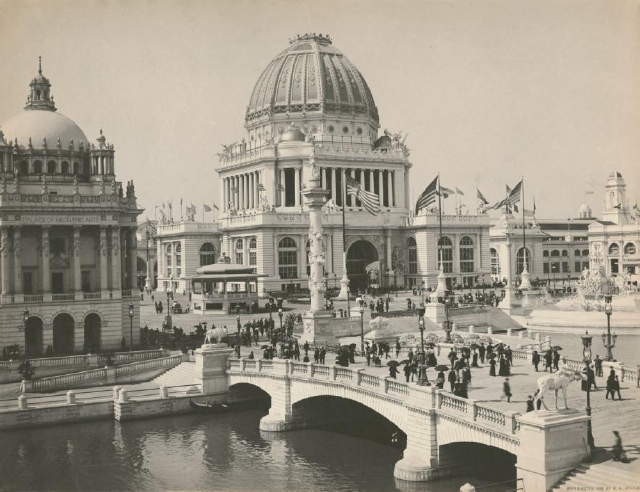
Administration Building in the White City

Administration Building in the White City

The book chronicles late 19th century Chicago and the turbulent race to create a World’s Fair in 1893 that would put Chicago over the top in the eyes of the world.

The White City, of course, is the Fair; the Devil is an archetype serial killer who fed on the hustle-bustle of the Fair.

Now, why in the world do I bring up this book in a gardening post?

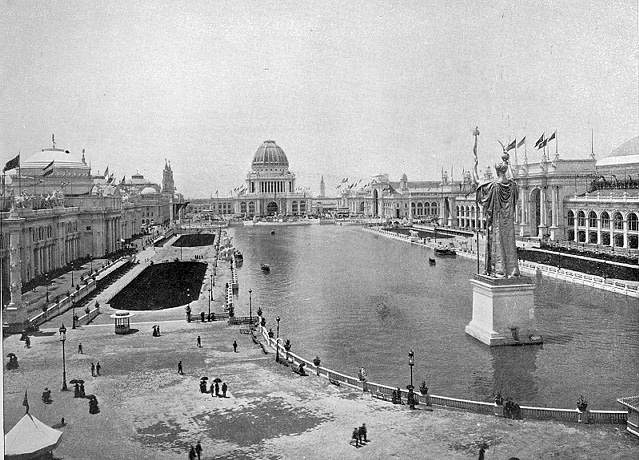
Court of honor with statue of liberty

Court of Honor with Statue of  the Republic

Because Frederick Law Olmsted of Central Park fame designed the Exposition’s landscape? Well, no. Unfortunately, most of what he did has been obliterated (though Jackson Park, the Wooded Island, and Osaka Gardens, features of the fair, are now going through major rehab, with a completion date of 2017, and the American Institute of Architects considers Wooded Island one of 150 great places in Illinois.)

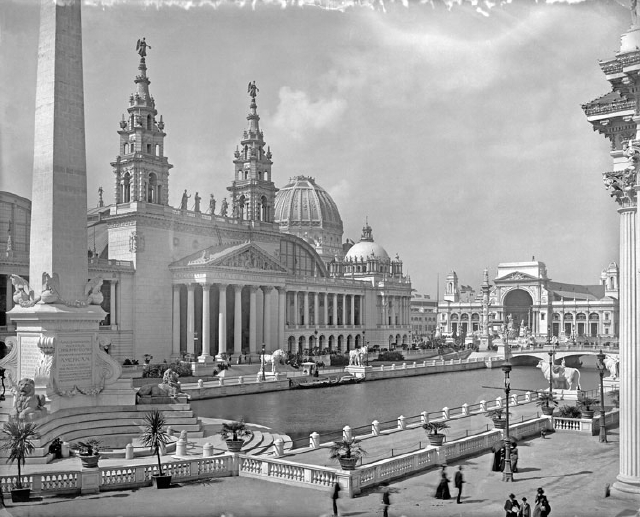
Pen-and-ink view from the obelisk by Louis Griffith

Pen-and-ink view from the obelisk by Louis Griffith

Because we stayed at the old Congress Plaza Hotel, said to be haunted, where the Devil snared victims? Curiously, we never thought about the connection. We booked the hotel because it was inexpensive and convenient: where Michigan meets Congress.

Because the vision that Chicago could eventually live up to its founding motto, “urbs in horto,” or “City in a Garden” was inspired by this World’s Fair? Yes! The Exposition of 1893 was a watershed in city planning that took fire across the country.

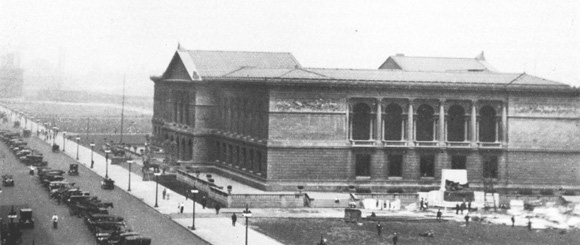
Art Institute of Chicago, 1914, one of two buildings remaining from the fair. Note the barren landscape

Art Institute of Chicago, 1914, one of two buildings remaining from the fair. Note the barren landscape

Make no little plans; they have no magic to stir men’s blood. Daniel H. Burnham, Director of Works, World’s Columbian Exposition, 1893. Burnham married himself to his credo. He committed years to bringing about an Exposition that dazzled the world. The magic of the White City stretched imaginations and inspired visions of what cities could look like.

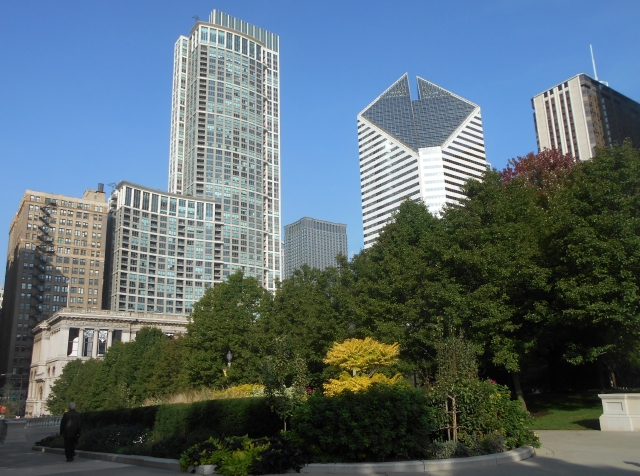
Skyscrapers rise above the gardens in Millennium Park

Skyscrapers rise above gardens in Millennium Park

Instead of soot and noise, planners and people began to dream of light and beauty in cityscapes. A City Beautiful movement sprang up, and Daniel Burnham designed a plan for Chicago that would replace railroad sidings and stockyards with a ribbon of lake shore parks for people — concert goers, baseball fans, art lovers, ice skaters, strollers and picnickers, and gardeners, too. Today, there are 570 parks in Chicago covering 8,000 acres.

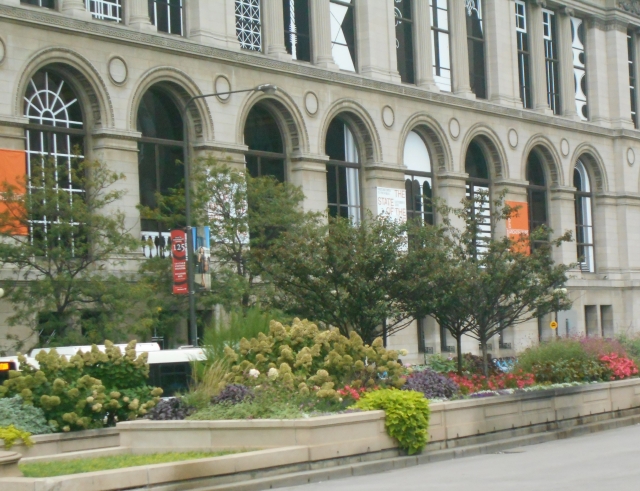
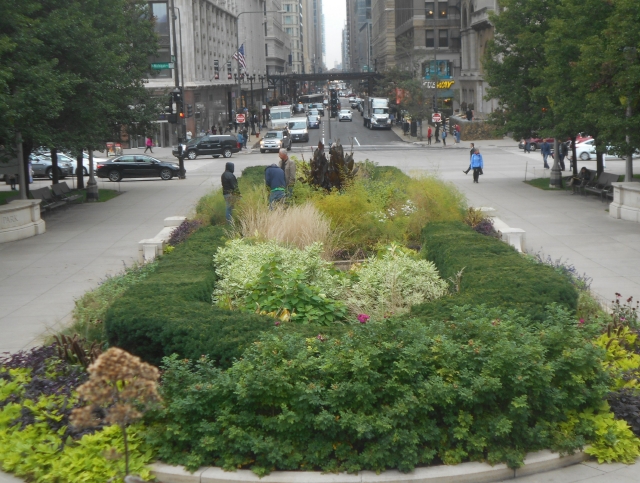
Panicle hydrangeas, sweet potato vines, grasses and flowering trees punctuate the islands along Michigan Ave

Panicle hydrangeas and flowering trees, anchor grasses, perennials, annuals in island beds along Michigan Ave

We wondered what we’d see in October. We stepped out of our hotel on to Michigan Avenue, just minutes from the Chicago Art Institute.

Despite risk of attack by brigades of revved motors, we had to stop and photograph exuberant islands of plants dividing the grand boulevard, inspired, we learned later, by the City Beautiful movement.

Plant palettes range from grasses to exotics, hedges to hydrangeas.

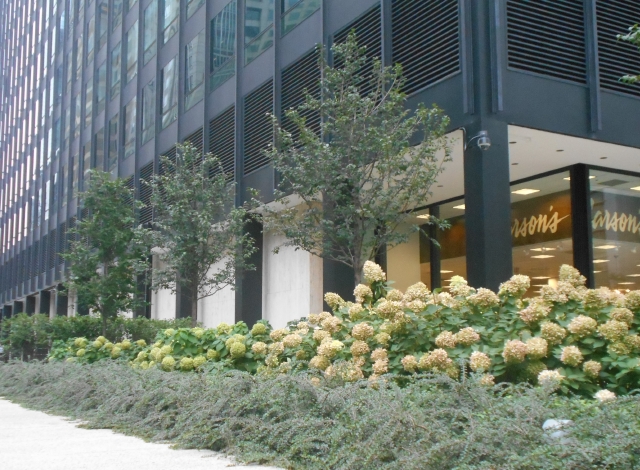
Curb appeal for skyscrapers: paniculata hydrangeas and cotoneaster

Curb appeal for skyscrapers: paniculata hydrangeas and cotoneaster

We would see these combinations repeated in oases across the city, lovely garden islands punctuating concrete.

Blooms on paniculata hydrangeas, a staple in these gardens, were muted now, but tropicals were bold and flambuoyant.
We guessed we would see a lot.

(After an all-day marathon in the Art Institute.)

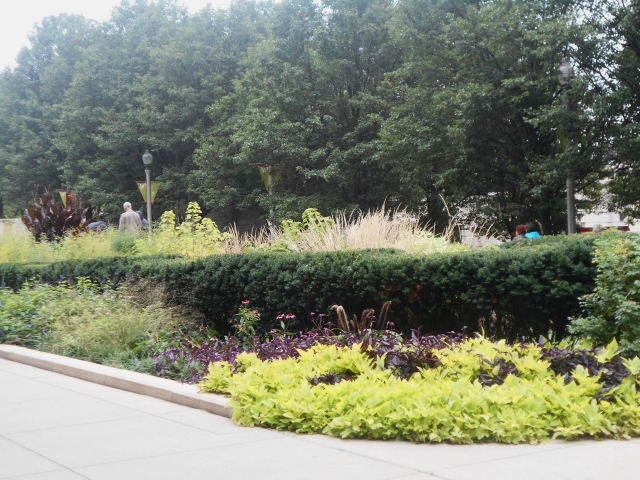
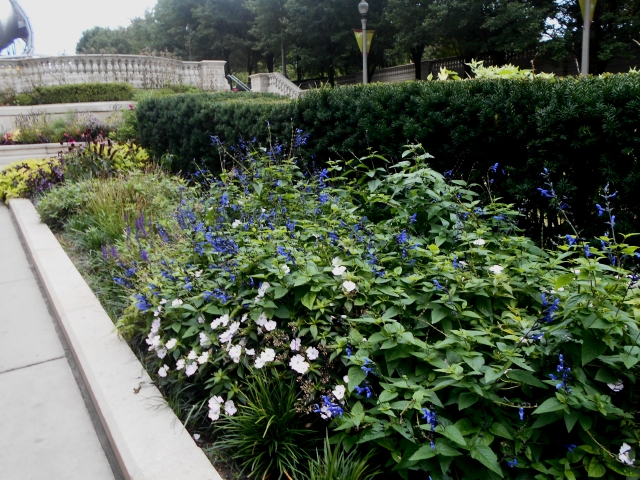
Evergreen hedges acts as foils for bright herbaceous plants

Evergreen hedges acts as foils for bright herbaceous plants in Millennium Park

We drifted into Millennium Park, a slice of Grant Park, and what a slice! We were drawn not so much by tourist imperative, but by its inviting design and lovely plantings.

It’s the newest and most visited addition to the lake shore greenbelt, and it’s hard to believe it tops a 2,000-car parking garage, which, in turn, is stacked above Illinois Central railroad lines and a Meta station. So, Chicagoans didn’t eliminate railroads along the lake shore. They just hid them, along with the memories of industrial wastelands that sullied once pristine wetlands.

An island in the park

An island in the park

This is a classy park. It should be. Fully half of the roughly 500 mill it cost came from Chicago biggies: the McCormick Foundation, Boeing, Chase, Wrigley, the Hyatt Hotels family and the Crown Family.

There were 91 million-dollar-plus donors, including McDonald’s, AT&T and BP. Here is an outstanding example of public-private partnership that worked despite fits of acrimony and charges of cronyism.

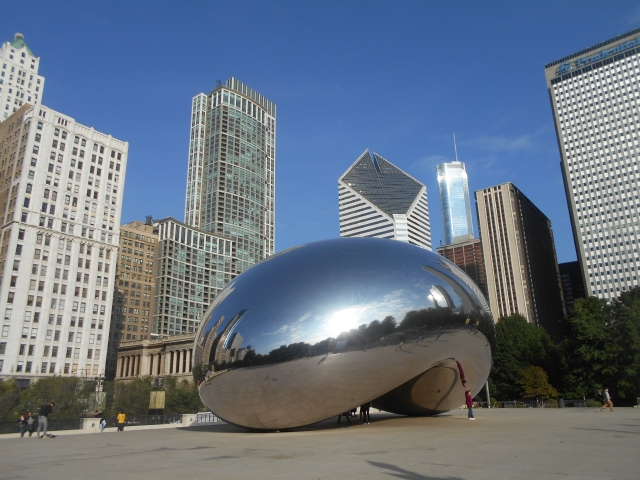
The Bean

The Bean

Anchoring the north end of the park is the mammoth, ultra modern, ultra popular Pritzker amphitheatre, a complex structure of steel plates arcing over a manicured playground for concert goers.

Walk south a few minutes and you come to The Bean. It’s so beloved by Chicagoans that its formal name, Cloud Gate, is rarely heard. What fun!

It’s a gathering place for tourists and anyone else who wants to see the city – and themselves – reflected in — a gigantic bean (or cloud) of highly polished steel plates.

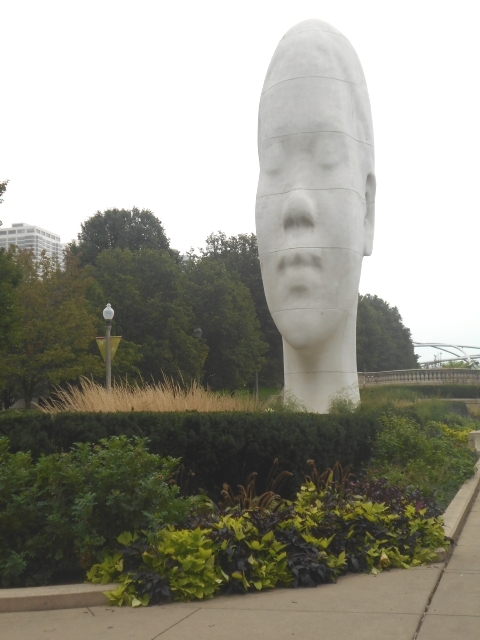
Classicism mingles with modern and whimsical in this park

Classicism mingles with modern and whimsical in this park

Then there is Crown Fountain, more fun: two fifty-foot towers of streaming water separated by a long narrow pool that invites toe-dabbling in nice weather.

Giant videos on the towers paint glowing portraits of Chicago residents while water cascades.

Some crafty humor here. If you are patient, you will see lips pucker and spit before one image dissolves and another appears.

CGmpstatYes, lots of steel and stone and pavement here. But it’s the landscaping that carries the park. More than a strategic grace note to surrounding structure, the planting pulls us along.

Without intruding, it flows and unites, imperceptibly leads us, and finally, invites us to set a spell, guiltless, in a busy city.

For more about our visit to Chicago, see our previous post, Under the Garden Spade, and our pages in Great Gardens: Chicago: Botanic Garden and Chicago: Lurie Garden.

This slideshow requires JavaScript.

Posted in Chicago, Uncategorized | Tagged , , , , , , | Leave a comment

Under the Garden Spade

Alice’s tumble down the rabbit hole is quite the adventure, but it wasn’t much different from winding through the maze that lies a few inches beneath our garden spades.

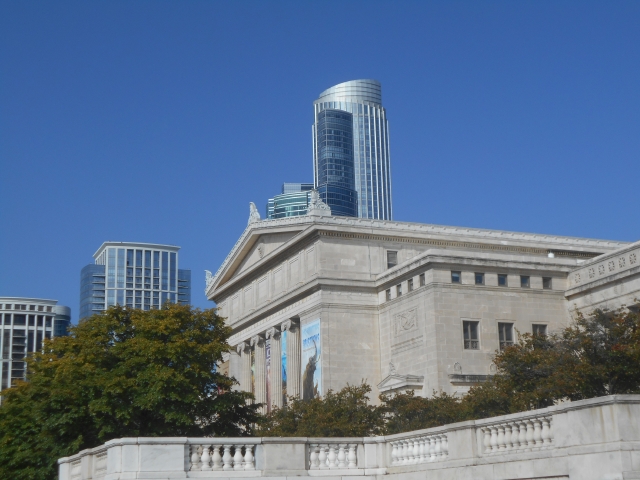
Field Museum of Natural History in Chicago

19th century Field Museum of Natural History in Chicago backed by 20th century skyscrapers

Of course, if you really want to follow Alice, there is this niggling problem of size. Alice, you may remember, drank from mysterious bottles, or ate cakes made from pebbles, or nibbled pieces of mushroom to change her size. Well, consuming items that do not have dietary labels or wear dates is not my cup of tea (reference to “Alice” intended).

Happily, the Field Museum of Natural History in Chicago opens up these wonders with no suspicious toxins in an exhibit called Dig It.

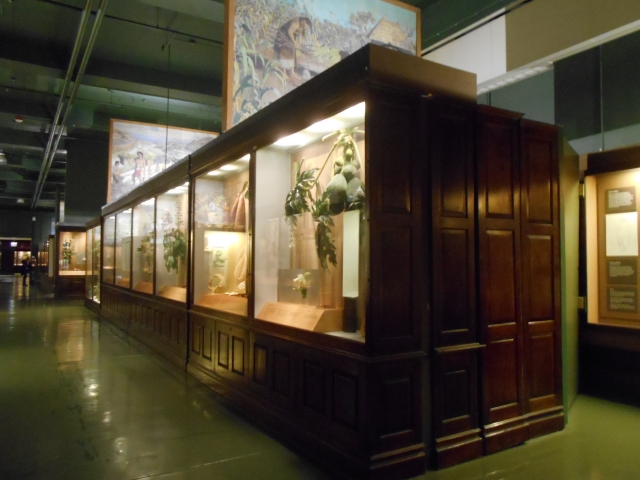
The patina of age and exploration and scholarship lies in these cabinets

The patina of age and exploration and scholarship lies in these cabinets

We didn’t intend to Dig It. We wanted to compare this midwest gem of a museum with the American Museum of Natural History in New York City, our stomping grounds of years back.

Yup, it’s just as grand, maybe even more spacious, with arches and vaulted ceilings and balconies in the atrium, fine old display cabinets of polished cherry wood, and dioramas that carried us to magic-carpet destinations, and, oh, those gemstones.

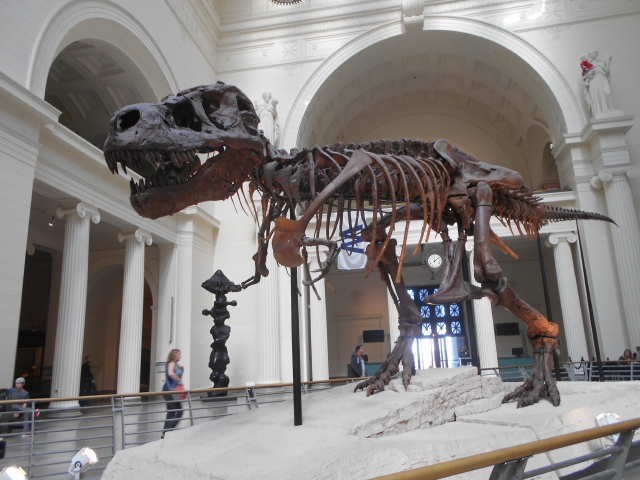
Say hello to Sue, who is 73 million years old but who died when she/he was 28.

Say hello to Sue

We wanted to meet Sue, too. It turns out that Sue is a Tyrannosaurus rex of superlatives: the largest, the most complete, the best preserved, the most famous.

Nobody knows if Sue was a boy or a girl. She’s called Sue because a Sue (Hendrickson) discovered her while examining a cliff in South Dakota. Here is a picture of the 67-million-year-old Sue. She was 28 years old when she died.

We enter the tunnel

We enter the tunnel

All this was a lot to absorb, so we decided a bathroom break was in order, which is when we discovered Dig It.

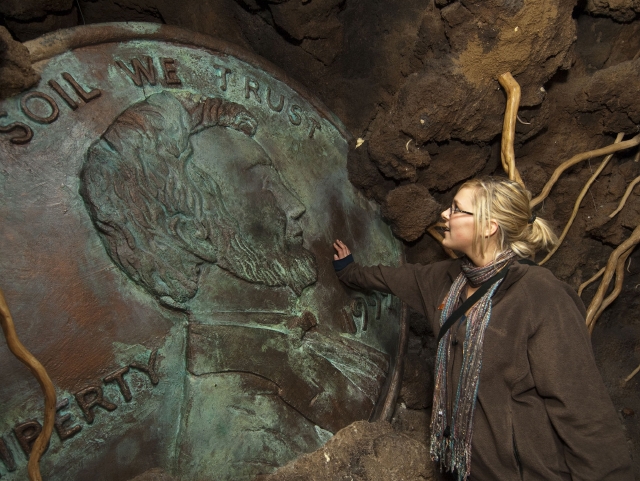
Curiouser and curiouser we followed the signs and wound through a special tunnel of imagination that shrank us down to the size of a penny, or maybe less, all without strange potions.

What Susan and I saw there was the invisible life in the subway of our gardens. What surprises us most? The creatures we meet are every bit as fantastic as Alice’s acquaintances. There’s one BIG difference, though. All these creatures play a role in creating or enriching soil. They mine, they dig, they transform nitrogen, or they are undertakers, disposing of the dead.

The Shrink Chamber

The Shrink Chamber

There’s a fierce, devoted mama earwig who seals herself underground to feed her babies and lick them clean, all twenty or thirty, or more of them. That ominous tail? She rattles it to warn trespassers away.

There are ants, true miners of the soil, thousands of them nesting in networks of tunnels, stirring up the soil like earthworms, bringing minerals to plant roots.

There’s a mole cricket who was born to dig, front feet shaped like shovels that breast stroke through the soil, creating winding tunnels to find worms and grubs to eat — or to keep from being eaten — or even to sing to a female.

Smaller than a penny, Museum photo

Smaller than a penny, Museum photo

There’s a wolf spider who commutes from burrow to daylight to find food. In Dig It he’s ready to suck the insides of a June beetle larvae, a fat white grub with stubby legs who would otherwise molt successfully and live as an adult above ground.

There’s a messy-looking rotten root, fungi and bacteria busy digesting it, mites and springtails grazing on the decomposers, and predators like a rove beetle hunting the grazers. Here is the underground food web in action.

There are rhizobia, not creatures, but unsung soil bacteria living in roots of plants. They transform atmospheric nitrogen into a form that plants like peas and beans can use.

There is a crayfish who looks like a giant lobster, and who, in real life, will burrow down to the water table so he can bathe his gills in water and get the oxygen he needs.

But don’t take our word for it. Have a look for yourself.

This slideshow requires JavaScript.


Posted in Soil | Tagged , , , , , , , , | Leave a comment

Last Monarchs. . .First Honeybees

Agastache 'Good Fortune." I challenge you to find the blooms

Agastache ‘Good Fortune.” I challenge you to find the blooms

Early November, Lowe’s Home Improvement was selling agastache ‘Purple Fortune’ almost bloomed out and looking like a ragamuffin, for one dollar. Like the perennial optimists we gardeners are, I rose to the challenge and bought two. Yes, I can coax these cast-offs back to good purple fortune.

Most gardener-resuscitators would immediately cut back plants like these. Such good husbandry never occurred to me. Nor did my usual excuse for leaving spent blooms come to mind – that I might want to collect their seeds. I squeezed the plants into a postage-stamp spot, figured they’d probably spill over next year and vex me. But why plan(t) ahead? In fact, I gave myself points for planting promptly and not consigning forgotten cast-offs to plant purgatory.

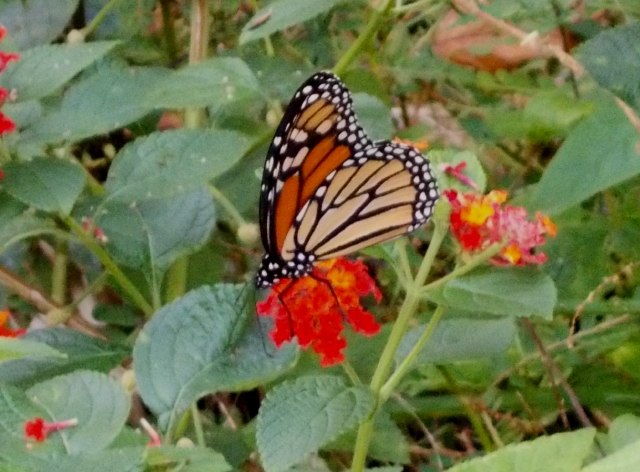
Here she is on lantana a few days later

Here she is on lantana a few days later

A day later a monarch butterfly was sipping from the scant, pallid blooms. Well, now, wasn’t I the canny gardener. My lumbering movements startled this light-weight. She flew up and circled. She was perfect, fresh from her chrysalis, but she looked very very small against the gray sky, and this was, after all, November, and she had miles to go before winter.

Hey there, I said when she landed again, why don’t you try that nice low butterfly bush—it’s blooming quite respectably. The skippers seem to like it. She flew off. I walked on. She settled down. I passed her in my planting rounds. She flew. And so she danced this jittery dance each time I went by. I never did see her on the butterfly bush.

Strong vein lines and lack of dark patch on hind wings indicate a female

Strong vein lines and lack of dark patch on hind wings indicate a female

It took a while before I could tell with any certainty that she was a lady. She wouldn’t give me more than a passing glance. Conserve your energy, I suggested, but she remained wary of this pesty giant.

The vein lines in her wings gave me the first hint, boldly etched in black, unlike the male’s more delicate traceries. A closer look confirmed that the telltale spot of dark scales on the hind wings that mark the scent glands of the male were missing.

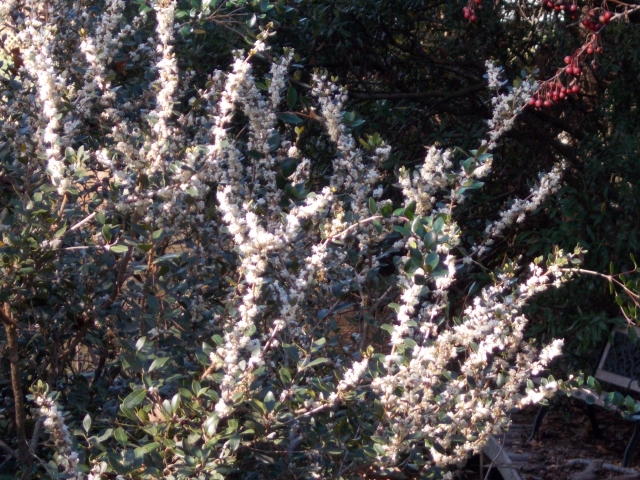
Holly-leaf osmanthus, lovely, white blooms in fall. Crabapples in background

Holly-leaf osmanthus, lovely, white blooms in fall. Crabapples in background

One day she was gone. The dance was over. Bon voyage, I silently called, melodramatically envisioning the winds that would buffet My Monarch under a lonely sky. Then I met her round the corner sampling sprawling lantana blooms. So much for drama.

A week or so later our holly-leaf osmanthus came into lavish bloom, a first for this ten-year-old. An eastern sun was sidling among the trees, casting its spotlight on buttons of small, oh so fragrant flowers climbing stiff branches. The wands of white flowers shined. Crowds of insects zipped in and around them, and sunshine reflected off their bodies and they sparkled like scatterings of gold dust.

Pineapple sage, one of the best bee/butterfly bloomers in fall

Pineapple sage, one of the best bee/butterfly bloomers in fall

Among them was My Monarch, still here, quietly sipping. In sunlight, her wings glowed like fine cathedral glass. She was gone a moment later, but that image will register long in the camera of my mind.

I looked for her next on the lantana, but it was shaded and vacant, a shuttered neighborhood tavern in early morning.

Insects that take energy directly from sunlight have little patience for plants in shade.

Acrobatics at the diner

Acrobatics at the diner

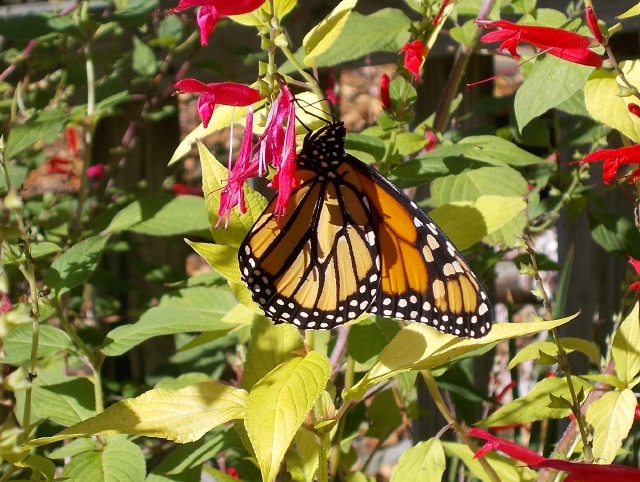
A few feet away, in the sun, pineapple sage was blooming with fire, and here was the carnival. There was My Monarch in staccato action, moving from bloom to bloom. Topsy turvy much of the time, legs clasping and reclasping each flower, wings folded or fluttering for balance, antennae waving, proboscis going deep, or maybe not, hard to say with all the acrobatics, but so determined to drink from those long, tubular flowers she never noticed me. I could have reached out and picked her off. (The slide show below catches more acrobatics, but stills don’t capture her boundless energy.)

Which one is which? Three females in the garden in November

Which one is which? Three females in the garden in November

A second monarch sailed in. They could have been twins, but this one flitted. Side trip to the chrysanthemums (less agility required for sipping and a reliable pinch-hitter when frost blights the garden, but maybe second-rate nectar?). Back to the sage.

Once the two flew up and circled each other. (Checking out sex? Travel plans? Or just a friendly hello.) Otherwise, their operations were solo.

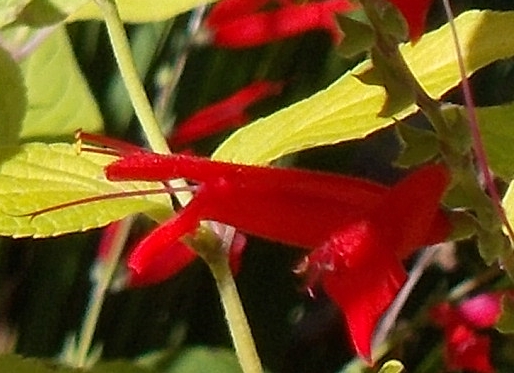
Up close, a sage bloom is beautiful, long pistil extending beyond petals, stamens more closely held

Up close, a sage bloom is beautiful, long pistil extending beyond petals, stamens, with pollen barely seen, closely held

I leaned in to watch the late arrival. She jumped to another flower. I took a step and she flew up. I moved again and she left to settle on the farther edge of the patch. Gave me pause. Which one was My Monarch?

To complicate matters, a third female joined the carnival, not so dedicated to these sage blooms that require so much work for a meal.

Within moments she was up on the persimmon, wings spread, soaking up sunshine before she left. Was she the one I later saw on camellia blooms?

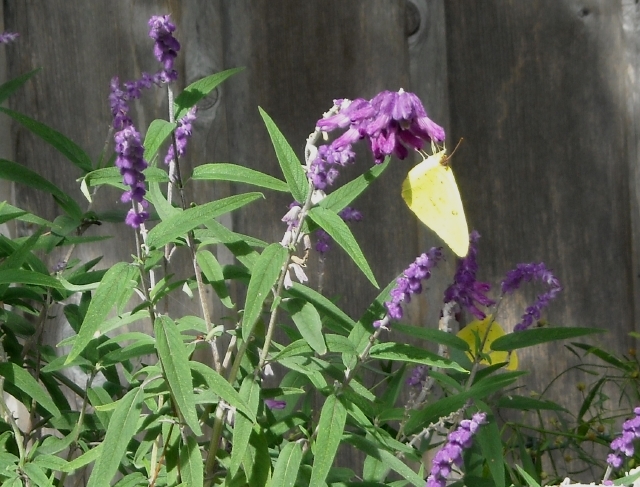
Sages are favorites of sulphurs. This one on Mexican sage, half hardy in our heavy, zone 8 soil

Sages are favorites of sulphurs. This one on Mexican sage, half hardy in our heavy, zone 8 soil

There were other visitors to the carnival. Giddy, fidgety, unremarkably brown skippers with wings akimbo when they alight, or so it seems.

If skippers went to psychiatrists, they would be labeled ADHD and prescribed a chill-out on opium blooms.

They rarely settle and sip, instead they dive and zoom, chase and circle each other with such speed a mere mortal can’t single one out of a bunch.

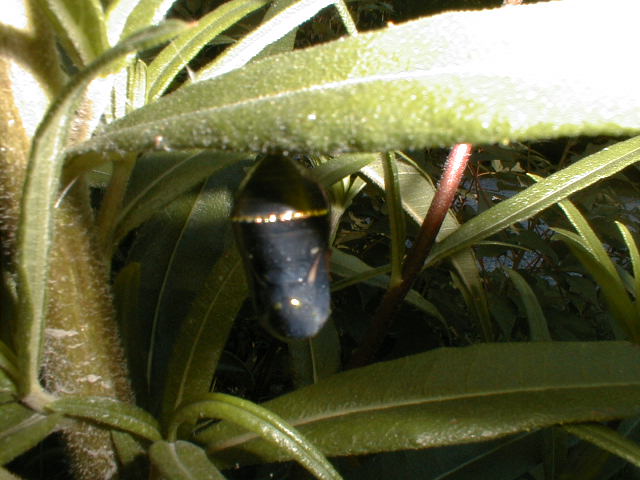
A monarch newly wrapped in its chrysalis

A monarch newly wrapped in its chrysalis

A solo cloudless sulphur fluttered in. Earlier in the season bright yellow sulphurs supped long and greedily on the sage, then disappeared.

As I watched, six or eight or more began to converge on the patch, probably freshly-hatched from eggs laid by September diners.

They tackled the sage with skill and inherited experience. No struggling, no maniacal balancing acts, no flailing legs. Their table manners were positively fastidious.

Chrysalis is darkened by the monarch's body, its god buttons shine, as, the butterfly prepares to emerge

Chrysalis is darkened by the monarch’s body, its god buttons shine, as, the butterfly prepares to emerge

The carnival brought back memories of the year we discovered monarch caterpillars chewing on milkweed in our ditch garden. We worried there weren’t enough leaves to go around. Did the fat ones live and the skinny ones shrivel? Four or five managed to pupate on swamp iris blades near the milkweed.

We watched as their crumpled reincarnations emerged and they pumped up their wings to fly for the first time and somehow we felt they belonged to us and our patch.

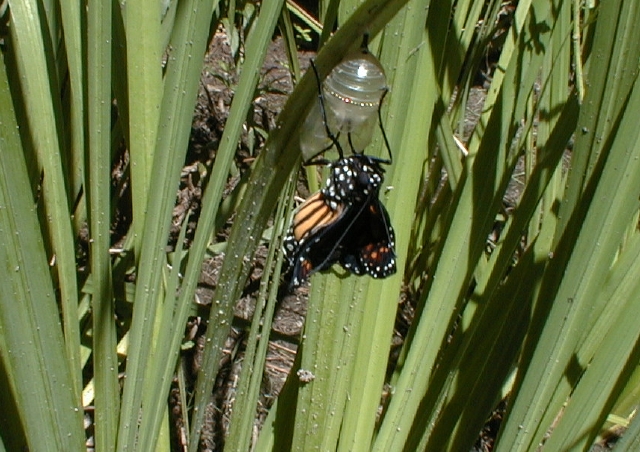
The struggle to emerge. Note the transparent chrysalis

The struggle to emerge. Note the transparent chrysalis

One day they were gone. Just like that. No goodbyes. No thanks for the milkweed memories. Just gone.

That was in September when food was still abundant and a flight to Mexico seemed reasonable.

Now I wondered if faltering supplies of flowers under short-sun days could fortify our three sippers on their way to Mexico. The sage here keeps pumping out blooms in pleasantly warm weather, but each day the carnival of flowers thins.

Fully emerged. Damaged chrysalis reminds us of the struggle

Fully emerged. Damaged chrysalis reminds us of the struggle

It appears (to me) that nectar is most abundant only at certain times in a flower’s life, further slicing the window of appeal to sippers.

I keep urging foragers to seek the freshest blooms, but they do not take my silent advice and may even gravitate to inauspicious time-worn blooms instead. There must be some secret I am missing.

I apologize. I have meandered and must return you to today’s carnival. The buzzing has been there all along, but I am only now waking up to its music.

It’s a familiar sort of buzzing, as Winnie the Pooh might say. A chattery buzz that signifies joy and busyness. Two decades ago I used to hear this buzz when burford holly bloomed in spring and glossy abelia bloomed in summer. I have not heard it since, though I listen and listen.

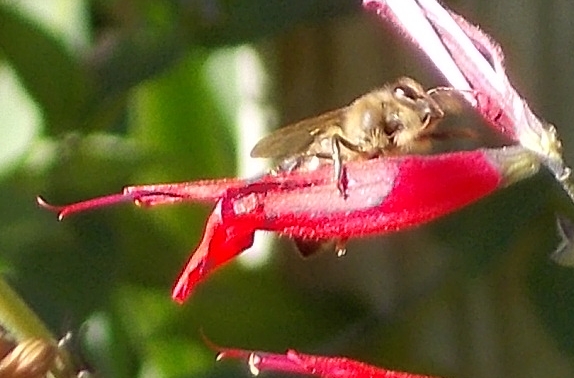
A busy moment for this bee, though she will take time to check out the spent bloom

A busy moment for this bee, though she will take time to check out the spent bloom

Honeybees! Yes, they are here, the first I’d seen in years. I’m surprised to see them working red blooms with deep throats. These flowers have two strikes against them: honeybees don’t see red, and their mouth parts are much too short to reach deep for nectar.

Honeybee color vision is shifted toward the blue end of the spectrum. They see ultraviolet rays but red becomes black. I’m betting there’s some blue hidden in those sage blooms (dying blooms become soft fuchsia), and some ultraviolet, too. Ultraviolet rays can create patterns and runways, invisible to us, that guide a honeybee to dinner. Do the bees see red sage as deep blue?

Honeybee will slip her proboscis between petals to reach nectar

Honeybee will slip her proboscis between petals to reach nectar

Granting the color-appeal of sage blooms, how could they get to the nectar? They looked to be biting the base of each bloom, but bees don’t bite. They worked with speed and deftness, not biting, but nudging petals apart at the base to reach that tiny pool of nectar. Doggedly they visited flower after flower, testing, sipping, rejecting, omitting, re-testing (absentmindedly?). Like the monarchs, they worked blooms upside down, clutching at petals in fast, frantic gestures.

Meanwhile the monarch works hard for a few sips

Meanwhile the monarch works hard for a few sips

One honeybee was so giddy she scurried around the floor of the deck, furiously poking at fallen petals. I watched her until I could stand the wasted motions no more, and though I usually don’t interfere, I gave her a little swat which lifted her to real live blooms. She was soon lost in the tangle.

A few, very few, bees had gathered pollen into dull yellow balls safely tucked into baskets on their legs. Pistils hang on to the flowers, attached by long white styles, but stamens that carry pollen are mostly missing. Only one bloom out of many yielded two stamens, each with a tiny platform that held the barest dusting of pollen. How long it must take to fill that pollen basket.

The last stand

The last stand

The weather is chilled. Sunshine is fickle. Flower gleanings are lean. The monarchs are gone. A few dedicated honeybees remain, along with some wispy wasps barely visible among aging flower stems.

A couple of inches of cold rain precede tonight’s cold front. I empty the rain gauge. I find a lifeless honeybee floating and I wonder what stories she could tell. Next morning I find a motionless sulphur berthed on the bark of a sweet gum tree.

The carnival is closing for winter.


This slideshow requires JavaScript.

Posted in butterflies, fall bloom, Honeybees, Uncategorized, wildlife in autumn | 2 Comments

Missing Summer — Already?

I can’t believe I spent most of the summer fretting about too much heat too much humidity too much sun and not enough rain, and now that cool weather is here, I am already wishing I could have another go at those days of sun and sweat.

I look wistfully at the shreds of summer, which should be cut away, but I will leave many of them till spring for hungry winter wayfarers, and for me too. When cold dreary rain sets in they will remind me of those hot but colorful times in the garden.

Ask me next summer, when I’m complaining and hibernating, how I could ever consider writing today’s fractured reveries.

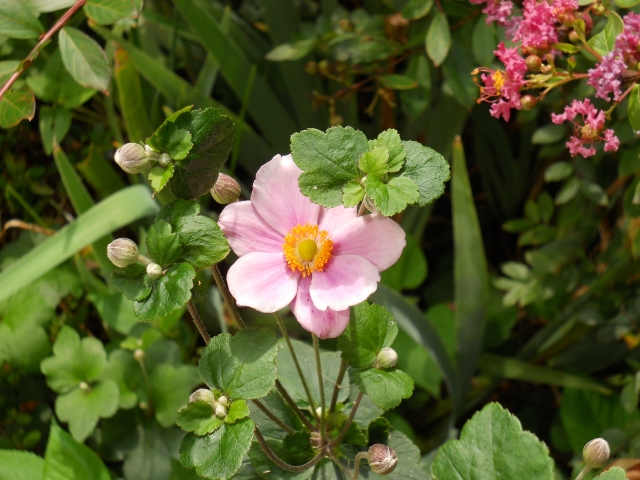
sumgonanemoneMy chorus of Japanese Anemones was vanquished by the voles years ago and has declined to return for a full-up gig. Now I take pleasure in the casual blooms that pop out to say, yes, we’re still around. Upper right, a lingering bloom of Crepe Myrtle nods. (Anemone tomentosa ‘Robustissima’)

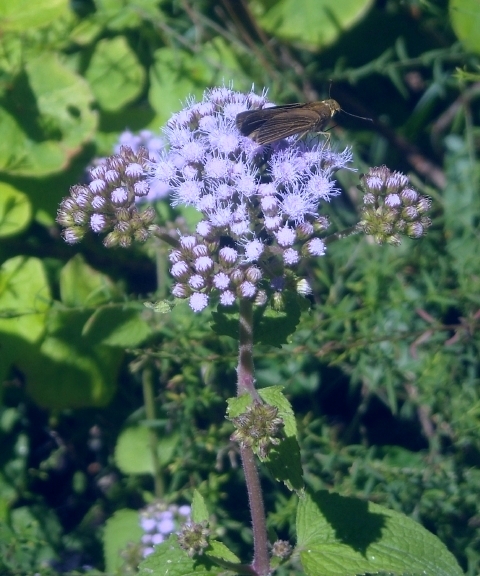
sumgonblumstbugI rescued Blue Mist years ago, though I can’t say it looked particularly unhappy at the side of a road. Since then it has rewarded my rationalizations of covetous do-good-ness with gusto. I wait to pull them, rhizomes and all, until they dry up and brown out, so they have time to reseed. It’s a great late-season disco diner for insect dudes like this skipper seeking a pick-me-up. (Eupatorium coelestinum)

sumgonboltWho cannot smile at Boltonia snowing in late summer after a wild romp in my homemade concoction of soil in a raised bed (sand, compost and clay). Laid down years ago, the mix has become black and it feels good to the fingers. Earthworms like it, too. Red Turk’s Cap in the background. (Boltonia asteroides ‘Snowbank’)

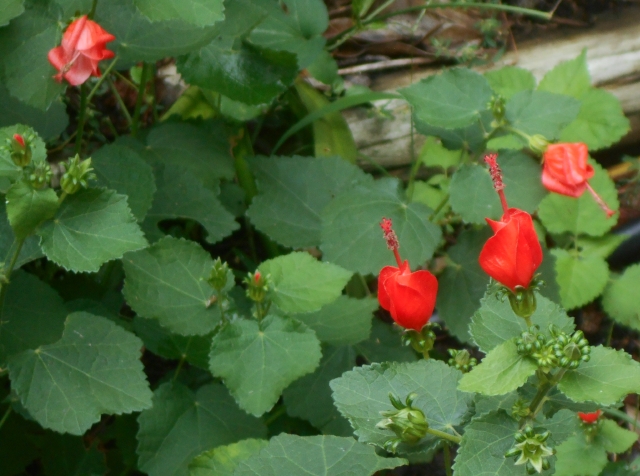
sumgonturkcapNow here’s a plant that keeps its secrets. It’s called Turk’s Cap because, if you have imagination, it looks like a fez, or Sleeping Hibiscus because its petals don’t unfurl. This doesn’t matter to bugs, butterflies or hummingbirds because they have easy access to the protruding stamen and pistil. It’s native to the southwest and central America, so I had doubts when a friend gave me a small plant. But it has grown, and so have its seedlings. The green fruits look like tomato miniatures, but that’s probably only my imagination. (Malvaviscus arborea)

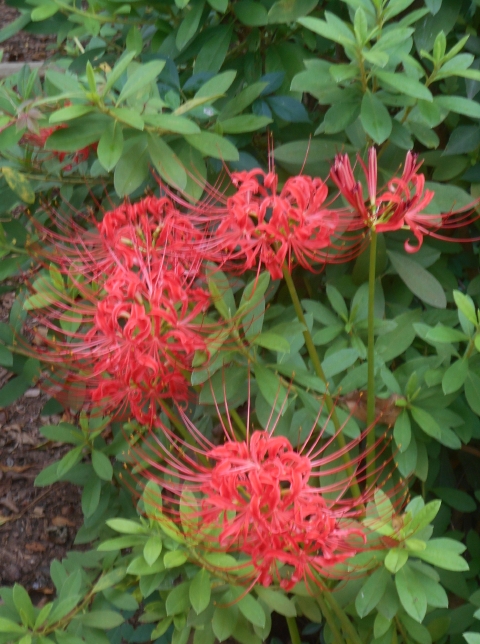
sumgonnakladQuintessential flower of the South, they’re called Naked Ladies because their stems are leafless. (It seems to me the ladies are so flouncy they don’t need dressed-up stems.) When the strap-like leaves finally show up, rising from bulbs after flowers have passed, they smack of crocus leaves on steroids. Here the ladies spice up southern indica azalea foliage. (Lycoris radiata)

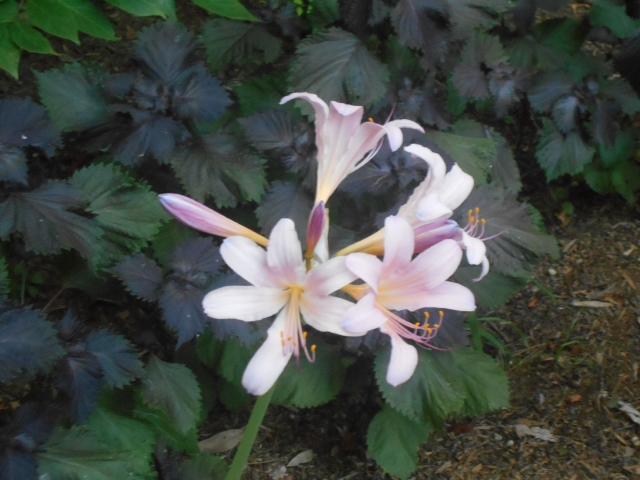
sumgonlilpnkMagic Lily, another flower of old southern gardens, a relative of amaryllis, is a fine Chinese import of long ago. I confess, this is last year’s photo. From the rampant display of amaryllis-like foliage this spring, I expected an extravaganza in late summer – not so. Maybe next year? (Lycoris squamigera)

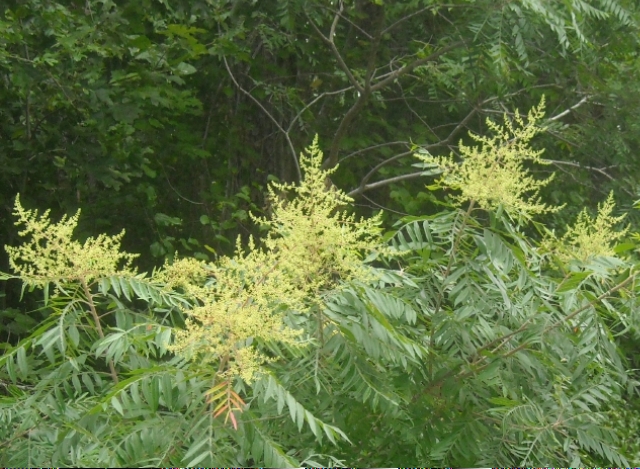
sumgonherclubWho would think that a small tree with lush panicles would have a name like Devil’s Walking Stick. Look beyond the blooms and you find stems covered in vicious spines. Years ago it had a devilish hankering to poke through our garden. A decade of dry weather checked that tendency, except for one mysteriously robust tree splendid with dark, tempting berries, for, maybe two days. The night before I planned to photograph the splendor, the tree was vandalized. Torn apart and broken up. Weight of berries? Hungry raccoons who learned too late about thorns in their paws? That plant never recovered. (Aralia spinosa)

sumgonjoeamstutI’ll leave the darkening Joe-Pye Weed flowers till leaves go gray. Butterflies and beneficials give it A+ in season, so maybe a hungry bird will appreciate seeds in winter. Do you suppose that’s why I have clumps throughout the garden? Nearby Blue Star was shorn of its seed pods and is still fresh in November. (Eupatorium purpureum) (Amsonia tabernaemontana)

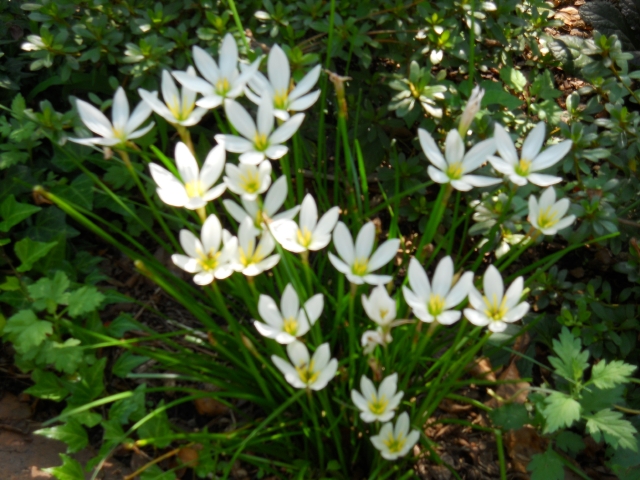
sumgonrainlilIn wet weather or dry, these lovely white Rain Lilies bloom profusely in late summer well after their foliage has emerged from dormancy. Bulbs seem to thrive when crowded and clumped. Which means, if you don’t make a map (ha, ha) or mark the spot you may have to rely on fuzzy memory, and woe to that plant you locate in their territory. (Zephyranthes candida)

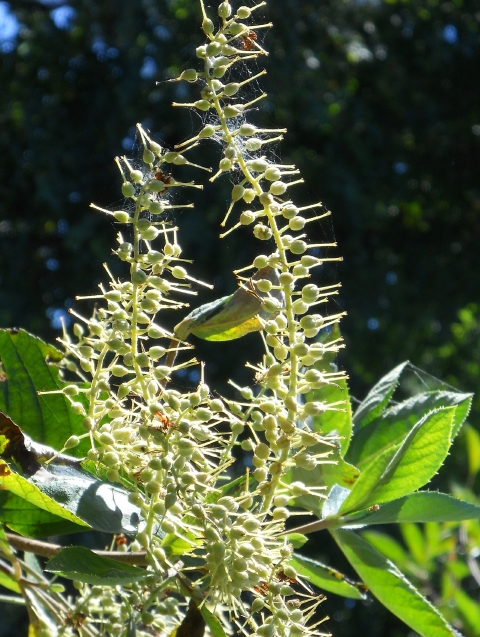
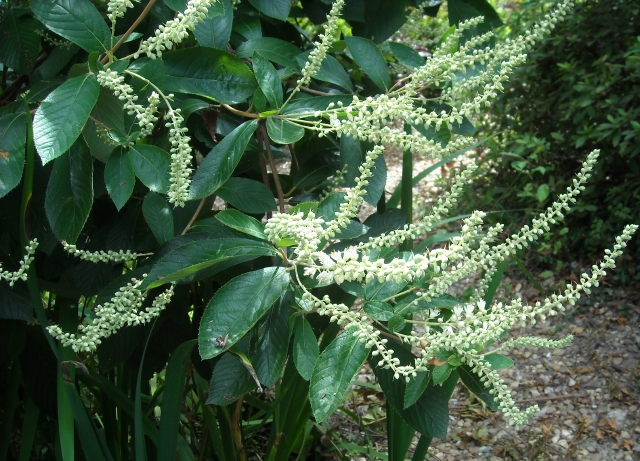
sumgoncleth2Woolly Summersweet’s long racemes of flowers never disappoint me – or the butterflies and solitary wasps that cavort through the shrub. The knobs on these spent flowers hold seeds and stay on as decorative accents all winter. (Clethra tomentosa)

sumgontretrunkGolden sunshine on a late summer afternoon . . .

sumgonwdastimpWhite Wood Aster just coming in, New Guinea Impatiens still hanging around. (Aster divaricatus)

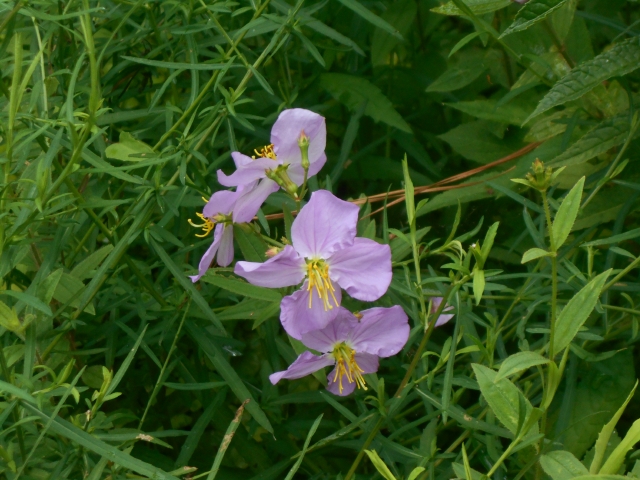
sumgonrhexialHandsome Harry roams half the country, but I can’t figure out how this nondescript native with the pretty flower got that nickname. Meadow Beauty and Deergrass may be more appropriate but it still looks like a weed until it blooms. Fortunately, I’m casual about pulling. Here’s an interesting process I’ve not yet witnessed: solitary bees grasping the flower and fluttering their flight muscles to dislodge pollen by vibration. It’s called buzz pollination. (Rhexia virginica)

sumgongoldrod2A tangle of stems, Goldenrod is summer’s splashy peace offering, and I can’t have enough of it even if, unchecked, it pushes its neighbors around. I leave seedheads (such a softie I am), so I always have some, even if it grows in the wrong place and I call it a spring weed and act accordingly. No matter, some always seem to survive.  (Solidago sps.)

sumgonrossharnLate afternoon shadows play over the last Rose of Sharon in summer. I’ve never seen a seedling come true from it, so I treasure this plant which we’ve limbed up to a small tree in our front garden. (Hibiscus syriacus ‘Helene’)

sumgonsneezeI’d forgotten about the Sneezeweed I planted a couple of years ago, until it bloomed this year. Its stubby, deckle-edged flower petals were a surprise and hold a certain charm, though they might have more pizzazz if the plant’s posture weren’t so casual. Blue mist and boltonia mingle among lolling plant stems. (Helenium autumnale)

sumgonbeautberTwenty-five years ago I was so taken with a small shrub growing wild in my neighbor’s garden she let me dig up one or two. I fervently hoped they would live in our muck. (Everything else seemed to die.) But American Beautyberry is one tough shrub, and it is not small, and today it bathes our wild spots with purple berries and, later, chrome yellow leaves. Late spring blooms are barely noticeable, but oh those berries! Birds and squirrels can’t keep up with the berry blast here, but on the Outer Banks, where migration is heavy, berries are gone within 24 hours after they ripen. (Callicarpa americana)

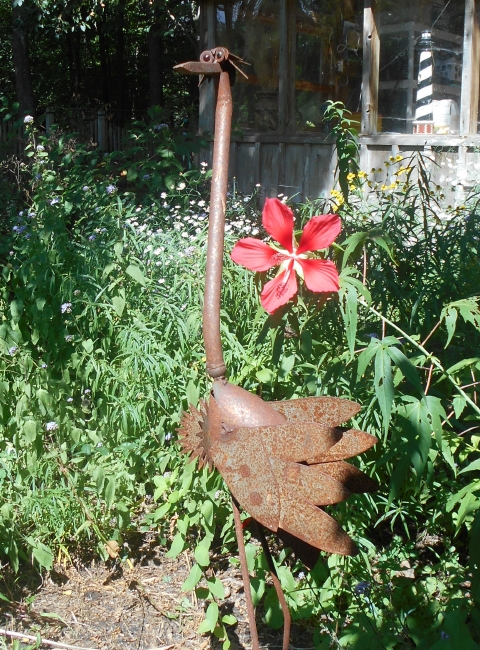
sumgonjunkhibcocThat red plant in the ditch. What is it? Native Swamp Hibiscus. It’s a show stopper at 7 or 8 feet. Here, in drier soil the last solitary flower on a typically skinny plant is soaking up some rays while a rusty, red-eyed skinny heron with an attitude looks askance. I whack the plant down in late fall, and wait for it to come back in late spring. (Hibiscus coccineus)

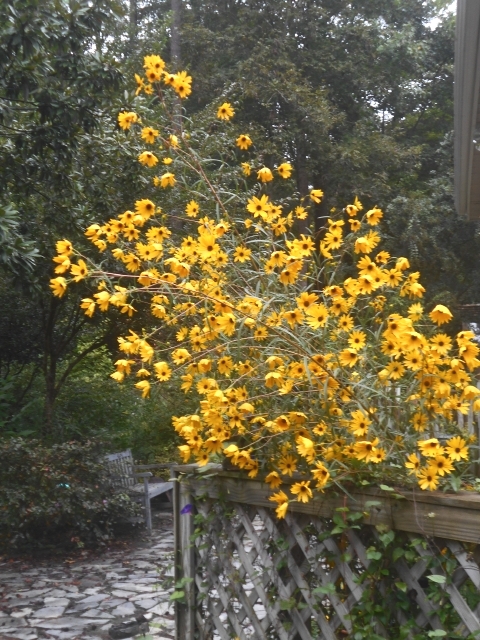
sumgonswampsunThey said you can’t ever get rid of it, but for a while I couldn’t even get it to grow. Today, Swamp Sunflower is a reach-for-the-sky plant anywhere the soil is damp. Here, a few sturdy stems have found a four-foot fence to lean on – note that they far exceed the usual 5 to 7 feet. Swampers need support, but their close relative, Maximilian Sunflower, stands proud and straight ten feet or more, and it grows anywhere – and everywhere, if you let it – but what a bloomer under gray November skies. (Helianthus angustifolium) (Helianthus maximillianii)

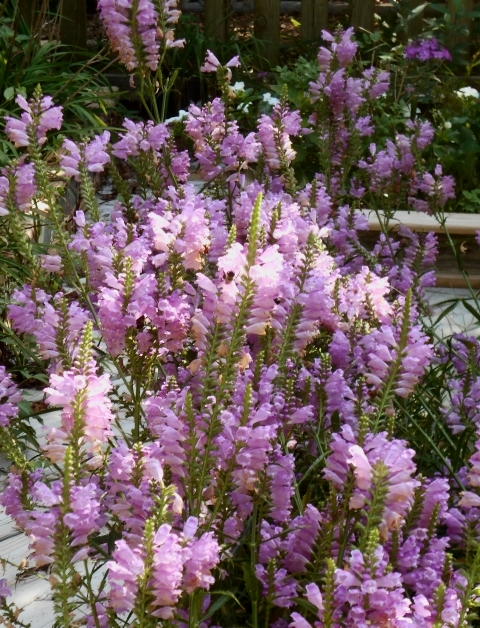
sumgonobedGrand finale. Obedient Plant is a flopper and an invader but I adore its lavishness. Restraining works early in the season, but even when I’m sure I’ve found out how to tame it, my smugness is shattered when, later, I see unruly stems that refuse to accept discipline. (Physostegia virginiana)

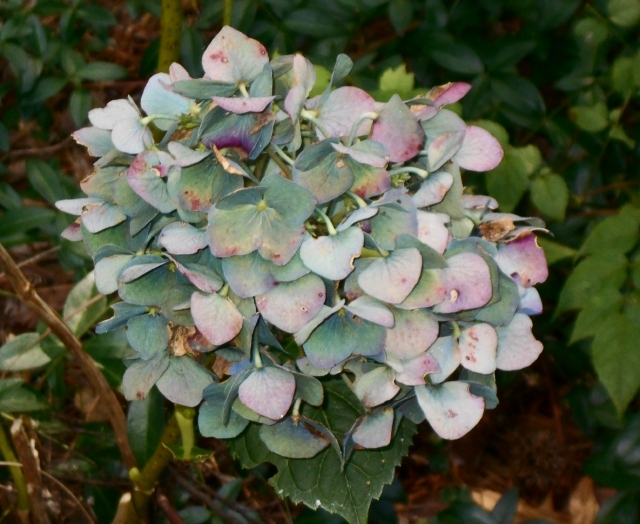
sumgonfadhydAn elegant farewell to summer. . .

Au revoir, mes tres bonnes amies d’ete. Venez a moi visiter l’annee prochaine. S’il vous plait.

Posted in fall bloom, Native Plants, wildflowers | Tagged , , , , , , , , , , , , , , , , | 1 Comment

The Taking of a Tree

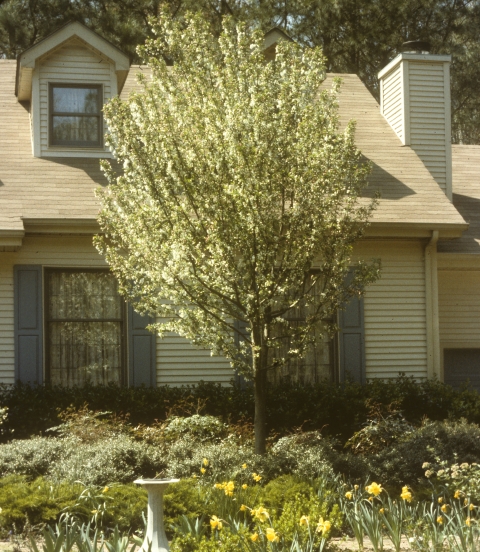
Eight years old in this picture

Eight years old in this picture

It was a Norman Rockwell tree. Each spring the crabapple, on schedule, would unsheathe its buds and break into a great song of white blossoms. Always the first week in April.

The crabapple is blooming, we would say (as if we had to remind each other to look) and we would gape at the sheer splendor of it, as though we had never seen it before.

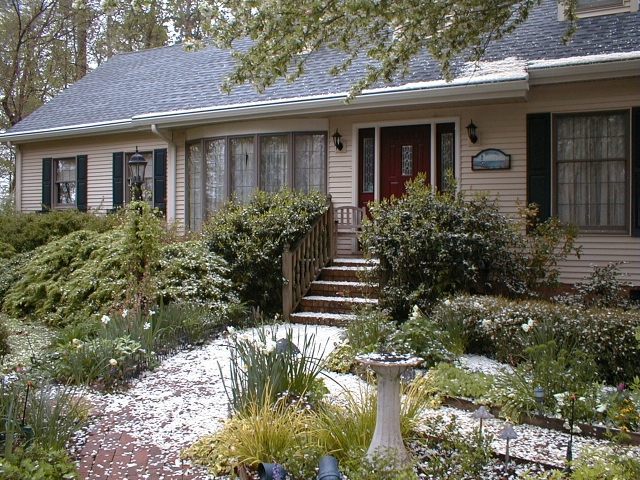
The spectacle lasted one short week. Then petals began slipping away. Taken by spring breezes, a sudden squall, or because it was their time, they would drift earthward until the path was white.

Let it snow!

Let it snow!

We loved that spring snow. We didn’t sweep or shovel. Scuff the soles of our shoes on the door mat? We invariably left tracks in the house.

It didn’t matter. Time enough to clear the petals after they turned to dry crumbs.

Flounces gone, the tree veiled itself in green and opened its branches for tenants.

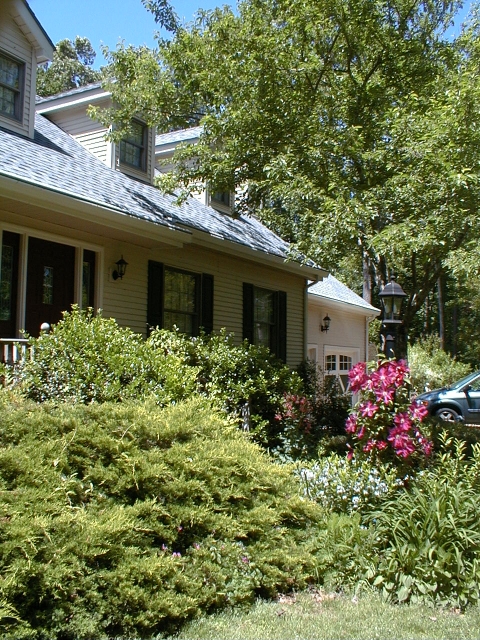
Simply green in summer

Simply green in summer

Robins nested, or cardinals, or sometimes mourning doves. Crowded leaves and tangled branches gave them a sense of snug privacy, but we watched anyway from a bedroom window.

Later, noisy visitors, not the original nesters who’d gone off as soon as they dared, teetered on branches and fluttered their wings while they squawked for food.

Squirrels romped. Playing tag? Or checking green berries for ripeness.

Once we saw a snake sunning on a south-facing branch.

Giving shade to hosta and epimedium

Giving shade to hosta and epimedium

It was a tree that kids could climb. The thick trunk divided itself about four feet from the ground, and branches followed from there out to a twenty-foot crown.

If you were nimble, you could get almost to the top.

It was a tree that retired gracefully into the background after its triumphant flash.

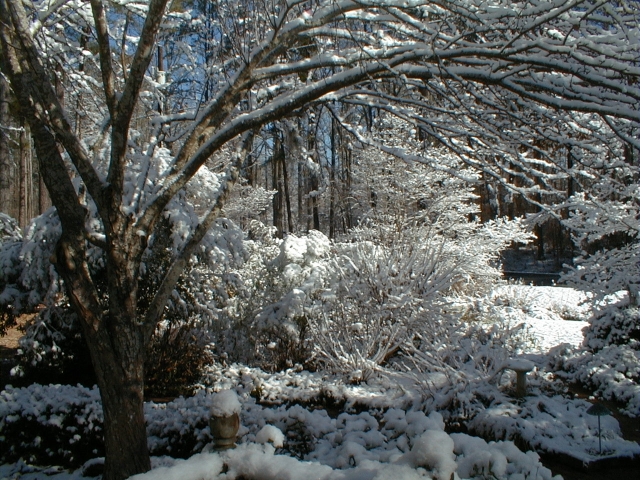
Foil to the magic of a winter storm

Foil to the magic of a winter storm

It was content to play a supporting role in the garden for the rest of the year.

In winter, its dark, trunk played off lesser but more elegant snow-draped plants.

In summer it anchored less permanent plants, hosta and epimedium that would look dowdy come fall and gaudy New Guinea impatiens whose turn had come to shine.

A tangle of branches and berries would tempt squirrels and birds

A tangle of branches and berries would tempt squirrels and birds

Squirrels seemed to be the first to find ripe berries in the fall. Tiny berries, the kind birds prize because they are an easy mouthful, appeared with stunning abundance.

They were efficient, these squirrels, tackling the tree in stages, lowest story first, then spiraling around to upper stories.

Birds were less efficient, and by the end of the season berries still crowned the top of the tree, along with stragglers here and there.

Setting the stage for quince and daffocils

Setting the stage for quince, daffodils

Some of these fell and were crunched on the path and some germinated in the garden. We swept the path and pulled the seedlings.

But we took no grand pictures of the berrying tree.

Thousands of small berries could not compare to the extravaganza of spring when forsythia, quince and daffodils, and sometimes the redbud depending on seasonal events, came into bloom.

For us, in the right place at the right time

For us, in the right place at the right time

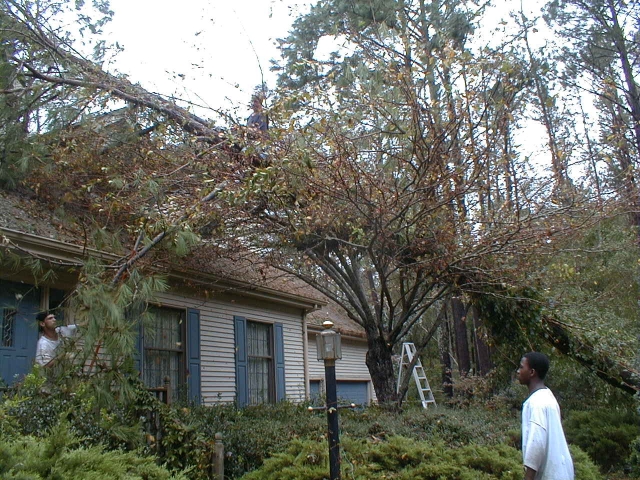
Did I mention that the crabapple saved our house? During Hurricane Isabel a cluster of pine trees gave way in saturated ground.

In retrospect, we should have removed them years before when they were young, but we did not think them a threat.

Storm winds grabbed them and whipped them up against the house. The crabapple stayed fast between the house and the pines.

The pines that fell, ten years before the storm

The pines that fell, ten years before the storm

We knew nothing until we tried to open the front door next morning.

The tree was fifteen years old then. We had purchased it as a three-foot whip from Kmart for $10 (or maybe only $8, we can’t remember) in 1988 and planted it in a raised bed of muck and imported farmer’s soil and hoped it would survive where two other trees had failed.

It was so spindly it never crossed our minds that it would be too close to the house when it grew up.

As in all things, there was a price, and it came to be a dear one.

Signs of failure: sparse berries, sparse leaves

Signs of failure: sparse berries, sparse leaves

The crabapple was left battered by the pines. Limbs crushed and contorted had to be removed before healing could begin. Limbs encroaching on the house needed to be cut back.

That was in 2003. Wounds healed and scarred.

Limbs thickened. New branches sprouted.

Blooms still astonished each spring and the crabapple became a centerpiece in a garden of low-growing, newly planted, fall-blooming camellias that we massed behind a dwarf yaupon holly hedge.

But the crabapple never truly recovered.

Tthe disease travelled from an old wound

The disease travelled from an old wound

Branches that should have arched gracefully to the sky stood up straight and stiff as toy soldiers, almost leafless, barren of side shoots.

Water sprouts we called them, an ugly reaction to the shock of losing so much of its crown in so short a time.

The drastic pruning disfigured the tree, destroyed its symmetry, but for just one week in spring each year that magnificent bloom erased the insults.

Suspended!

Suspended!

Each year that passed the tree failed a little. After a while it could no longer hold its leaves through the summer.

Berries dulled and dropped, failing to whet appetites of squirrels or birds.

The mess of it all overcame us.

It took us five years for us to decide that the crabapple had to come down.

It took an hour and a half for a team of four to take it down.

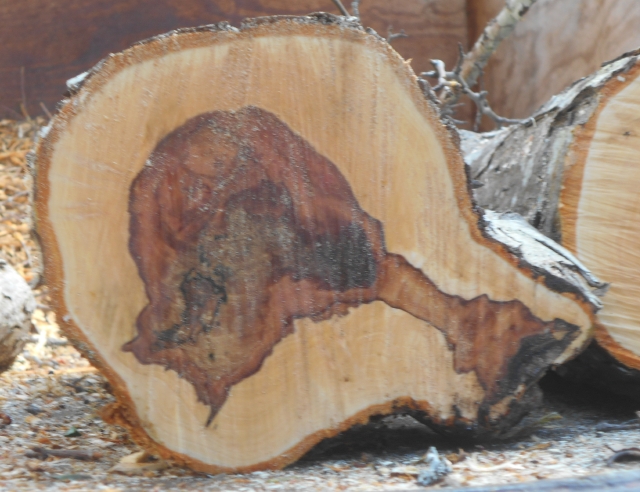
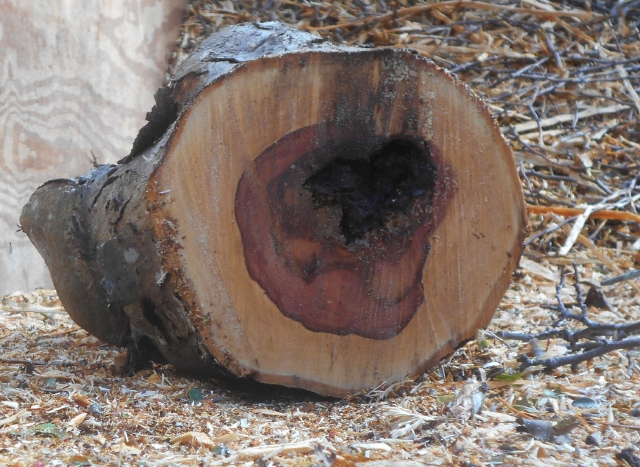
We didn’t know how much the tree was hurting until we saw the cut limbs.

There's a black hole there

There’s a black hole there

Normal crabapple heartwood is reddish brown. This tree’s heartwood was shot through with black stigma, a sure sign of rot within. Somewhere in the trunk there was a tiny cavern where two slugs were spotted, probably enjoying a cool dark moist hangout.

The wasting began a long time ago. The arborist pointed out a tiny hole in a scar where a limb had been cut.. Inconsequential portal for a scrap of a spore that would grow a fungus that would begin the outsized task of breaking down a tree.

The last cuts

The last cuts

By the time they were finished, the crabapple with that magnificent bloom was reduced to an assortment of limbs and branches, a pile of wood chips, some crusty leaves, and a few berries scattered among the washed river run that defines our driveway.

We can see sky from the bedroom window.

We can see the house from the road, and it seems so spacious.

We aren’t sweeping berries from the path this fall. There’s sunlight in the living room. The garden seems empty.

crabbloom

crabherb

Posted in Uncategorized | Tagged | Leave a comment

Midsummer Madness

Quince and daffodils light up our path in March

Quince and daffodils light up our path in March

The thing about spring is its order. There is a natural progression starting from bare twigs, bare earth to lovely bloom. There is space, precious precious space, for plants to expand and show off. Insects are usually a little behind the action, so the tidy growth looks fresh after waking from winter. I can walk in the garden and dream. This year plants will play nice. I can pretend not to see trouble between neighbors down the pike.

Late spring gives me a hint of what's on the way. But who can deny this clematis the joy of blanketing azaleas

Late spring gives me a hint of what’s on the way. But who can deny this Dr. Ruppel clematis the joy of blanketing azaleas

The thing about midsummer is its disorder. Come midsummer the gloves are off and the wrestling begins. Leaning, pushing, smothering, hogging, twining and vining, grasping and clasping, there is no trick too dirty in the plant world. And who can predict a winner? Sometimes the tortoise in early spring becomes a hare-on-steroids in sunshine and heat.

That’s when a gardener must become not just a weeder and a waterer but a referee. To be a good referee you have to be as ruthless as the plants. I am not a good referee. I am languorous in hot weather and softhearted all the time, and I cannot make hasty decisions (though I can be rash when provoked by a renegade). The plants in my garden know this and they take full advantage. Here is the evidence.

summadsprbedsAren’t the courtyard beds tidy in May? Missouri sundrops in the center bed will be cut down when they fade. Yellow marigolds team with purple salvia. True, mullein is outstripping its companions, but lantana Dallas red is struggling.  Purple Japanese iris in background with coreopsis.

summadctydbedCourtyard beds in August: Salvia guaranitica black and blue near the fence, ripped out in spring but back in force, reveling with Dallas red lantana, a serendipitous combination. Unseen are pineapple sage about to bloom red, a treat for yellow sulphur butterflies, Japanese aster (kalimeris), chelone lyonii, blue lobelia syphilitica, swamp sunflower, and a few, sweet shy items that remain in hiding.
summadblimp1If this blimp were any lower he’d be tangled in foliage.

summadgazeboThat’s confederate jasmine capping our gazebo. It methodically bumped out the sweet autumn clematis that reigned there for several years, whose wispy white blooms and heady scent bamboozled us into ignoring its grasping tendrils. The confederate jasmine, equally beguiling, came in for a second act and created its own roof garden out of its detritus. (We think a snake lived in its tangle.)

We could have continued to ignore the invaders, except the roof is slatted. Its hard-won turf wafted down onto us and our dinners. We don’t like dirt in our dinners. The hatchet came out.

PS We miss the vines. The naked gazebo is sunnier than we remembered and summer temps are 3-4 degrees warmer than official weather reports. Formerly, they were 3-4 degrees cooler. Stay tuned, both vines are trying to make a comeback.

summadottetalGrandpa Ott, what are you doing here? Still hanging around after all these years past when I planted morning glory seeds? Consorting with mullein leaves? Playing twine-around-the-rosies? Oh, you’re probably more an early-morning checkers fan. And still unpredictable as ever. I’d miss you if you didn’t show up somewhere each year.

summadjulypathThe bed that looks out on the slip is still manageable in July; you can see the path. Blue salvia guaranitica, which grows everywhere behind my back, yellow woodland sunflower, a wanderer, and purple joepyeweed and shrubby St. Johnswort in the background, manna plants for pollinators will be toughing it out with others.

summadperjoebolt. . .It’s hot.  Joepye weed fading but perilla elbows in, its purple leaves a splash and its minty blooms a late-season dinner for pollinators. New York ironweed,  not pictured, towers, and boltonia , bottom right, adds a tangled grace note. The path, by the way, has disappeared.

summadstjjoeAnother view. Shrubby St. Johnswort, foreground left, is a massive bloomer, can look untidy but the insects love it.  Woodland sunflower won’t be stopped. Wispy starry aster plucked from a roadside is coming along will bloom white  with red Turks cap hibiscus and purple-leaved perilla. Spent daylilies in the background once held court. Chrysanthemums bottom right are edgy but don’t flop when their button blooms add fire. (Hooray!). There’s a path between the St. Johnswort and chrysanthemums but you have to hunt for it.

summadsalvsunfSalvia guarantitica dances with yellow woodland sunflower. Wonder who will do the leading. They’re both aggressive in our garden.

summadturtSo much greenery from Formosa azalea (left), native magnolia, cheeky river fern, native deciduous holly (right), variegated solomon’s seal now faded from too much sun, and Sheffield chrysanthemums near term, our rusty turtle is working on an escape.

summadclemSweet autumn clematis (ternifolia) may have been knocked off the gazebo, but it will not be stopped. It’s found its way along the porch rail and probably intends to climb to the roof. Underneath it is a tangle of confederate jasmine, crossvine and Virginia creeper. Below that tangle is our spring-blooming clematis and azalea (see above). Enjoy life now, you creepers and prowlers, for it’s off with your heads this fall (except for the spring bloomers).

summadphlcrepNow here’s a true opportunist. The seed that started this phlox fell through a spreading crepe myrtle, nestled in moist, shaded soil, germinated unseen, and quietly grew, adopting crepe myrtle branches as leaning posts.

Sure wish I could take credit for some of these untamed antics. My, I’d think myself so clever. But, you know, I doubt my garden would be nearly as much fun if it didn’t surprise me with its ramblings. At least in this season of fading summer. Come late fall/early spring when I’m bending and swaying to wholesale scything of beds, and there’s that spring deadline, I may — or maybe not — sing a less spirited song.


Posted in summer bloom, Uncategorized, wildflowers, yellow flowers | Tagged , , , , , , , , | Leave a comment

The Bee Report

We owe the beleaguered honeybee and his friends

Bam! Statistics on honeybee survival leave you reeling. Take a look at some news items released this year. (Bold italics my emphasis.)

Multiply this guy by millions

Multiply this guy by millions. Photo from Friends of the Earth site

From Reuters in May, 2015 comes this alarming report: “Honey bees…disappeared at a staggering rate over the last year, according to a new government report that comes as regulators, environmentalists and agribusinesses try to reverse the decline. Losses of managed honey bee colonies hit 42.1 percent from April 2014 through April 2015, up from 34.2 percent for 2013-2014, and the second-highest annual loss to date, the U.S. Department of Agriculture said in a report issued on Wednesday.”

We've been encouraging native plants, this sunflower came from a seed our grandson gave us

We’ve been encouraging native plants, this sunflower came from a seed our grandson gave us

Key Point: Sustainability of honeybee culture depends on maximum colony loss of 19 per cent each year (about one in five). The Reuters release shows losses of almost one in two colonies.

From Bayer Crop Science, major manufacturer of pesticides called neonicotinoids, comes this cheery report: “In its latest survey, the USDA reported that the number of U.S. honey bee colonies grew to 2.74 million, the highest level in years and an increase of 4 percent over 2013. This. . .shows we are on the right path toward a more productive and sustainable agriculture. . . As the chart shows, the number of U.S. colonies has risen over the past 10 years, helping to ensure there are sufficient bees to meet the pollination needs of agriculture.”

Who knew garden phlox would draw pollinators. Palomedes swallowtails cavort, raised on red bay, their host plant

Who knew garden phlox would draw pollinators. Palomedes swallowtail caterpillars grew up on red bay, their host plant. Background plants are green-eyed coneflower, big draws, too

Key Point: Between the years 2006 and 2011, five million colonies (about 1 out of 3) were lost, at an economic cost of $2 billion.

From the US Dept of Agriculture in May 2015: “Total losses of managed honey bee colonies from all causes were 23.2 percent nationwide for the 2013-2014 winter, according to the annual survey conducted by the Bee Informed Partnership and the U.S. Department of Agriculture. This represents a noticeable drop in mortality compared to the 30.5 percent loss reported for the winter of 2012-2013 and compared to an eight-year average of winter losses of 29.6 percent.”

Joepyewee, St. Johnswort, perilla, woodland sunflower, boltonia, even daylilies and chrysanthemums attract pollinators in this crowded, sunny spot

Joepyeweed, St. Johnswort, perilla, woodland sunflower, boltonia, even daylilies and chrysanthemums attract pollinators in this crowded, sunny spot where something’s in bloom all summer

Key Point #1: The Bee Informed Partnership is an arm of Bayer.

Key Point #2: Summer losses were higher than winter losses during the past two years, a disturbing trend, since bees do all their work in summer. You need to add summer losses to winter losses to get a true reading of colonies lost. The Reuters news release now makes sense.

The poor honeybee is being studied to death, analyzed for risk assessments (done with smoke and mirrors?) and dissected in congressional hearings.

Native clethra, or summersweet, is a magnet for pollinators, smells heavenly, too

Native clethra, or summersweet, is a magnet for pollinators, smells heavenly, too

Here are some of the issues: CCD (colony collapse disease), mites from China, assorted viruses, winter weather, summer drought, queen die-off (a recent phenomenon), neonicotinoids, and poor nutrition.

Poor nutrition? Doggone it, shame on those bees. They are not eating a varied diet. Maybe that’s because they can’t find it. Manicured lawns and gardens, great swathes of monoculture, heavier use of herbicides have eliminated wild meadows and wild fields where bees forage wildflowers that most of us don’t plant in our flower beds.

Yes, even the non-native butterfly bush (this one a dwarf) attracts pollinators

Yes, even the non-native butterfly bush (this one a dwarf) attracts pollinators

And now, when the system is failing, it’s time to point the finger at beekeepers. Here is a list of their supposed sins.

(1)They are not inspecting hives for mites often enough.

(2) They are not aggressively treating mites.

(3) They are not feeding their bees high protein food and supplements when needed. (For beekeepers’ convenience, a special Megabee diet has been developed. How costly is that?)

(4) They are not using Best Management Practices.

(5) They are not splitting colonies in spring and summer when bees can build up stores quickly. Wait a minute, we just said that bees are having trouble finding food and queens are dying off and colonies are being lost in summer. Oh never mind.

Even when she'd down and out, pollen still bristles on her disc flowers, so I'm not so quick to deadhead

Even when she’s down and out, pollen still bristles on her disc flowers, so I’m not so quick to deadhead

The beekeeper today must work harder and spend more to pamper bees made sickly by conditions he can’t control. Used to be you could set ‘em out and forget ‘em unless a hungry b’ar was prowling.

What kind of  cockeyed picture is this? Honeybees are feral. Feral means they don’t need humans to get along. They do fine by themselves, as long as the environment is bee-friendly. They have been on their own for centuries — found shelter, gathered food, and raised young all without us. And they pollinate food for us. We owe them.

If you would like to be part of a movement to create bee-friendly oases in your garden, or in your community, here are some suggestions.

Native skullcap, underplanted in gardens, is easy and attractive -- to us and pollinators

Native skullcap, rarely planted in gardens, is easy and attractive — to us and to pollinators

(1) Do research on bee/butterfly/pollinator plants that will grow in your area. Natives are best but many non-natives work well (e.g., abelia, holly).

(2)Choose sunny/partly shady areas away from harsh winds. These oases of nectar can be scattered around your garden but each group should be large enough to accommodate clusters of identical plants so bees and pollinators can find them easily and learn how to work them.

(3)Try to have some bloom throughout the growing season. For butterflies, be sure to include host plants for caterpillars.

Buttonbush,in our ditch garden, is another good-bug magnet, likes moist places

Buttonbush, another good-bug magnet, grows in our ditch garden, likes moisture and sun

(4)Choose non-hybrids, if possible. Bees don’t like fancy, frilly flowers. They like simple, old-fashioned blooms that have productive nectaries and give visual signals they can interpret easily.

(5) Don’t be disappointed if honeybees don’t flock to your plantings. There may be no hives nearby. Other pollinators will, and you will be strengthening their numbers.

(6)Don’t use pesticides, especially neonicotonoids. Learn to tolerate some damage from chewing and sucking insects.

(7)Don’t buy plants treated with neonicotonoids, if possible. This is a tough call unless you know the grower. Some Big Box stores have promised not to market neonicotonoids but their nurseries may still offer plants that were dosed with these chemicals.

Native St. Johnswort, grows easily from seed. Flowers are buttons, not large like non-native types. Seed pods tend to hang on

Native shrubby St. Johnswort, grows easily from seed. Flowers are bristly buttons, not large like non-native types. Seed pods tend to hang on

(8) Look for plants grown and sold locally by non-profits such as Master Gardeners and school ag programs. Watch for their sales in newspapers.

(9)Take pictures of your garden.

If you want to go further, you can become part of a new nationwide campaign – the Million Pollinator Garden Challenge. Enroll, plant, and send them pictures. It was launched in July to register a million school, public and private gardens that support pollinators.

beemillpollogoThis is a huge collaborative effort by conservation and gardening organizations under the umbrella of the National Pollinator Garden Network. Check out http://www.millionpollinatorgardens.

For more about honeybees, their history in our country, the widespread use of neonicotinoids and how they work, the threat of the varroa mite, stories from beekeepers, and gardening practices that will bring pollinators to your special patch of eden, see our series of posts:

Who is Killing the Honeybee? Part I (Not I, says the Gardener)

Who is Killing the Honeybee? Part II (Pesticides and Who? Us Gardeners?)

Who is Killing the Honeybee? Part III (Two Beekeepers Tell their Stories)

What is Killing the Honeybee? Part IV (Brinksmanship? Ignorance? Greed? Inertia?)

A Pollinator’s Heaven

Posted in butterflies, Hobby Beekeeping, Honeybees, Native pollinators, Neonicotinoids, wildflowers, yellow flowers | Tagged , , , , , , , | 1 Comment

St. Petersburg V: From Tar Yards to Revolution. . .and Beyond

(Click on Peterhof and Catherine Park for pictures and discussion of these gardens. For the first post in this series of five, see St. Petersburg: I: First Impressions)

Thank goodness Irina brought a car and driver with her today, Susan said. I don’t think I could walk another step – but she did, of course, plenty of them. We had lots of historical whodunnits to uncover.
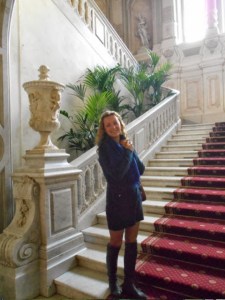
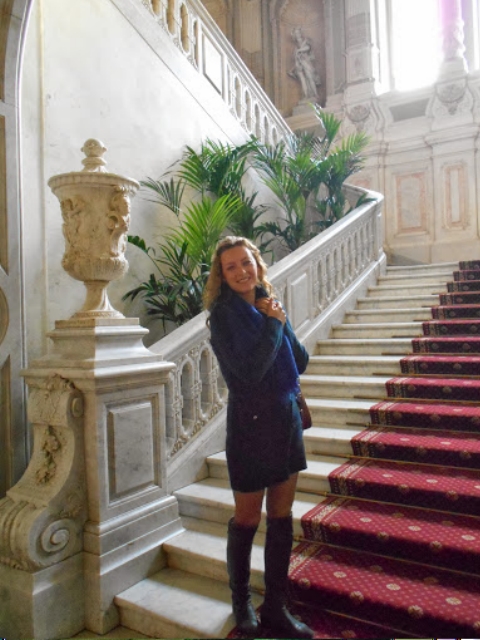
Our guide, Irina, at Yusupov Palace

Our guide, Irina, at Yusupov Palace. Photo by Susan

We had booked our hotel through the Virginia office of Travel All Russia and they provided a guide or scheduled tours when we were not exploring on our own. They also took care of our Visa applications.

Irina would be our guide for the day, and what a day, with visits to cathedrals, a palace and an institute. We would go back in time to the tar yards of the 18th century and through the Russian Revolution and beyond.

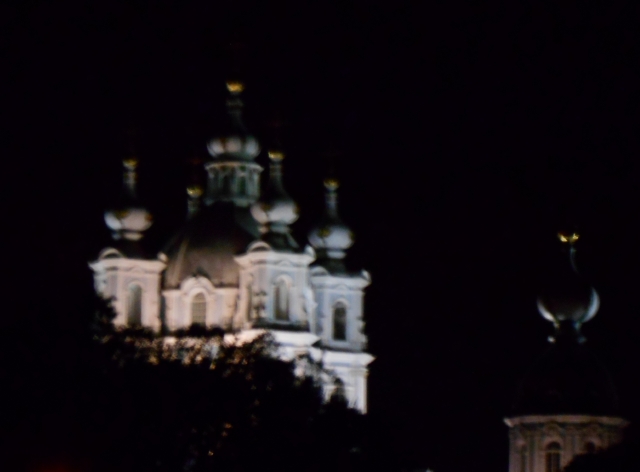
The vision of Smolny Cathedral breaching the nighttime skyline of St. Petersburg was still haunting us, and that is the first of our historical whodunnits.

Smolny Cathedral by day

Smolny Cathedral by day

Cream puffs, Catherine the Great called the baroque creations of Italian architect Rastrelli: the Winter Palace, Peterhof, the Summer Palace in Pushkin, and Smolny Cathedral. Cream puffs maybe, but oh so delicious. Yes, Irina would take us by bus later in the day to see Smolny Cathedral.

The Cathedral is a short walk from the Neva River as it rounds a bend in northeastern St. Petersburg. Its name comes from the Russian meaning “place of pitch,” so called because the shipyard was here during Peter the Great’s reign. Hard to visualize pots of pitch and planked ships and laborers heaving and hauling in this quiet neighborhood, but Peter’s passionate love affair with the sea and sailing ships kept the shipyards busy.

Smolny Cathedral with convent

Smolny Cathedral with convent. Photo by Susan

Easier on the eyes is this cathedral with its convent built for Peter’s daughter, Elizabeth. No man had title enough to match hers, and without a marriage, it was off to the nunnery after her father’s death in 1725. Peter’s daughter in a convent? Not this willful, fun-loving, and vain character.

Fifteen years and some lovers later, she became empress through a coup. Lavish parties took priority over affairs of state, but Elizabeth was canny, and Russia prospered: new territories and a fresh bloom for arts and education.

Smolny Institute, school for girls during Catherine the Great's reign

Smolny Institute, school for girls during Catherine’s  reign, then  headquarters for the Revolution

Her nephew, Peter III, childish, loutish, succeeded her for just long enough to unravel political capital before his wife, a foreigner whose original name was Sophie, took the rule from him in a coup.

Empress Catherine the Great was a voracious reader, some might say a scholar. No surprise that educating young women was a priority for her. It happens that Smolny Institute, classic, trim, plain by baroque standards, is practically next door to Smolny Cathedral. It became a school for girls ages 5 to 18. How proud Catherine was of these girls, who, depending on station in life, learned fine arts or homemaking skills. The school operated until the opening shots of the Russian Revolution.
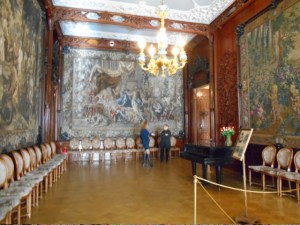
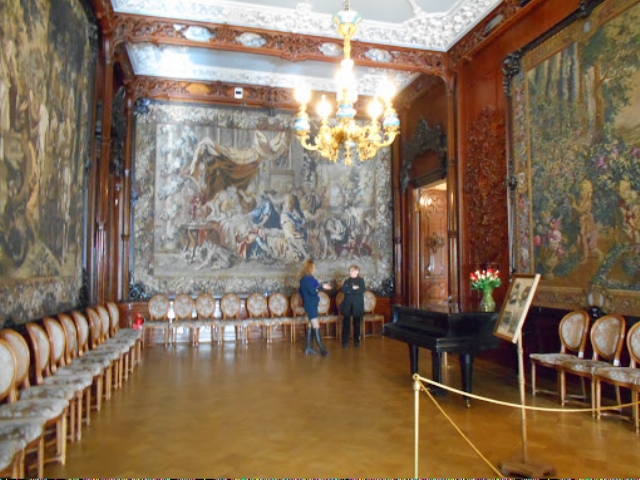
Great ballroom and tapestry at Yusupov Palacve

Great ballroom and tapestry at Yusupov Palace. Photo by Susan

It’s a complex affair, this revolution, propelled by radical ideas, sputtery industrialization, a growing proletariat, a World War, and chaos in the capital. Chaos in the capital? Now that’s a juicy historical whodunnit. For that one, we go to Yusupov Palace.

The Yusupov’s, descended from a Muslim prince who served Ivan the terrible, were the richest family in Russia, philanthropists, art collectors, diplomats, and residents of the finest palace in the city on the banks of the Moika River.
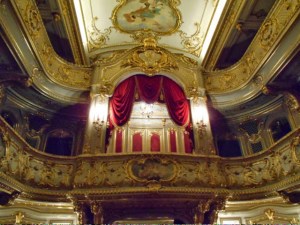
Ornate private theatre where Glink and Pavlova and other greats have performed

Ornate private theatre where Glinka, Pavlova and other greats have performed. Photo by Susan

Quintessential elegance and decadence, but all in good taste. A grand ballroom and banquet room, an ornate rococco private theatre.

Silk and gilt and frescoes and tapestries, but all in good taste. Lavish but not quite as overwhelming as Peter’s and Catherine’s palaces. People lived in this palace until the Russian Revolution, and the fine, well preserved interiors represent high life in the late 19th century.
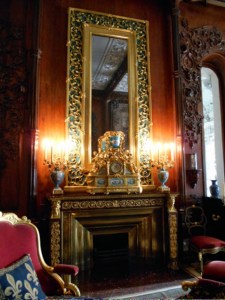
One of many ornate fireplaces

One of many fireplaces. Photo by Susan

Prince Felix Yusupov, the last of his line, was a goodhearted, high-society chap notorious for his escapades and extravagant crossdressing.

In 1914 he married shy Irina Alexandrovna, niece of Tsar Nicholas II, who gave the couple 29 uncut diamonds, each 3 to 7 carats, as a wedding gift. It was the society wedding of the year, the last such occasion before World War I.

Prince Felix didn’t serve in the war, but he opened a wing of the palace as a hospital for wounded veterans. A year later he was the father of a baby girl the couple would affectionately call Bebe during their long marriage.

Felix and Irina, engaged in 1913

Felix and Irina, engaged in 1913

Prince Felix: high-spirited, maybe, but not a murderer, certainly not somebody who would launch a revolution. Just the opposite. He wanted to preserve the monarchy, save Russia from being torn apart by the ‘mad monk’: Rasputin.

How the dickens did a guy with greasy hair get to be so powerful? He was the toast of Petersburg society, but it took more than that for him to make it to the history books.

It happened that, after the birth of four daughters, a son who could carry on the line and become the future tsar was born. Joy was tempered by worry when the royal family learned Alexei had hemophilia. Enter Rasputin who brings Alexei out of crisis more than once. Tsarina Alexandra, who doted on her son, came to idolize this strange man.

R5Rasputin2He was, after all, a healer, wasn’t he? He had divine power, didn’t he?

Rasputin the itinerant peasant-preacher, unwashed visionary, charismatic quack, manipulative egomaniac, boorish libertine, master of debauchery, he whose name means “debauched,” held the confidence of a tsarina and mesmerized an entire society.

Under his aegis, Alexandra removed loyal public servants, replaced them with cronies, mostly inept. It was gentle Nicholas who carried out her wheedling demands, of course, because he did not like his wife to be cross.
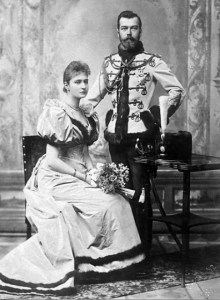
Tsar Nicholas II and Alexandra

Tsar Nicholas II and Alexandra

When the troops left for World War I, Nicholas left too, in a misguided attempt to rally them. His presence on the battlefield could in no way relieve the desperation of soldiers suffering from lack of food and basic equipment (rifles and ammunition) and missing reinforcements. Yet they fought on, four million dead or wounded in one year. Meanwhile, Alexandra and Rasputin were left in charge while strikes and food riots broke out.

Rasputin was tough to murder. It happened on December 17, 1916. We descended palace stairs to the Turkish Room to hear the story of how Prince Felix invited Rasputin to the palace for a good time. Irina was supposed to be the lure for Rasputin, who had bedded half of St. Petersburg royalty (except for Irina), but a bad case of the jitters kept her out of town. So Felix fed Rasputin poison pastries while co-conspirators played a gramophone loudly upstairs, simulating a party.

Poison-pastry scene re-enacted in the Turkish Room

Poison-pastry scene re-enacted in the Turkish Room

When the arsenic didn’t work, the panicked conspirators shot the charlatan as he ran to escape. They rolled him in a blanket (Dead or alive? Not sure.) and dumped him in a hole in the frozen river.

The perpetrators were exiled by the tsar at once, a lucky stroke for them. They were gone from the city when the Bolsheviks revolted and murdered royalty and ransacked palaces.

Three months later Tsar Nicholas abdicated and a year and a half later, in 1918, the royal family was murdered gangster-style, fulfilling Rasputin’s prediction of the monarchy’s collapse if anyone dared murder him.

McDonald's, hangout for teens and twenty-somethings

McDonald’s, hangout for teens and twenty-somethings

After our grab and go meals at McDonald’s and Russian-style fast-food cafes, we appreciated the leisurely lunch Irina arranged for us. Divine borscht that I would sip every day if I could, and wonderful chicken kiev.

A word about McDonald’s in this city: subdued lighting, dark brick walls brightened by occasional pieces of framed artwork, the antithesis of Golden Arches ambience. But the shrimp wraps were fabulous, it was handy to our hotel, and we enjoyed watching young people hang out.

Lenin arrives to foment revolution in St. Petersburg Germany

Lenin arrives from Germany/Finland to foment revolution in St. Petersburg

For the record, we are walkers and snackers. Small samplings of native fare are quite enough to satisfy us, and hours of exploring give us little time for lengthy sit-down meals. Having said that, we have never lost weight on a trip. Must be those afternoon pastries.

Back to our historical whodunnits at the Smolny Institute. October 1917, the girls were out and Lenin and the Bolsheviks (meaning: majority) were in. It was a heady, creative time, fluid, charged with energy.

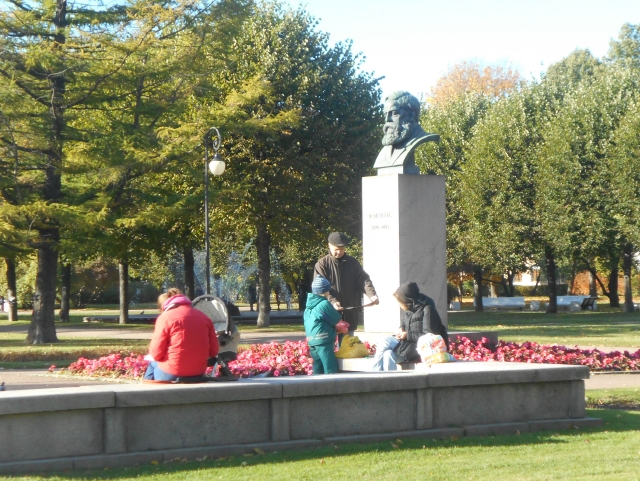
This tranquil scene in Smolny Park near the Institute belies its history as a shipyard and a cradle of revolution

This tranquil scene under the bust of Karl Marx in the park near Smolny Institute belies its history as a shipyard and a cradle of revolution

In the open halls were noisy meetings and long debates. Soldier, sailor, peasant, worker, anyone could take the podium and speak freely. Broadsides were cranked out almost daily. Peace, Land and Bread emerged as a slogan of the people. This yeasty fermentation of ideas continued for almost a month at the Institute, an arsenal of guns and ammo, but not always so much bread.

But behind the scenes, quietly, biding his time, was Lenin, who believed in tight centralized control by a few disciplined and dedicated revolutionaries. Patiently he waited until he could manipulate the uprising.

Cruiser Aurora, now a museum

Cruiser Aurora, now a museum

By November the Bolsheviks held most government offices and the Red Army was sabotaging railroads to keep loyal troops from retaking the city. On November 7, the cruiser Aurora, now in the hands of the Bolsheviks began firing on the Palace from the Neva River, probably blanks, damage was negligible.

Bolsheviks crowded the streets and surrounded the palace. By sheer numbers they pushed their way in. The takeover was practically bloodless. No one dared fire a pistol or launch a grenade, for fear of hitting a comrade.

Well, we all know how things worked out. Years of civil war and famine. Revolts by starving peasants who resented government seizures of their stores of grain exported to finance the growing of industry. A record drought. Government inaction. Millions dying during the greatest famine in recorded history, leaving a photographic record that is terrible to behold. Peace, Land and Bread, such simple, heartfelt requests, had been hijacked.
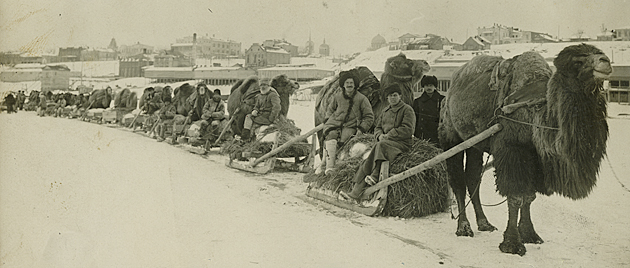
An ARA transport column on the frozen Volga, Tsaritsyn.

An ARA transport column on the frozen Volga, Tsaritsyn. Camels tolerated cold weather better than other animals

Grudgingly Lenin allowed outside agencies to bring in some aid. The American Relief Administration under the direction of Herbert Hoover engineered the largest relief effort ever up to that time, despite continual harassment and obstruction by secret police. The agency eventually served 11 million meals daily in 19,000 kitchens across the country, employing Russians as cooks and aides.
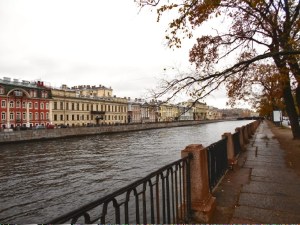
Restored palaces lining the Fontanka River opposite the Summer Garden. Photo by Susan

Palaces line the Fontanka River opposite the Summer Garden. Photo by Susan

Quashing dissent and erasing vestiges of religion and royalty was more important than feeding a country. Churches were ransacked for their valuables, adding gold to communist coffers, but little of it was allotted for  food. To weaken the influence of orthodox priests and promote the party line, churches became Museums of Religion and Atheism. During World War II they doubled as morgues and warehouses. Saviour on Spilled Blood was called, in typically sardonic Russian humor, Saviour on the Potato.

Palaces were stripped of their artwork and valuables. On a positive note, what was not destroyed was added to Catherine’s vast collections at the Hermitage, which remained open to the public. The Russian Museum was formally consolidated.
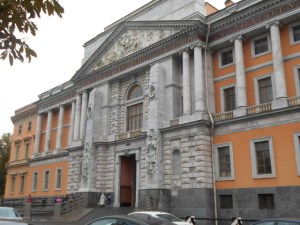
Mikhailovsky Castle today

Mikhailovsky Castle today

(Historical Whodunnit: The Mikhailovsky Castle, an elegant arm of the museum, is a curious mixture of architectural styles. Once upon a time it was an outlandish medieval castle with moats and drawbridges, well guarded by royal troops.

Paranoid Paul I, son of Catherine the Great and most hated tsar, had it built around 1800 to protect himself from assassins. Forty days after he moved in, Paul was murdered in his bedroom by his own councillors. (So much for security from terrorists.)

R5avovostatin

Avovostatin (station) with columns, chandeliers and sculpted ceilings

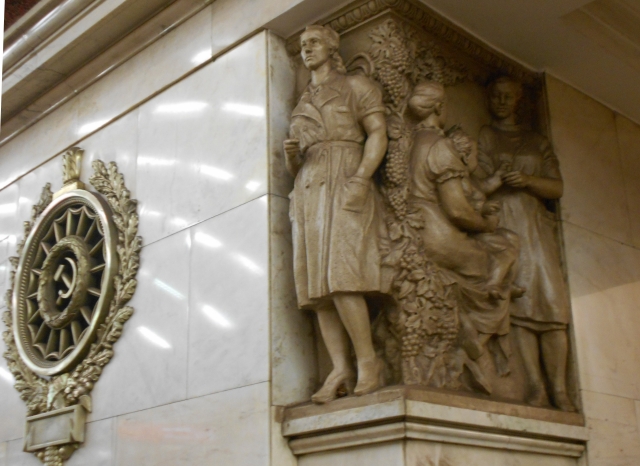
Skip to the late thirties and into the 21st century. A grand metro, still in process, was being created. Immaculate stations gleaming with chrome and chandeliers and stunning mosaics and sculpture and bas relief that celebrate the people’s revolution and honor its leaders. They are modern palaces–the people’s palaces, where workers sojourn to and from work. Mostly, we suspect, the average commuter barely notices the glitter in his hurry to get to his destination.

A long journey. Admiralskaya station is more than 330 feet deep, completed in 2011. photo by Susan

A long journey. Photo by Susan

We, on the other hand, were tourists, so we lingered.  It wasn’t till the end of our stay that we gathered courage to explore the metro. Getting lost underground was not on our list of things to do. We descended into a cavern so deep it seemed to be a puncture wound in middle-earth.

Remember, Petersburg is built on a swamp that is laced with rivers and streams. Shifting clays don’t make solid anchors. Digging deep was the only way to reach stable conditions.

An engineering marvel, the escalator we rode to the surface at Admiralteiskaya Station, finished in 2011, is the longest, 377 feet. During construction, tunneling proceeded at a pace of 25 feet  a day.
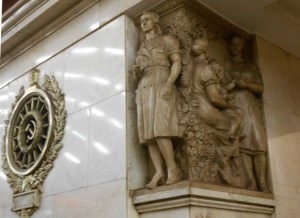
Artwork features the industry of the workers

Decor features the industry of the workers

Stations are clearly marked in arabic and cyrillic. Trains come often, and it is easy to change from one line to another. Some stations are more impressive than others.

We never got beyond counting stations to mark our progress, but we wondered why we had not tried this excursion earlier. If we had dared, we could easily have been all over town and Susan’s feet would be in good shape. Still, we congratulated ourselves on another coup, almost as fine as the coffee coup on our second day.

It was time to leave this great legend of a city with its layers of history and its remarkable culture. But we must first investigate one final historical whodunnit and offer a note of thanks.

Irina's lean torso complimented twenties styles

Irina’s lean torso complimented twenties styles.  Their studio, IRFE, a combination of their names was re-launched in 2009

Final Whodunnit: Whatever happened to the royalty whose palaces were seized? Two hundred thousand made haste to Europe with whatever they could carry in trunks, eventually settling in Paris, where they established a close-knit community. They had been in the habit of spending money but not earning it. When the rubles ran out, princesses became seamstresses and models (forerunners of today’s runway models), princes became waiters and dishwashers, and the White Guards who had fought the Reds, became taxi drivers.

As for Felix and Irina, when their cache of diamonds was gone, they opened a successful haute couture fashion house in 1924, a couple of years before Coco Chanel introduced the little black dress.  The business closed seven years later, but the couple were never short of cash.

In 1933 they sued MGM for falsely portraying Irina  as a victim of Rasputin in the movie, Rasputin and the Empress. The large settlement allowed them to live in style for the rest of their lives and, incidentally, gave rise to “all persons fictitious” disclosures in future movies.

Catherine the Great in her coronation dress

Catherine the Great in her coronation dress of silver silk and ermine trim. Her crown contains almost 5,000 diamonds with a 415-carat ruby on top

We close with a posthumous note of thanks to Catherine the Great. When George III began fighting those rebellious colonies across the sea in 1775, he asked Catherine for the rental of 20,000 infantry and 1,000 Cossack Cavalry. Catherine was sympathetic, but she declined. Peace with the Turks after her successful war against them was beginning to unravel.  She might (and did) need those troops in the future.

Knowing how fiercely the Russians could fight, even when deprived of food, and their penchant for plunder, we take great comfort that George hired the less enthusiastic Hessians. Thank you, Empress Catherine.

One last word.  St. Petersburg seems of the ages, yet it is a young city, founded only three centuries ago in 1703. America was in its infancy then, casting for a future. A city and a country an ocean apart, growing and changing side by side in time, both caught in revolutions, both molded by the past, each following different trajectories. After a people’s revolution and unprecedented material progress, life in this eastern city still reflects centuries of deeply ingrained history and religion, while the western country, guided by its vision of Manifest Destiny, opened frontiers and forged new beginnings that had their foundations in Old World ways.

St. Petersburg I: First Impressions

St. Petersburg II: Heavenly Coffee and Historical Whodunnits

St. Petersburg III: The Neva Runs Through It

St. Petersburg IV: A Church, a Museum, and Sunday in the Garden

St. Petersburg V: From Tar Yards to Revolution. . . and Beyond


Posted in Uncategorized | Tagged , , , , , , , , , , , | 1 Comment

St. Petersburg IV: A Church, a Museum and Sunday in the Garden

(Go to Peterhof and Catherine Park for discussion and pictures of these gardens.)

Today, we meet Ilya Repin, but first we must explore a historical whodunnit.

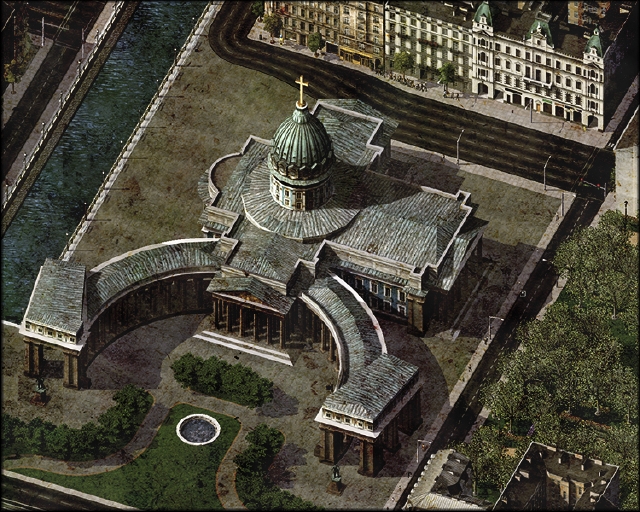
Kazan Cathedral

Kazan Cathedral

You can’t miss Kazan Cathedral on Nevsky Prospekt with its colonnades and statues and roses still blooming in October. The church isn’t especially inviting, but people worship regularly here, and its icon, Our Lady of Kazan, is the warp and woof of Russian history.

Peter the Great built a wooden church here as a permanent home for Our Lady. Catherine the Great converted from Catholicism to Russian Orthodoxy and was married here. In 1801 her son, Paul commissioned a grand church,  after St. Peter’s basilica in Rome, in honor of Our Lady.

One feels like a wee Alice in Wonderland climbing these steps

One feels like a wee Alice in Wonderland climbing these steps

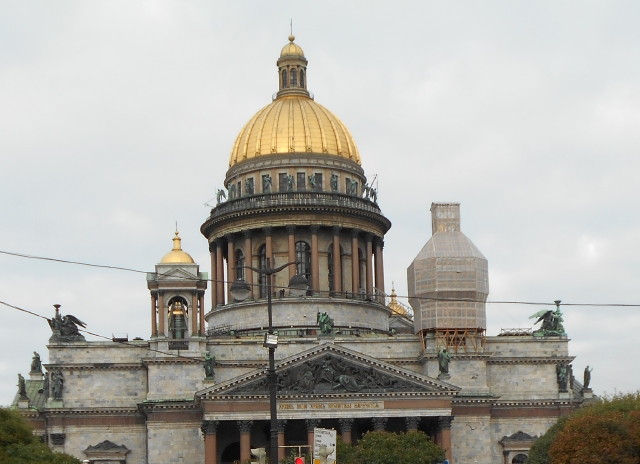
We threaded our way around scaffolding and entered through the huge bronze doors recreated from Ghiberti’s Gates of Paradise on the Florence Baptistry. How gloomy inside, even with filtered light from the great dome. I guess we expected the opulence of St. Isaac’s and Church on the Spilled Blood.

A long line, mostly older ladies in dark dresses, pious, waited patiently to kiss the icon of Our Lady. It’s not imposing at all, modest, a small stylized image of Mary with the Christ child standing, actually a copy, but that doesn’t seem to matter. We wondered about hygiene. Maybe piety prevents infection here.

What’s so special about Our Lady? In two words, history and power. She was brought to Russia from Constantinople in the 13th century, then went missing for hundreds of years.

Orthodox cathedrals have an east-west axis, but the colonnade faces the Nevsky, a tricky arrangement

Orthodox cathedrals have an east-west axis, but the colonnade faces the Nevsky, a tricky arrangement

One night a little girl in Kazan had a dream about her and led her mother to the house where it was buried. From Kazan Our Lady went on to St. Petersburg and became, in the hearts of the Russian people, the Holy Protectress of the country.

She holds the power of victory and defeat. In 1904 she is stolen and Russia loses its wars with Japan. She is part of a parade around Leningrad during World War II and Leningrad survives the 900-day siege.

Routinely she is brought to battlegrounds to bless the combatants.

Mikhair Kutusov

Mikhair Kutusov by Pyotr Basin (1793-1897) as seen in The Hermitage

In his darkest hours during the Patriotic War against Napoleon, General of the Russian armies, Mikhail Kutuzov, prayed to her, and she gave him victory. When Kutuzov, who is a central figure in War and Peace, dies a hero in 1813, he is buried in this church. And so the church has become a memorial to the War of 1812.

Vladimir Putin allegedly flew the icon over Crimea. To bless the Sochi games, or to propitiate his military operations? Or is rumor-based legend being spun today?

We were intruders. Out of respect, we would go no further. This church belongs to its devout worshippers who stand during services, as they always have, and pray for their people and their country. It does not belong to tourists who browse, flit in and out with check lists. We stood quietly in place for a few moments. Then we turned and left. We had our check lists.

Arkady Plastov painting

Spring, Arkady Plastov (1893-1972)

And one item on the list was the Russian Museum. We didn’t know much about Russian art, except we loved the fine, imaginative detail and rich colors of the highly lacquered Palekh folk art.

We walked into a temporary exhibit by Arkady Plastov. Fate and Soil it was called. It bowled us over. In one glorious painting after another the artist invites us into the life of the peasant: shepherd boy, potato pickers, older sister dressing younger sister, mother with baby and child, a skinny boy, sublimely happy, basking in the sun. Everyday moments of life in his native Ukraine are rendered with such glowing light and color – and love — they became almost magical, though muted backgrounds keep viewers soberly rooted in the realities of peasant life.

R4Repinstatecouncil

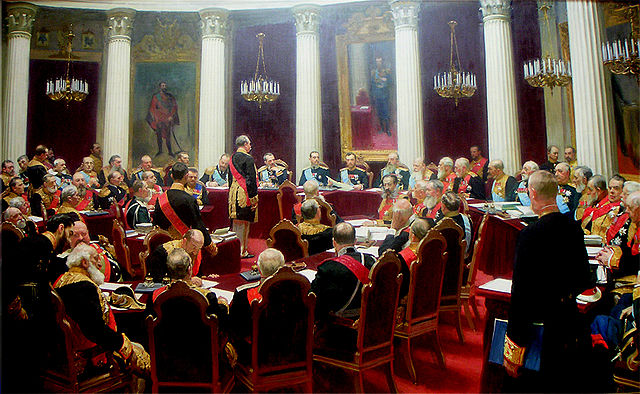
Ceremonial Meeting of the State Council on May 7, 1901, painted 1903 by Ilya Repin (1844-1930

We entered a large dim room featuring one colossal picture, the Ceremonial Meeting of the State Council. We had no idea what this picture of, maybe, seventy-five noblemen was about, but that didn’t matter. A symphony of red, wine, black and gold against a subdued ochre background of columns led us through the minutiae in this masterful group portrait. (Later we would learn it was commemorating the hundredth anniversary of the State Council.)

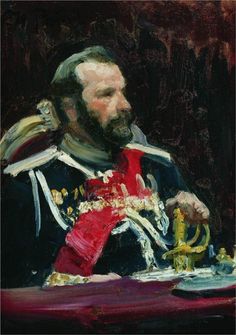
Portrait by Repin of War Minister Aleksei Nikolayevich Kuropatkin

Portrait by Repin of War Minister Aleksei Nikolayevich Kuropatkin

Yes, these participants were highly orchestrated. Each was a recognizable individual living at the time of the painting: features, uniforms, poses distinct yet bound by composition and color into a stunning presentation of ruling aristocracy.

Who did this painting? we asked.

And that was when we met Ilya Repin. Truly, this is a remarkable artist, we thought. And so he is, one of Russia’s greatest. He was a contemporary of Tolstoy (whom he painted often) and full partner in Russia’s 19th century intellectual and artistic flowering.

Which brings us to Repin’s most celebrated painting, Barge Haulers on the Volga.

Barge Haulers on the Volga

Barge Haulers on the Volga by Ilya Repin ( Bound by chains, women were also used as barge haulers, but nobody painted pictures of them)

The old Lucky Strike Hit Parade radio show pops into my head. What? We’re seeing dark figures, straining against straps in a bright world of sand, sea and sky, slaves pulling a trading ship, and I’m thinking pop tunes of the 1940’s.

Yo Ho Heave Ho we would sing ad infinitum as kids, the memorable line from Glenn Miller’s rendition of the Russian Song of the Volga Boatmen. It’s the only line I remember today. Who knew of the misery we were singing about, especially wrenching because, typical of Repin’s work, each slave is recognizable as a unique individual.

Interesting digression: Writers were persecuted. Artists, in general, were not. Their work, though it could be graphically critical, was tolerated more readily than the written word that had the power to disseminate powerful ideas efficiently. Artists and writers alike created out of love of homeland.

Hermitage Raphael Loggias

Hermitage Raphael Loggias

In the slice of an afternoon we’d discovered a small slice of Russian art. Much more lay beyond these walls in unseen collections and in other wings of the museum.

We had visited the Hermitage with a guide the previous day and here, too, had sampled only a fraction of the offerings. The Hermitage is not a museum like others we had visited, with arrangements of pictures on walls. Here the artwork is integrated into a magnificent setting that brings back an age of princes and princesses. On another level, it was just plain fun to see the originals of paintings we had pored over in books.

Alexander with his family and Milord, 1864

Alexander with his family and Milord, 1864

Now, here’s a bit of trivia. Alexander II used to walk his dog, Milord, along the latticed paths in the exclusive, open-to-nobles-only Summer Garden adjacent to Peter’s Summer Palace. At the time, Milord was the most famous dog in Russia.

The Garden is the oldest in St. Petersburg, about as old as the city itself (founded 1703) and in good weather, it was the center of social life. Military victories and birthdays were celebrated with special lighting and fireworks.

Those days it was a formal garden with strict geometric layout, manicured parterres, pleached treeslining paths, and treillage screens dividing gardens for privacy. Fountains and buildings were added early on, dress rehearsal for the dramatic water displays at Peterhof.

Surrounded by statues, Susan takes pictures. Note treillage fronting greenery

Surrounded by statues, Susan takes pictures. Note treillage fronting greenery

Landscaping trends were changing in the 18th century. To reflect new ideas the garden became more parklike, required less care, lost its formality but not its geometric design.

A lot can happen to a garden in 300 years. Floods in 1777 destroyed fountains and buildings, irreparably. During World War II the garden was bombed and lawns were dug to become kitchen gardens.

But not before the good people of Leningrad buried as much statuary and as many artifacts as they could, to be exhumed during reconstruction. That these gardens, Peterhof, Catherine Garden and Palace, and the Summer Garden have been recreated out of World War II ruins is mind-boggling.

Pictures, pictures everyone's taking pictures. We had a snack at this pavillion

Pictures, pictures everyone’s taking pictures.

These days, since the October revolution, the Summer Garden is open to everyone. It doesn’t have the eye-popping vistas of Peterhof and Catherine Garden, but it’s where people come to stroll on Sunday afternoons if they are not crowding the shops along Nevsky Prospekt.

Hallellujah, today, nobody is rushing. People are smiling and dawdling, stopping to take pictures and chat. Tall, slender, classy Russian women pass us. They look like runway models or future wives of the rich and powerful. Sigh. . .Do they eat lettuce to keep in shape?

Happy Day!

It’s customary for the wedding couple to tour the city on their happy day

And then there are strolling brides and grooms, everywhere it seems, flanked by their wedding parties, carefree, on top of the world. Less romantic but no less appealing are families with strollers and kids in tow. Maybe, once upon a time, these parents had strolled the paths in this garden on their wedding day.

Nobody seems to mind that it’s misting and the fountains are turned off and the statues look lost without their dancing waters and there is no color, except from autumn leaves. They are taking advantage of a last mild weekend before winter.

Fountains turned off for the winter

Fountains turned off for the winter

For our part, we can’t get used to the garden being wrapped in lattice. On this dingy day, it looks to us like the plants are in jail. We can’t see a thing, and it seems like a lot of work to hide plants. It’s historical, of course, but. . .

We stop at the coffee shop in the pavillion and decide the garden would look smashing on a fine summer day when the sun is shining and fountains are splashing and statues are shining and the imposing wrought iron gates invite you in to play.

A peek into Mikhailovsky Gardens adjacent to the Summer Gardens and near the Church on the Spilled Blood

A peek into Mikhailovsky Gardens adjacent to the Summer Gardens and near the Church on the Spilled Blood

Another strolling couple

A glowing bride and her new husband will probably end their tour of the city at the Bronze Horseman for a celebration there

A bosquet

How inviting! Bosquets, we learned, are roofed corridors that lead to another part of a garden


Autumn leaves are collected and enjoyed in wreaths people are carrying

Recycling autumn leaves. We saw several people carrying these colorful wreaths

Peter's Summer Palace at the edge of the Summer Garden. He loved this simple palace, the only original building standing today, now a museum

Peter’s Summer Palace at the edge of the Summer Garden. He loved this simple palace, the only original building of its vintage standing today, now a museum with Peter’s artifacts

Posted in Russia, St. Petersburg, Uncategorized | Tagged | Leave a comment

St. Petersburg III: The Neva Runs Through It

(Go to Peterhof and Catherine Park for pictures and discussion of these gardens)

We decided not to climb to the dome of St. Isaac’s Cathedral for the tourist view of St. Petersburg because we were taking a late-night boat ride on the Neva River. We’d see the monuments of St. Petersburg in bright lights, we reasoned. (There was probably a degree of rationalizing over that decision not to climb those 300 steps.)

Bridge opening t allow traffic on the Neva River

Bridge opening to allow traffic on the Neva River

After one o’clock in the morning the bridges on the Neva rise to allow barge and sightseeing traffic. The River Neva divides this city on a swamp that Peter the Great built in the early 1700s. Well, actually it was the serfs, dragooned by the thousands, who drained the swamps, dug the canals, built up the land by hand, literally – they were always short of shovels and wheel barrows — and died for this Venice of the North that became Russia’s glittering window to the west.

Palaces and tour boats along the Fontanka River. No originals, though, the early wooden palaces burned

Palaces and tour boats along the Fontanka River. Early wooden palaces burned; these dating later are made of more substantial materials

In the years that followed, baroque and classical palaces rose like mushrooms, either admired or reviled by Europeans, symbols nonetheless of Russia’s growing presence on the continent.

Living in these palaces was quite a different experience from looking at them. Noblemen, who were required to live in the new capital if they expected favors, resented the demands of the tsar. Beneath the glittery façade buildings were damp with the distinct essence of must and mildew. How they missed Moscow!

The Bronze Horseman and St. Isaac's Cathedral, oil on canvas by Vasilii Surikov, 1870

The Bronze Horseman and St. Isaac’s Cathedral, oil on canvas by Vasilii Surikov, 1870

The pier was only a ten-minute walk from our hotel. Yes, it would be safe to walk at midnight. St. Isaac’s Cathedral, a few blocks away, and the Bronze Horseman, opposite the pier, were our landmarks. Simple enough.

You can’t miss St. Isaac’s. It’s Russia’s largest cathedral and its shimmering dome punctures the skyline. Looking at it today, you wouldn’t know this was the fourth try. The first, a small wooden church, commissioned by Peter the Great in 1710 was flooded. Fire finished off the second, after bad foundations caused the stone walls to crumble.

Building of St. Isaac's

Building of St. Isaac’s

Catherine the Great commissioned the third try in 1768, but she died before it was finished.

Her son, Paul I, whose taste in architecture is questionable at best, commandeered its marble for one of his palaces, substituted clay bricks for the church’s façade. (Maybe some not-so-passive aggression against his dead mother, whom he hated?)

Sumptuous interior of the cathedral

Sumptuous interior of the cathedral

Finally, by 1818 Alexander I got tired of hearing nasty jokes about that church his father had left in such hideous condition, so he ordered a new one. The undertaking was monumental. Think about building a 4,000 square-foot church – room for 14,000 standing worshipers – walls faced with slabs of granite, stone columns and pediments as grace notes, mosaics and gold icons decorating the interior, altogether weighing hundreds of thousands of tons. In a swamp. Ten thousand pines were dragged from virgin forests, tarred and sunk to create footings.

The classic dome

The classic dome

It took 40 years and the reigns of three tsars before it was finished. It cost 123 million rubles (so they say, I can’t imagine how the cost was accurately reckoned) and the lives of hundreds of serfs, but what’s the loss of a few serfs when you’re building a grand city and a grand church. Like minerals, there’s an unending supply in this country that never ends.

There’s actually a connection between America and Russia here. Alexander II (memorialized by the Savior on the Spilled Blood Church) used the money from the sale of Alaska to gild the great dome. Sixty serfs died from toxic fumes of mercury used to spray the gold. Day or night the dome is a beacon, much like our own capitol dome which was modeled after it. Only during World War II was it shadowed, painted gray to mislead enemy bombers.

Columns of precious minerals and incredibly beautiful icons

Columns of precious malachite and lapis lazuli mined from the interior frame incredibly beautiful icons

Let me point out that reading a map at midnight in a strange city under a dim streetlight can be next to impossible. Nor is it recommended travel behavior, nor is asking strangers for directions on lonely streets late at night. Avid walkers, avid map-readers, we had, on this simplest of walks, lost our bearings.

No choice but to march sure-footedly ahead. Into this dark and deserted neighborhood? No, this is wrong. Ah, a taxi driver. Would he take us to the Bronze Horseman? He apparently understood our monosyllabic gibberish as well as we understood his Russian, though we managed to figure out he was saying No. We thought maybe he gestured toward the river, so we marched sure-footedly ahead in a different direction.
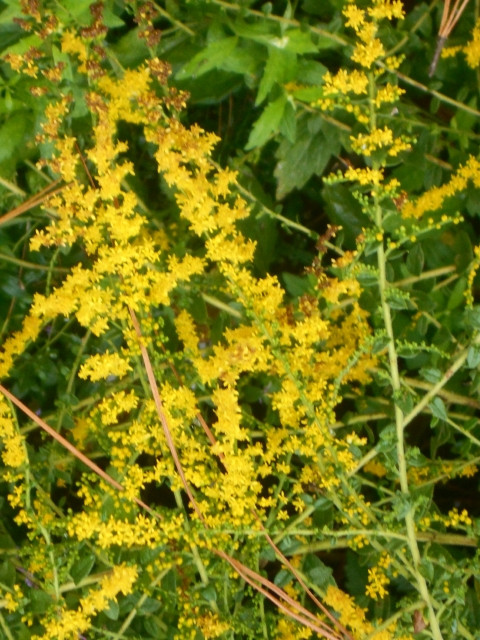
Our heads swiveled as we took in the opulence

Our heads swiveled as we took in the opulence

Ah, a gentleman leaving a private club(?). And so gracious. Oh you want the beeg sheep, he said, which we did not think we wanted a beeg sheep but we figured a beeg sheep had to be on the reever and from there we could find the leetle sheep, so we said yes and thank you so much.

He spoke English so well, with just that trace of accent; and doubtless he knew other languages. Our lack of language skills made us feel provincial, and maybe a little self-centered.  But we couldn’t dwell on that; we only had twenty minutes before cast off.

The Winter Palace

The Winter Palace

Yes, we found the river. Along the embankment we caught up to a jolly gentleman with two happy lady friends, one on each arm. Follow us, they suggested (we think), we’ll get you there. But they were having too much fun ambling down the avenue, and we were on a mission. They took no note as we jogged past them. The night was quiet but shattered glass embedded in the stoney walk suggested previous rowdy times.

Up ahead we saw an elegant couple disappear onto a pier. That’s it, we cried. We’ve made it with time to spare. But. . .why are they leaving?

Bridge opening

Bridge opening

Hey, the boat is untied and revving up and moving and it’s not time yet and we have tickets. No, the gatekeeper gestured emphatically. “Teekets,” I cried. Head shake. “Teekets,” again and again (my Russian-accented English becoming more authentic with each try). I shoved the indecipherable papers at the gatekeeper. They could have been tickets to Siberia for all we knew.

The Captain must have heard the commotion, for I was making a commotion. I was not giving up. We were, after all, on a schedule. There was a lot of thinking going on. The captain finally agreed to allow us to board.

R3BridgOp3

Utilitarian by day, bridges sparkle at night

Relief and exultation, but embarrassment, too, when we realized how much was involved. They had to stop the boat, pull in, anchor, rope up two boats lying next to the pier, then tie them to our tour boat before we could walk through them to board. Meanwhile, boats were rocking and water was churning.
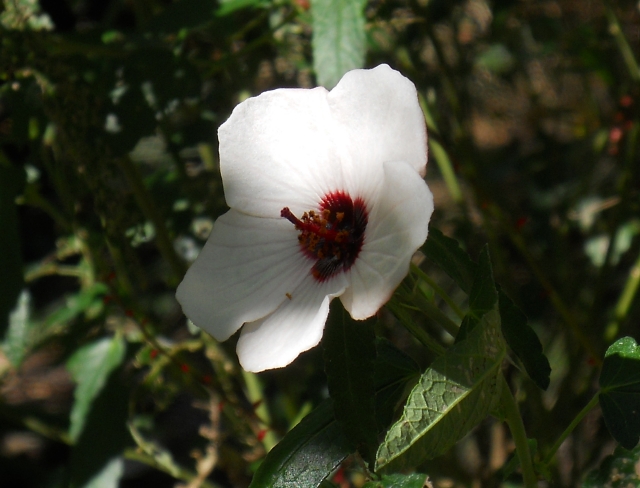
Strong hands steadied us, but we never saw their faces. Our expressions of gratitude went unacknowledged. We were settled on the ship before we realized the elegant couple had followed us. We glanced their way, but they remained aloof. (Probably didn’t want to acknowledge that badly behaved American woman.)

Smolny

Smolny Cathedral

Day or night, this must be one of the most spectacular waterfronts in Europe, especially with piped-in music by Tschaikovsky. The boat idled as bridges opened to let us pass. We were mesmerized by disembodied patterns of light floating up in the night.

Around a bend, the domes of Smolny Cathedral glowed, lit up against a dark sky. We said we had to see it by day. But next day, when we looked on the map, it seemed too far for us to manage.

You’d think, at three am, we’d take a taxi back to the hotel, but the taxi drivers looked baleful and the empty streets looked petty safe. Besides, how could we communicate?

R3BronzHrsmn

The Bronze Horseman, statue of Peter the Great, inscribed Petro Primo Catharina Secunda MDCCLXXXII in Latin  on one side, Russian on the other. The rock, 1250 tons, largest ever moved, took 400 peasants 9 months of manual labor to bring it from Finland where it was found half buried in a swamp

We turned to go, and we saw the magnificent Bronze Horseman. I can’t imagine, as we sprinted for the boat,  how we could have missed that mammoth statue of Peter the Great bathed in blue and mounted on a monumental rock, Thunder Rock, it’s called.

Here is Catherine the Great’s tribute to Peter the Great, posthumous gift from a young German teenager turned Russian empress who won the hearts of her people by embracing all things Russian, to a mighty tsar who turned Russia’s face to the west. It took years to design and build. It’s a masterpiece of design and engineering.
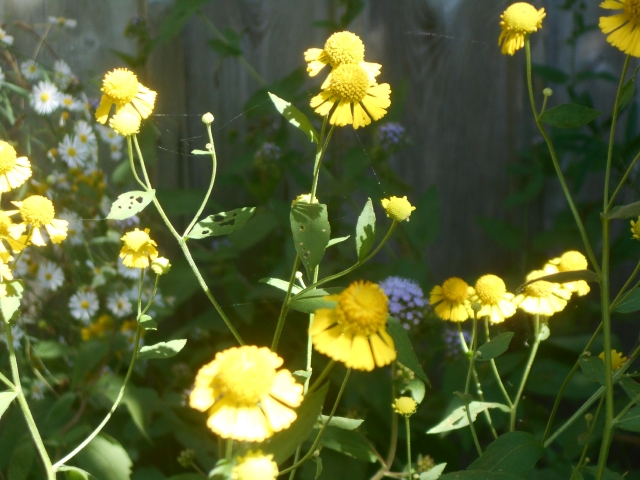
The walk back was easy. We kept our eyes on St. Isaac's dome. Picture taken the previous day
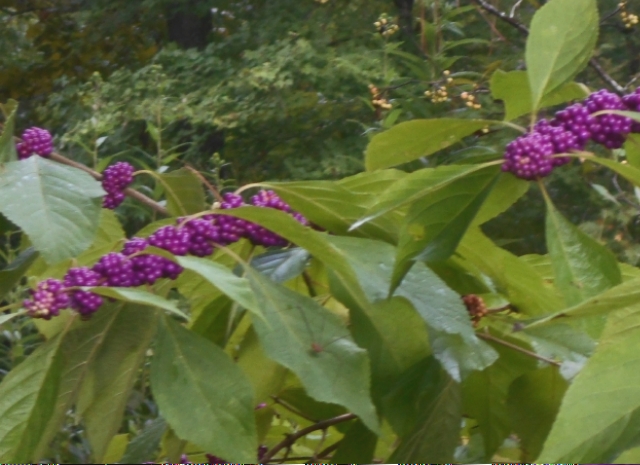
The walk back was easy. We kept our eyes on St. Isaac’s dome. (Picture taken the previous day)

We were confident we knew the way. It was a short walk. We passed a young woman in peacoat and leggings, and then a man in jeans and leather jacket, each walking alone, in no particular hurry. Otherwise the streets were deserted. We felt comfortable enough to cut a corner through a spacious park.

We had a cup of tea and a nice chat to celebrate our return. We said we didn’t think our husbands would care for this kind of adventure.

This folk dance presentation -- in a palace, of course --was a lot of fun

This folk dance presentation — in a palace, of course –was a lot of fun

Postscript: From then on, we took taxis to evening events. We took the precaution of having our hotel do the booking and tell us what the fee would be. This was a wise move. On one occasion the driver could not read our tickets. We did some sort of opaque polyglot back-and-forth, like an Abbott and Costello routine, but we never did understand each other. Finally, he called our hotel for directions. When we wanted to return, we depended on the good nature of a concierge in another hotel to summon a cab.

Posted in Russia, St. Petersburg, Uncategorized | Tagged , , , , , | Leave a comment