St. Petersburg II: Heavenly Coffee and Historical Whodunnits

(Go to Peterhof and Catherine Park for pictures and discussion about these gardens.)

We were staying at Herzen House on Bolshaya Morskaya. (Remember those names, they have a nice ring, don’t they? and they figure into our Historical Whodunnits.) Herzen House is a cozy place, reasonable, centrally located and very well run, with a full complimentary breakfast and sweet porridge that tastes like rice pudding, and gray coffee, and good tea and cookies all day long.

Bolshaya Morskaya, oil painting by Alexander Karlovich Beggrov 1878

Bolshaya Morskaya, Alexander Beggrov, 1878

Now, Gostiny dvor, the covered shopping yard on Nevsky Prospekt doesn’t figure into our historical whodunnits, but we should mention it because it became our anchor for the week. Gostinka, as Russians might call it, is where we met for tours and where we caught the metro and the bus.

It’s probably the oldest and largest shopping center in the world. (And we thought Mall of America was top banana.) Inside are no-frills concessions on bare concrete floors, though the classical 18th century exterior has a certain frayed charm. But who cares about architecture. The vending-machine coffee smelled  heavenly.
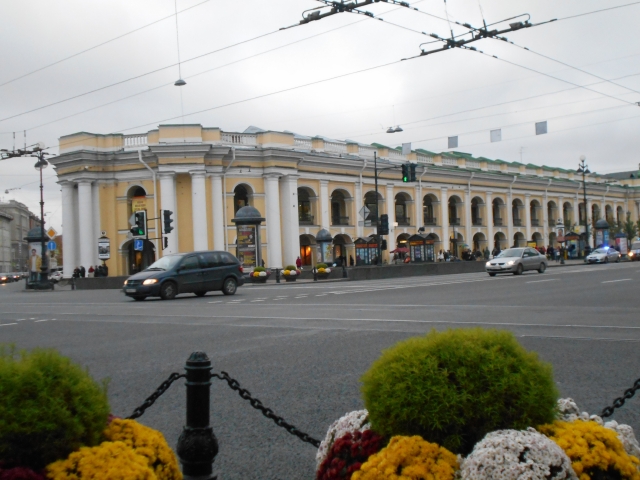
Gostiny Dvor

Gostiny Dvor from across Nevsky Prospekt

Why don’t you try some? Susan suggested, ferreting out some coins that might or might not work. We pondered the couple dozen push-buttons labeled in cyrillic. What do you want? she asked. I have no idea. I can’t read that list. Just punch the same buttons as “that woman” in front of us. (Did I detect a subtle rolling of the eyes? Nevertheless, Susan was game.)

On the alert, but casual, like a trained agent, Susan scrutinized “that woman’s” every finger-touch, committing each to razor (I hoped)-sharp memory, yet managing to keep our target oblivious of  surveillance. When she left, Susan deposited a random collection of coins. With precision and speed, she duplicated the pattern as only a trained agent could.

Then the agent and her assistant lost their cool. In anticipation of – what? — we bent near-double over the low spigot. As liquid poured out, we could hardly believe that Susan had cracked the code. The coffee tasted as heavenly as it had smelled. In fact, retrieving coffee may have been the coup of the week.

Aleksander Herzen portrait by Nickolai Ge 1864

Aleksander Herzen portrait by Nickolai Ge 1864

Every place in this town has an ancient footnote, maybe several. Finding the connections is like following historical whodunnits through the centuries. Take the Herzen House–Bolshaya Morskaya–Tolstoy–Church on the Spilled Blood nexus.

They tried to shut Aleksander Herzen up by regularly exiling him from St. Petersburg, but he wouldn’t quit promoting his radical socialistic ideas on farming and freedom for serfs. He and his compatriots — Pushkin, Gogol, Dostoevsky, Turgenev, Tolstoy — were among the shining stars of Russia’s golden age of literature in the 1840’s. They were all censored.

Sometimes brutally under Tsar Nicholas I who ramped up the secret police and restored the death penalty to stamp out new ideas that had blown in from the west. His misguided wars killed millions of serfs and his backward economic policies were a disaster. But Nicholas had the luxury of dying comfortably in his bed.

The Arrest of the Propagandist, 1880-89, courtesy www.ilyarepin.org

The Arrest of the Propagandist, Ilya Repin

Today, the world knows the names of these once persecuted writers, but it has largely forgotten about Tsar Nicholas I.

Aleksander Herzen is revered today as the finest political writer and philosopher of the era. Russian universities carry his name, as does our hotel. The perennial exile, who wrote newsletters and broadsides from London, lived here with his wife and son for a year in 1840.

Leo Tolstoy, study by Leonid Pasternak (Boris' father) 1908

Leo Tolstoy, study by Leonid Pasternak (Boris’ father) 1908

Now, Bolshaya Morskaya, as we have mentioned is the street address for Herzen House. It also happens to be where callow socialite Princess Betsy lived, and where Anna’s and Vronsky’s delicious tete-a-tete took place during a particularly stifling, upper-crust soiree.

Pretty shabby, you are thinking, mixing fiction and fact in a historical whodunnit. Well, yes, that was a crafty geographic way of linking Herzen and Tolstoy. Readers of Anna Karenina may remember landowner Levin’s frustration with unproductive farming methods and his struggle to inspire feckless serfs. Here, Tolstoy, a good friend of the “brilliant” Herzen, is promoting Herzen’s ideas in his fiction.

Alexander II, 1818 to 1881

Alexander II, Emperor of Russia from 1855 to 1881, one of the greatest reformers in Russian history, known as Alexander the Liberator to his people

Which brings us to Church on the Spilled Blood. Nicholas’ son, Alexander II, didn’t have the luxury of an easy death.

We took countless record shots of the elaborate onion domes that pierce the sky wherever you go in historic St. Petersburg. Close-ups. Long shots. From the garden. Along the canal. At dusk. At high noon. In sunshine or under clouds. My, did we have records, none of which capture the splendor of this Church of the Resurrection of Christ, more colloquially known as Church on the Saviour of Spilled Blood, or simply Spilled Blood.

Mind-boggling detail on the domes

Mind-boggling detail on the domes

Inside, the church dazzles with light and color. Walls and ceilings are covered by huge mosaics of biblical themes so detailed they look like fine paintings framed by lovely patterned borders. Why such splendor teetering on the edge of a canal?

The story begins with the crowning of Alexander II. His accession to the throne kindled maniacal joy in the country. Here was a ruler people could worship, a kind son taking over from a hurtful father.

The artistry of mosaic taken to grand heights

The artistry of mosaic taken to grand heights

A reformer, too. Had he lived, he might have altered the trajectory of Russian history.  Two days before he died, he planned to announce the formation of a duma, or parliament, a radical step that could have moved the country toward greater political stability.

He took time to listen to Herzen’s and Tolstoy’s ideas (actually commuted one of Herzen’s frequent exiles) and sympathized with the serfs. They had become slaves, freely bought and sold, strong young men and nubile women favored on the auction block, used as collateral in card games, sent off to war, families broken, the aged tossed out after years of service.

In 1861, two years before Abraham Lincoln, or The Great Emancipator, freed American slaves, Alexander II freed Russian serfs. This was no tidy Emancipation Proclamation. The decree was long and confusing. Serfs expected full freedom and land. Landowners didn’t want to lose land or serfs. Magistrates were sympathetic but powerless. Nobody seemed to be in charge.  (Can we say that there are some parallels here with America’s experiences?)

Mosaic or Painting? Can't tell if you don't know

Mosaic or Painting? Can’t tell if you don’t know

Despite reform, anarchists remained impatient and bold, and Alexander was their target, though severa attempts on his life had failed. Finally, in March 1881, a member of a terrorist group, The People’s Will, threw a grenade at Alexander’s coach. Alexander was unhurt.

Instead of turning the matter over to guards, he got out of the bullet-proof carriage (a gift) to talk to the conspirators. A suicide bomber acted on this serendipitous face-to-face. Bleeding heavily from his lower torso and legs, the tsar died a few hours later, affirming a soothsayer’s prediction that he would die wearing red boots.

Like Lincoln, the tsar was deeply mourned. Here was a  tsar who had promoted local self-government and locally elected judges, abolished capital punishment, taken privileges from nobility, and supported universities. At the same time, an efficient and brutal secret police was intent on rooting out terrorism and was sending thousands, real or imagined radicals, into exile in Siberia. No surprise that this act of The People’s Will brought even more oppression to the Russian people under succeeding tsars.

Yet another face of the churchl

Yet another face of the church

Two years after Alexander’s death the magnificent church that would take twenty-four years to finish, was begun on the site of the assassination. Think about it; twenty-four years to build this church, a quick blink considering the centuries it took to build cathedrals in Europe.

We could not begin to fathom the patience and skill of fine artisans of the past, who, before they could begin work on a design, had to craft colors and tiles from raw materials, then shape and blend them seamlessly in mosaics so fine they can be mistaken for paintings.

The church was not finished until 1907, but it would be short-lived as a memorial.  A decade or so later, after the Revolution, it was ransacked and looted.
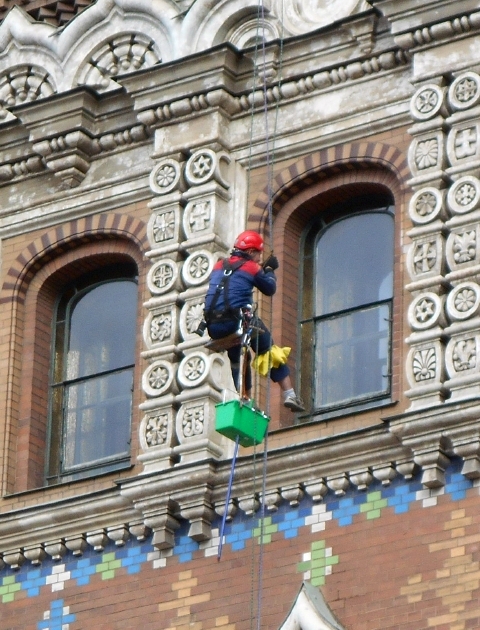
And the work goes on

And the work goes on today

In 1930 it was closed, then reopened during World War II and the Siege of Leningrad as a morgue for those who died from combat or starvation. After the war it became a warehouse and, with sardonic humor, was called Saviour on Potatoes.

Finally, money began coming in to restore the church. Restoration took 27 years, three years longer than to build. The church was reopened in 1997 but is not a full-time place of worship. It is one of St. Petersburg’s finest tourist attractions.

We were beginning to understand how the turbulent history of this country, its bold crusaders, its peasants, and its powerful rulers are represented in venerable monuments that weave complex tales over time to create a tapestry of a civilization.

A stunning painting by Mihaly Zichy of Alexander's coronation in 1856. Here, the emperor is crowning the empress

A stunning painting by Mihaly Zichy of Alexander’s coronation in Moscow in 1856. Here, the emperor is crowning the empress
 

Posted in Russia, St. Petersburg, Uncategorized | Tagged , , , , , , , , , , | Leave a comment

St. Petersburg I: First Impressions

(Click on Peterhof and Catherine Park for pictures and discussion of these gardens)

An example of Stalin Renaissance apartment buildings

An example of Stalin Renaissance apartment buildings

Dateline October 1, 2013. It was sleeting when we arrived in St. Petersburg. What in the world were we doing here, two garden lovers 90 miles from the Arctic Circle on the cusp of winter lurching into town along Muskovsky Prospekt gaping at blocky Stalin Renaissance apartment buildings during rush hour.

Then there was the luggage. Susan’s was missing from the carousel of mostly shrink-wrapped bags and mine was padlocked. Creepy.

The Nevsky never sleeps. Sunday traffic

The Nevsky never sleeps. Sunday traffic

That’s when we realized we were strangers in a foreign land. Best take an independent approach. The bag, it turned out, had been put off to the side behind a cordon of yellow crime-scene tape (Why? Didn’t care.) We grabbed it like thieves and raced out of the terminal and into our waiting cab.

As for the padlock, that was a cliffhanger. We were not sure the exceedingly business-like concierge understood what we needed, nor were we sure we understood what she was telling us. Never mind, there was still tomorrow.

Throngs even on Sunday, but the mood is happier

Throngs even on Sunday, but the mood is happier

We weren’t walking fast enough. Not for these rush-hour Russians. We were finding our way along Nevsky Prospekt, which I had naively imagined to be a quiet old cobblestone lane in a quaint historic district. Instead this was a boulevard in gridlock with smashing architectural features that we would only come to appreciate later in the week.

Our destination: Gostiny dvor, or Merchants Yard. This was a practice walk (run) to make sure we knew where to meet our city bus tour.

Apparently, we were lagging in the race. Not allowed. This was a pushing-shoving rush hour. Nobody smiled. Nobody said excuse me. Closed-faces gave warning: don’t get in my way.

Not typical. We would love to have known her story. Note the hammer and sickle on red scarf

We would love to have known her story. Note hammer and sickle on red scarf

We stopped to get our bearings and a closed-face coming from the Metro paused to (Maybe?) ask directions (Of us?), then harumphed when we mumbled something back in English that was unintelligible even to us.

For a brief, very brief moment, we caught our breath and sat down on a bench in a kiosk at the Gostiny bus stop. We smiled at a matron sitting nearby. It’s what we do at home, a smile, a nod, a finger wave.

She openly glared. Her eyes probed us from tired hair to worn-in walking shoes and back again. Was she going to tell on us? We minded our business from then on. We wondered if this was going to be a vacation in silence?

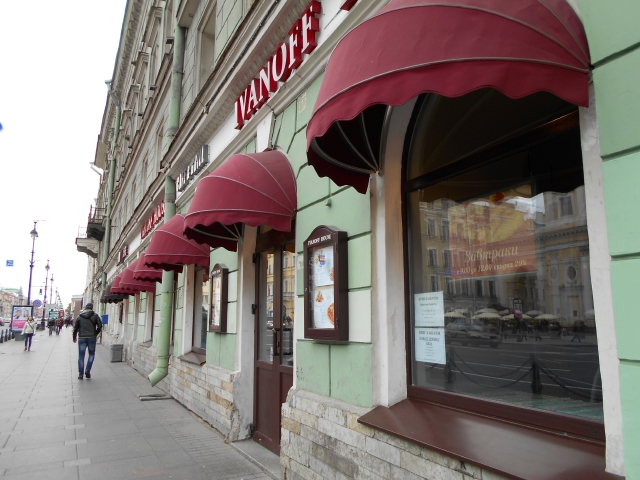
R1RestaurWe passed a restaurant with noble architecture and bright, domed burgundy awnings and a long street presence. Hunger and jet lag were catching up. Touristy? Expensive? Nice ambience? English spoken? Maybe.

We remember the interior as disconnected from the elegant façade, shadowy, muted, quiet, a haphazard mix of seasoned country kitsch and old world bits and pieces that looked like lucky yard sale finds.

Eliseyev Emporium and food mart, built in 1902, is pure elegance, worth a stop

Eliseyev Emporium and food mart, built in 1902, is pure elegance, worth a stop

The waitress seated us wordlessly and left. We fumbled with the menu, eggs, latkes and salad looked reasonable. We waited. Nobody seemed to notice us. We watched people coming and going. We waited. We got the feeling we were supposed to know something we didn’t know.
It is difficult to summon a waitress when you don’t understand the language and there is no eye contact, no smile, no glance.
Scrumptious ! Chandelier lights are reflected in the glass
Inside the Emporium. Scrumptious ! Chandelier lights are reflected in the glass
After a while you can’t quite be sure of what your waitress looked like. Every step of the way, it was a long meal, and we never did figure out the protocol, if there was one, and it took us a day to figure out how much it cost, though the exchange rate was really pretty simple.
That night Susan googled “Why don’t Russians smile?” Yes, the question is discussed on Google. We learned that Russians are a fun-loving people and laugh a lot among good friends and family but are buttoned-up with strangers. Fair enough, we said, and fell asleep hoping the padlock would be off tomorrow.

Another Nevsky art nouveau landmark, the Singer Building, largest bookshop in the city

Another Nevsky art nouveau landmark, the Singer Building, largest bookshop in the city

It was. Promptly at 10 am the hotel maintenance man dropped the freed bag like a hot potato in our room. He left so quickly we had no time to thank him or give him a smile or a tip. We guessed he didn’t expect it.

We were beginning to understand. Russians are just not effusive. They don’t stand on the “have-a-nice-day” ceremony. They are courteous but efficient about doing what needs to be done. In fact, Russian men can be quite gallant, quick to open doors or stand aside, but we never saw a smile or made eye contact, or noted acknowledgment of our thanks. Life here may be simpler if one remains aloof.

How we laughed with Caroline!

How we laughed with Caroline!

One moning as we lingered over a late breakfast we were rescued from the silence of remoteness. Caroline sailed in, brisk and hearty, as though she’d known us forever. “You must be Americans,” she said. “You’re the only ones laughing.”

Caroline grew up in England, so quite naturally she became second cousin to us. She had come in by train from a convention in Moscow intending to take care of some business and, incidentally, to holiday in St. Petersburg. She was having second thoughts.
Amazing how easy it is to establish ties with strangers in a foreign country simply because they sound like you. Does that mean we’d be ripe for a con artist one day? We spent some lovely, laughing times with Caroline; the bottle of wine we shared at the fine Italian restaurant around the corner from us probably figured into the festivity.

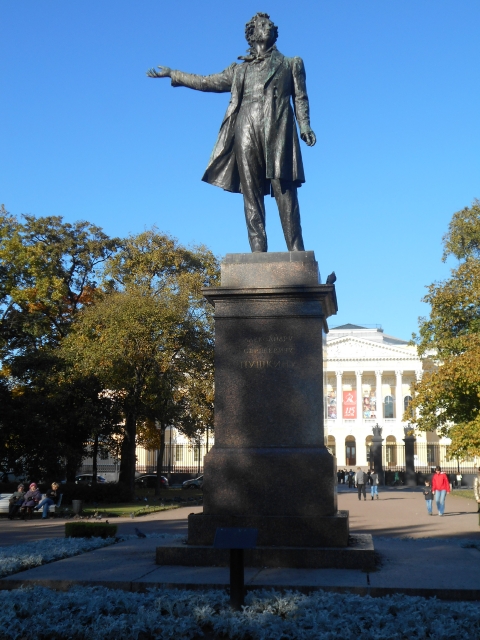
Pushkin the poet hailing a cab outside of the Russian Museum

Pushkin the poet hailing a cab outside of the Russian Museum

As time went on we would learn that deference and dignity does not preclude a certain sardonic humor that reminds us of the call-a-spade-a-spade humor of New Yorkers. For instance, you can’t go far in St. Petersburg without finding a statue of some favorite son on a pedestal, one arm flung out to the side, hailing the world. A noble gesture, you think, until someone tells you, with a sly grin, that they are really hailing a cab. (Except for the statue of Catherine the Great. Apparently women didn’t hail cabs in those days.)

The day before we were to leave on a very early flight – sigh, no sweet porridge that morning — the concierge, efficient as ever, surprised us. She reminded us to pick up the lunch-to-go she had ordered for us. How nice! Later, I happened to bump into her at the door of the breakfast room. Our eyes locked and we laughed. I had a good feeling.

Russian humor? Pectopah means restaurant and this one is a steakhouse with typical Russian food

Russian humor? Pectopah means restaurant and this one is a steakhouse with typical Russian food

Posted in Uncategorized | Tagged , , , , | Leave a comment

The Lollapalooza Month

FebnandinaFebruary 2015. We had high hopes of finding February after losing January. One balmy day and we were out whacking down grasses and seedy natives to make way for daffodils, then planning the next attack on a wayward garden. We had even recovered from weather-channel junkie-dom, or so we thought. We had great expectations for a warm and wonderful spring. Then we fell on hard times.

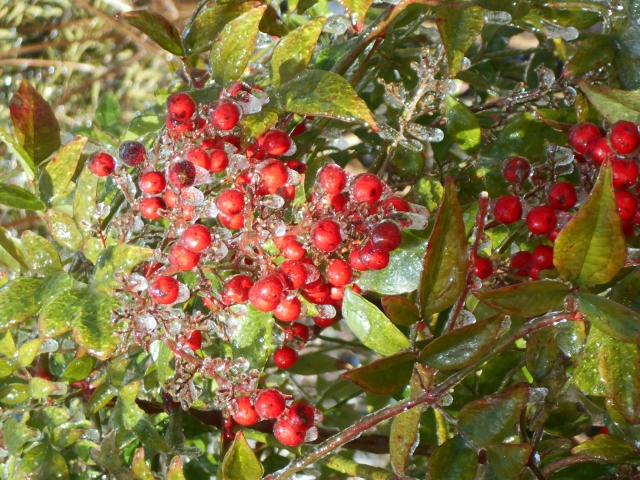
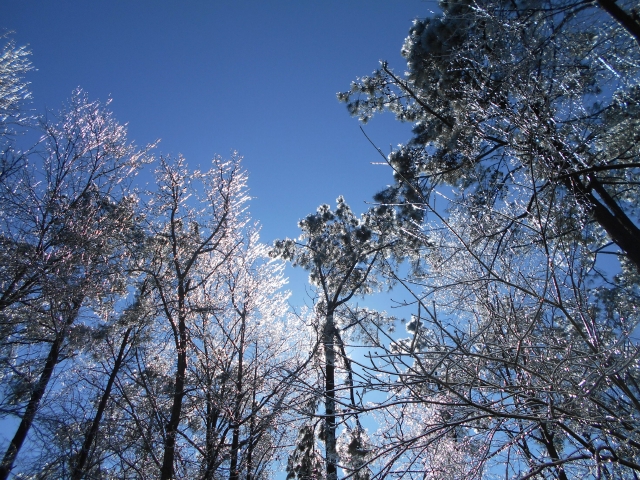
FebskycrystalsIt wasn’t much. All it took was a couple inches of snow followed by freezing rain and sleet and punishing temperatures down to single digits and we had a slippy slidey Winter Wonderland. (Funny, in that song, they’re such carefree walkers, never waddling stiff-kneed and flat-footed like penguins, never clutching each other for support, never slipping and falling, never shattering some indispensable body part.)

FebCrepemyrt2We were shut down here for a couple of days, secondary roads not clear, provided with suggestions from the electric company about how to conserve power, in particular the postponing of laundry chores if possible. Indeed, that certainly was possible, and what a fine idea. Now a benevolent sun is doing its own brand of clean up, dissolving icicles everywhere, sending them off in torrents of brittle rain showers that crackle as they fall. You northerners might laugh at our paralysis during winter storms, but we southerners are not used to such indignities.

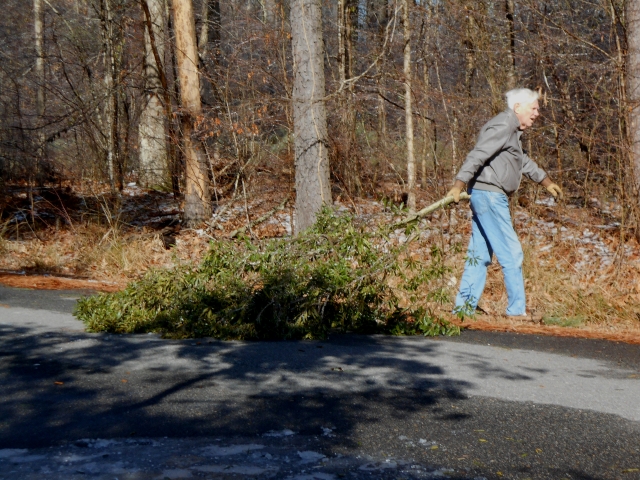
FebwasmyrcourtThe wax myrtles have lost all structure, their bowed branches blocking the driveway, threatening mail delivery and closing off our front path. Our front steps were icy mounds of snow till I chopped them away with my Christmas Hers shovel (gift tag still attached, unusual inauguration for a shovel).

This is such a singular event I take lots of pictures, while Bob fixes weather stripping, changes filters, saws broken branches and cleans ice off the car. Someone has to do the work.

FebmailboxI see their footprints on a path near the house today, stamped in the crusty snow before it became crusty last night. Then I hear them. It puts me in mind of Clement Moore’s line, When out on the lawn there arose such a clatter. . . I turn my head in time to see panicked deer fleeing a noisy fracking scene: their hooves had plunged through a sheet of ice and the rackety crackling, unfamiliar, frightened them off into the woods. Good.

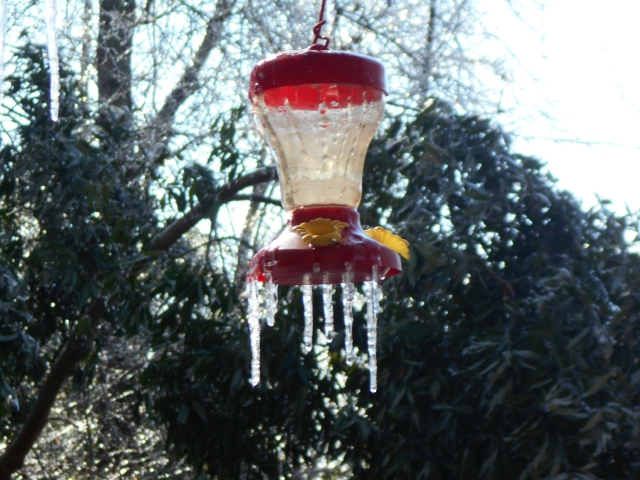
FebbobdragThe birds are frantic. We throw seed out or fill feeders, five pounds a day. They swoop and dart, barely avoid colliding with each other. They are flying into windows so often, especially on that first gray day, it sounds like pop guns going off. Not so much the regulars who know the routes and resting places, but the bad-weather throngs who are coming to mooch while food sources are scarce. Amazing that there are no permanent casualties.

FebhbdfeedicicOne warblerish bird (pine, prairie warbler?) sits fluffed and still, eyes closed, wings akimbo, on the icy floor of the gazebo. We want to cradle it, warm it on its away, at least give it some boots, but there is no point in terrorizing the creature. It’s there for the longest time before it opens its eyes, bobs its head, straightens, and flies off at some signal.

A flock of red-winged blackbirds and starlings swoops in. The birds, which multiply by the minute until treetops are crowded, displace our usual visitors, but they are skittish and heave away if we go near the door. I am always surprised at how that narrow red bar on the blackbird becomes quite a showpiece in flight.

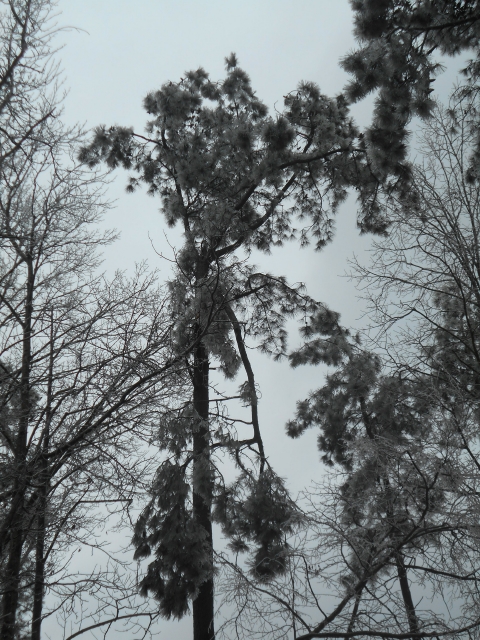
FebblkbrokpineTheir leaving gives space to the mourning doves, cardinals, juncos, chickadees, titmice, sparrows and finches who only budge when threats are dire. A single red bellied woodpecker moves in, and a single blue jay, but they are not aggressive; they are too big to peck comfortably at our feeders.

In general, it’s a pretty good-natured group, some jostling but none take notice. Part of a bird’s life. Goldfinches, who have worried away seedheads from stalks of green-eyed coneflowers, vie for the Eat-Like-a-Hog prize. Two male cardinals chase each other, the redder one clearly the bolder one. Hey, it’s ‘teen temps, can’t you forget the hierarchy and conserve energy? You’re squandering expensive black-oil sunflower seed.

FebsparkleThe squirrel has not been around. We are missing the squirrel. A day later three show up, picking through discarded shells under the feeders. We’ve finally positioned the feeders so they can’t reach them. We guess they had better pickins’ elsewhere.

Curiously, the flock of blackbirds and starlings leaves the porch floor and gathers on the sterile, snow-coverd front lawn. They mill around. No pecking. No feeding. Looks pretty aimless to me. I move too close to their comfort zone and they fly.

FebdustpinA black lump remains. I investigate and find a male starling, iridescent head shining in the sunlight, paralyzed. He watches me, probably terrified. I see no sense in becoming a threat and walk away. When I check later, he is gone. Had the flock been rallying around the disabled? Protecting it? Comforting it with their presence? Just plain  rubbernecking? That is, until danger is perceived and the flock evaporates.

FebquinceIt’s too soon to know how the camellias will react. The low temps could kill some, cause dieback even to the roots, or blast flower buds, or they might shrug off the hazardous weather. I remember camellias succumbing to a couple of hard winters in Savannah, though old and established tended to fare better than whippersnappers.

Sigh, but what about all my rooted cuttings and seedlings that looked so good in November — will they make it? I gambled on a kind winter, potting them late and sheltering them in our potting area. I watched as dry leaves, lazy on a breeze, created a fluffy mulch over them, and I was satisfied then. Will they survive January’s downpours and February’s ice?

FebCrepbrightHmm, and what about the roots of woodland wildflowers I planted late fall. . . And the rohdea from a friend . . . And . . . And . . .Come to think of it, my gardening has always been a high-stakes game.

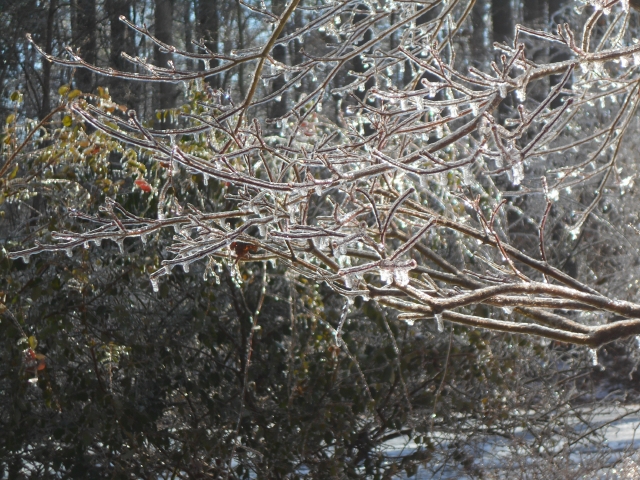
I may lose this one, but if that is the price for having these stunning, sparkly days with the dripping icicles and branches crusted in fake diamonds so bright they hurt your eyes, I will pay it.

Febicybranch

Posted in Winter, Winter Gardens | Tagged , , , | 1 Comment

The Lost Month

January. Disappeared. Wiped away. That’s why this is being written in February.

The Unfinished Path

The Unfinished Path

That’s not to say calendar days didn’t march by, one by one, as prescribed by the physics of the solar system. I’m talking here about garden days.

Let me explain. Each year, by summer’s end I’ve made a mental wish list, usually extravagant, of all we’ll accomplish during the good weather we will have in January. To be clear, nothing on the list smacks of the Boring-But-Essential: weeding, mulching, raking or deadheading.

Long shadows on grasses that are hiding a nascent field of daffodils

Long shadows on grasses that are hiding a nascent field of daffodils

This is instead a grand overhaul of the garden, most satisfying. Planting orphans that want out of their pots. Giving ne’er-do-wells a second, or a third, or maybe even a fourth try at making a go. (Do I ever give up?) Pruning opportunists. Thinning zealots. Revving up soil with compost. Mending paths.

Such ambition! It leaves me breathless. But it makes good sense. New plants will have time to settle in by summer and pruning is easier when thickets are naked. Soil is not frozen, so paths and beds can be tamed at leisure. There will be plenty of time later, in February, March and April, for the Boring-But-Essential. Won’t there?

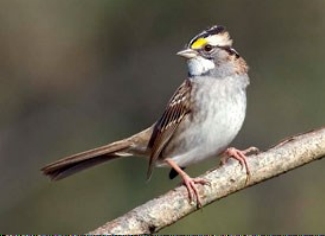
Handsome Whited Throated Sparrow by Kelly Colganazar

Handsome Whited Throated Sparrow by Kelly Colganazar

Some years we actually get to cross tasks off my list. Not this year. This year we lost January to drear: rain, cold, fog, wind, ice and soggy soil. Most days we barely glanced out the window. I forgot I made a list.

Come February the white-throated sparrows arrived. The Morse code bird we call them, though Old Sam Peabody Peabody Peabody is the usual handle. It was time I ventured out for an unvarnished look at the yard.

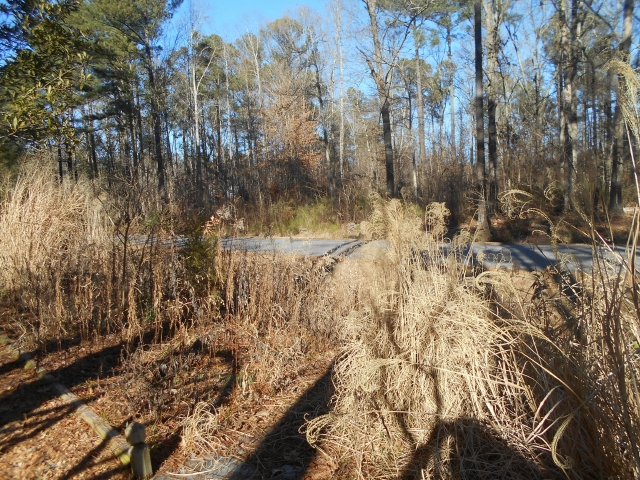
I discovered that while we were cowering indoors, January had left its signature on February’s deed to the garden.

Caution: Viewer discretion is advised. Tucked among hopeful signs are explicit disclosures of garden debris.

Camellia japonica 'Berenice Boddy'

Camellia japonica ‘Berenice Boddy’

Berenice Boddy is shining this month despite all that January has delivered, probably because she’s reasonably protected from full sun and wind.

She’s been previewing spring in American gardens for almost 70 years. A biting frost will nip at her flowers, but she always seems to have more in reserve as weather warms.

Like most camellias, she’s a slow grower and wants to reach for the sky.

Spiraea thunbergii 'Ogon'

Spiraea thunbergii ‘Ogon’

Such a breath of fresh air in early spring, ogon spirea. January has coaxed into life hundreds of flower buds burgeoning under cloaks of green. In a month the shrub will be covered in tiny stars. Though the plant is technically deciduous, its tiny leaves come early, stay late. Ogon is tough, though it grows best in good soil and reasonable moisture. I know. Deer resistant, too, and will tolerate a haircut when shaggy.

Itis 'Louisiana Iris'

Itis ‘Louisiana Iris’

New life for Louisiana iris! They were tired this fall when I cut them to the ground, but January was especially kind to them.

They drank mightily during all those rainy days and, being true water-and-sun lovers, they thrive to the point of weediness in our heavy clay soil, compost added.

Oh, but they are stunning bloomers, like clockwork in May, with hybridized Black Gamecock, a deep rich purple being our favorite.  The original copper species still graces many southern gardens. And, bless them, they are not attractive to deer.

LosMonChrys

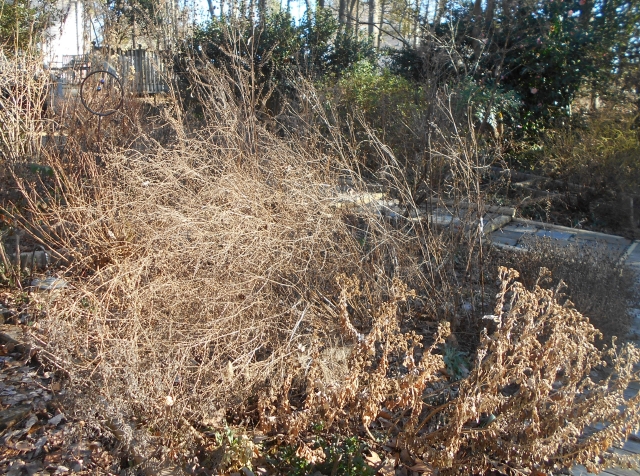
Viewer Discretion

Wasted chrysanthemums. Rich tapestries in fall, dish rags in winter. The rags protect new rosettes and camouflage hydrangeas to confuse deer.

Do you sense a winter theme running through this post?

I’m already looking for bare spots to plant the thinnings in spring, since chrysanthemums are one plant deer seem to universally avoid.

Buds on Chaenomeles speciosa 'Jet Trail'

Quince buds, Chaenomeles speciosa ‘Jet Trail’, note poinsettias in window

Not many predators can make it through a tangle of common flowering quince branches. Birds burrow in, safe, spend time loafing between trips to our bird feeders. January brings the first flower buds, which will open until May.

This one’s planted too close to the house — it was only supposed to grow 3 x 3, not a vigorous 6 x 6. Guess I shouldn’t have believed the books. Judicious pruning necessary annually. Oh well.

Ilex x verticillata "Sparkleberry' (hybrid holly)

Ilex x verticillata “Sparkleberry’ (hybrid holly)

Buds come in and berries leave. There are still masses of berries on this Sparkleberry, a female deciduous holly, but their numbers have been thinning since the first of the year. Though we rarely see the mockingbird in winter — he never announces his presence — we have noticed him methodically stripping the shrub. So far, his ownership of berries is undisputed except by a squirrel who is not shy about checking berry-status regularly.

Kerria japonica 'Pleniflora'

Kerria japonica ‘Pleniflora’

Kerria, now here’s a workhorse that even January’s nasty weather could not dampen. Its erect green stems brighten the garden all winter. Deer are ambivalent, choosing the newly planted or easily accessible for grazing.

Once established, kerria becomes so dense, we hardly notice a nibbled stem. Our plants grew from plucked-up stems that were thicketing. Butter yellow frilly flowers last a long time in spring.

Viewer Discretion

Viewer Discretion

This year’s winter garden décor for azaleas. Last winter it was Irish Spring soap-on-a-spike which kept deer away for most of the year, though squirrels nibbled the soap-sicles and occasionally dislodged them.

I’m hoping, when we trash this décor, the azaleas haven’t drowned in winter downpours. Once freed up, the azaleas will have to be sprayed till they bloom. After that, they’re on their own.

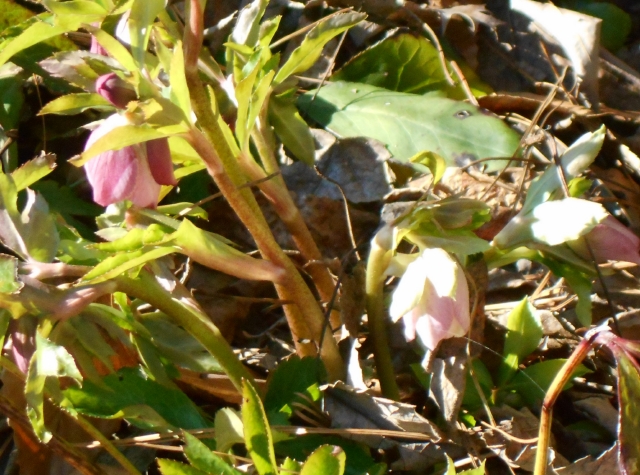
'Hellebore orientalis

‘Hellebore orientalis, Lenten Rose

So, the hellebores are arriving despite nasty weather. They’re never-fail, charter members of the Old Postman’s Motto Club. Usually I fertilize them on balmy January days when I see stirrings. This winter I forgot I had hellebores. Tattered leaves still need pruning, one of those BBE jobs. They thrived in the shade of this high-and-dry-but-composted bed until we lost the hawthorn. Maybe the spice bush will begin to gallop and give them relief from summer sun.

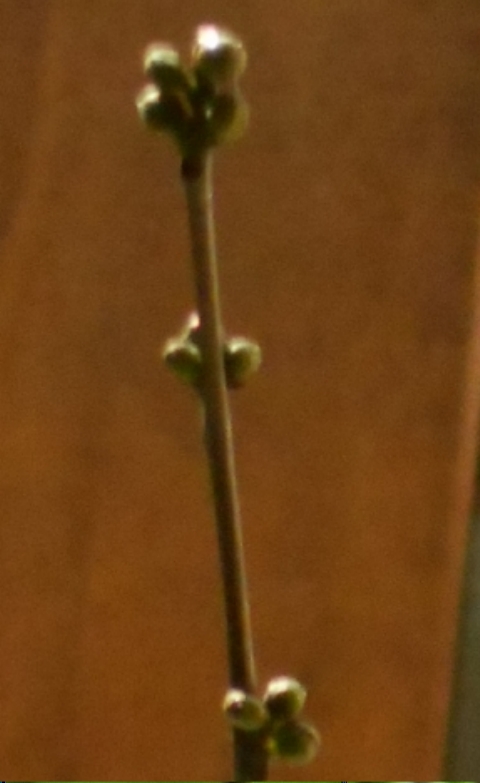
Lindera benzoin, spicebush buds

Lindera benzoin, spicebush buds

Spicebush flower buds plump and green but so small they are easily overlooked outdoors. I brought them inside to photograph.

In another month they will wrap the shrub in a haze of tiny yellow-green blossoms. These are followed by red berries in summer on female plants. Our sole male, pictured here because his buds are a soupcon bigger than hers, does the pollinating.

A walk in moist woodlands is made more delightful when aromatic leaves of this native are crushed to release their fragrance.

Bonus: The plant is host to the spicebush swallowtail larvae, whose parents we enjoy in summer.

Viewer Discretion

Viewer Discretion

Tattered view from the window, stark reminder of BBE. I postpone deadheading and tidying to give birds food and cover and protect plants from deer. Fun to watch goldfinches balance on bobbing seed heads.

What I managed to cut down this fall I strategically arranged over seedling dianthus — after I was lax and found that deer had gotten first crack. Regrowth made it through January with flying colors, though.

Harbingers of spring

Harbingers of spring

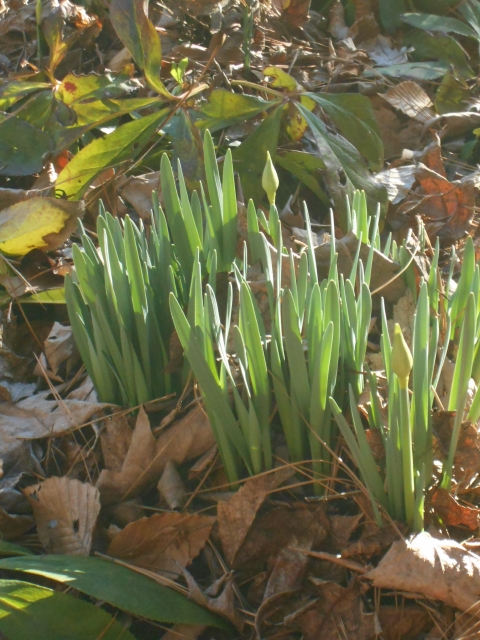
Daffodils! Now why do they wake in January? Who is thinking about daffodils in January? Surely, a little more slumber would bring brighter flowers.

Apparently not. They’re popping up on schedule, buds too, and as usual I’m behind hand.

Daffodils scattered in the sprawling bed that fronts the road should have been fertilized last fall, but there was too much spent foliage from wildish plants left for birds.  After my discovery walk in February we spent the first warm sunny day chopping and clipping and hopscotching over hopeful daffodils.

Ilex s 'HL 10-90' Christmas Jewel TM

Ilex s ‘HL 10-90’ Christmas Jewel TM

Christmas Jewel holly, heavy-berried, native to South Carolina, spinster female, may be hardy to zone 6. January let it be, so it is still a treat for our eyes, though apparently neither deer nor birds consider its soft foliage and bright berries treatworthy. Stringy growth gives it the gawkiness of a teenager, but we are hoping to see the pyramidal shape emerge in a few years. It should make a show at 10 feet by 3 feet.

February may have come in a little like a lamb, but lately it is baring its teeth like a lion. Taking lessons from January?

Posted in Native Plants, Winter Gardens | Tagged , , , , , , , , , , | Leave a comment

The Blizzard of 2015. . .

. . .And Other Winter Snows

We were treated like some kind of heroes.  For no particular reason, except that we had weathered the blizzard and come home to talk about it.

Stems of native wisteria, foreground looks like umbrella spokes

Stems of native wisteria, foreground, look like umbrella spokes, 2010

The weekend before the great storm,  fifteen of us had come together at our son’s family home in the Boston suburbs to celebrate a late Christmas. Drinks in hand, jolly in the warmth of the grand fireplace, we watched snow flutter as if from a snow globe, while the grandchildren made snowballs. We remarked on what a pretty White Christmas we were having in January, a true Norman Rockwell moment, and how it would all be gone by the time we were going home.

Despite the usual hyper-predictions, we were somehow unaware of an approaching blizzard. We took this eight-inch prelude as a serendipitous gift, presented solely for our jolly gathering. But it was only a teaser.

An ironic salute to winter

An appropriate salute to winter, 2010

We left the Boston area on Monday, just as barely visible ocean-effect flurries  skimmed the windshield. No chance for our flight out on Tuesday, or even Wednesday, so we did the next best thing.

We hunkered down in our daughter’s family home near Manchester, kept watch at the windows, and toasted in the heat of their blazing pellet stove.

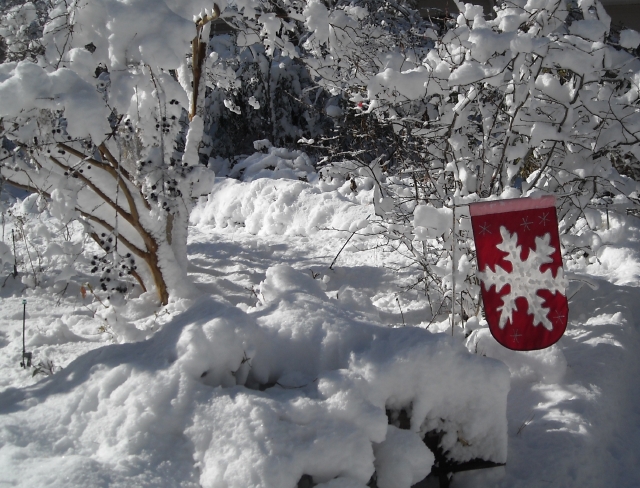
The blizzard was not particularly photogenic. Fine dry flakes collected into abundant but light snow that caused little damage to plants, was easily ploughed into dirty piles that were then trucked to wherever. But it started me thinking about winter’s pranks and masquerades.

Our elf on a pedestal looks like he's been in a snowball fight -- and lost

Our elf on a pedestal looks like he’s been in a snowball fight — and lost, 2010

The slide show presents a collection of images of winters past and present and the notes below tell of winters’ tales.

The bonfire on the porch was put together by our enterprising grandson, who had figured if eskimos could make a fire in the snow, so could he. He was smart enough to borrow a couple of pieces of slate to insulate the wooden porch floor from the fire pit.

The glowing light and the “souffles” were photographed during the blizzard by my sister in New York City, though she says she’s seen better toppers. She took the pictures from inside.

Pathway to our armillary, that tiny stand in the snow

Pathway to our armillary, diminished in the snow, 2010

Ice patterns were created by Ariadne, our Greek goddess of mazes, spilling her vessel into our pond during a frosty spell about a week prior to the blizzard.

And finally, our snowbound garden was recorded during a mini-blizzard the day after Christmas 2010. Heavy wet snow caked branches, sculpting them. Under their shrouds, each tree wrote its signature.

Look for twisty branches on the willow oak by the fence. Traceries of lace on the crabapple near the bench. A crepe myrtle branch bowed over garden seats, its seed pods poking through snow like scattershot. The wild, sticky stubby hairdo of the fringe tree, a tangle we’d not noticed before. And the Japanese snowbell drooping over the gazing globe, its vase shape misplaced.

After every storm we find branches torn or broken. Crowns of trees, deformed, give us hours of pruning and years of waiting and hoping.

But these masquerades always bring surprises.

This slideshow requires JavaScript.

Posted in Blizzard, Winter, Winter Gardens | Tagged , , , , | 1 Comment

We Left Our Hearts. . .

In San Francisco

Top sight on Haight? Just above the unparalleled Piedmont costumery. Photo by Susan

Top sight on Haight Street? Just above the unparalleled Piedmont costumery. Photo by Susan

Dateline June 2014 It was a perfectly lovely adventure. We stayed in Haight-Ashbury in the Metro, a quiet old neighborhood hotel. We prospected the city by bus, BART (Bay Area Rapid Transit) and foot. We were looking for gardeners’ gold, and once we learned the lie of the city (on the obligatory bus tour) and had lunch somewhere on Fisherman’s Wharf (the obligatory tourist stop), we beelined to the most extravagant garden and playground in town: Golden Gate Park.

And what did I have? The SF Special: yogurt, fruit and granola

And what did I have? The SF Special: yogurt, fruit and granola

On the map it’s long and skinny, three miles by only a half-mile wide. We could walk this easily, couldn’t we? We left our hotel early, in high spirits and high sunshine. Self-discipline kept us on the mark and off the big toe of Buena Vista Park on Haight Street, though the steep climb through new (to us) plants under blue skies would have given us commanding views of Golden Gate Park. Sensibly, we substituted a hearty breakfast at The Pork Store Café—it got big pluses from people in the hotel lobby.

The park looked bigger in real life than on the map. Traffic buzzes by and paths meander through rolling woods and greens. In sunlight the glass-and-filigree Conservatory of Flowers razzle-dazzled. We could have been on a set of Downton Abbey. We lingered, parsing the outdoor plantings, loathe to move on.

Grand, yes, but a gardener's work is never done. Photo by Susan

Grand, yes, but a gardener’s work is never done. Closed on Mondays, too bad. Photo by Susan

Hard to believe that most of this park was once “outside land,” windswept, treeless sand dunes. Frederick Law Olmstead said there was no future here and turned down the invitation to create a sister park even larger than his crown jewel, Central Park. Well, the cows helped made this 1000-acre park happen.

By the time we arrived at the Botanical Garden and the Japanese Tea Garden, less than a mile in, the sun was whited out by a high mist slipping in from the Pacific. Compared to the biting soup we experienced on Twin Peaks the previous day, this was a benign teaser. Besides, we’d hit the mother lode with these two gardens, so we tarried, and tarried. You can find our impressions in Great Gardens (see Sidebar).

Blue skies smiling down on elegance. . .won't last long

Blue skies smiling down on some 16,000 windows in this 1878 structure, oldest in the park

The park really does owe its existence to cows (horses, too). And to a brilliant engineer named William Hammond Hall, a self-taught landscape architect who surveyed the park in 1871, then became its first Superintendent. In just five years he designed the park, conquered shifting sands with lupine and grasses, planted thousands of trees, and stamped it with his vision as a place where people can walk on a Sunday afternoon and lose themselves in a world of greenery.

Lush and tropical, no hint of thin, sandy soil

Lush and tropical, no hint of thin, sandy soil

Now, to give credit to the livestock. Horses pulling wagons on roads and cows grazing in meadows produced tons of manure, just the ticket to wake up sandy soil. Check the map and you’ll find a district called Cow Hollow northeast of the Park, formerly a lagoon and meadows where cows grazed and dairy farms thrived. Today, the boutique-y, bustly neighborhood we found as we walked along Union Street gives no hint of its bucolic past.

Poppies in the Botanical Garden

Poppies in the Botanical Garden

Well, W H Hall was his own man, brilliant, but irascible. In five years he was gone and Scottish master gardener John McLaren, continued Hall’s work. A much loved and respected leader, he guided the park for 53 years until 1940. His mantra: No Keep Off The Grass signs. Like Hall, he felt statues, or “stookies,” did not belong in a park for people. “Aye, then we’ll plant it ott,” he would say before hiding a statue behind greenery. A statue of John McLaren stands unscreened in the park today. Pity there is no statue to Hall.

Since 1927, the spiritual center of Russian orthodoxy on the west coast

Since 1927, the spiritual center of Russian orthodoxy on the west coast

Did we finish our walk in the park? You’ve probably guessed the answer to that. Time was short and new horizons waited around a corner. We hailed a bus going west toward the Pacific, then walked north through the Richmond District to Geary Boulevard where we found the Holy Virgin Cathedral, also called Joy of All Who Sorrow.

This Russian Orthodox Church with its five gold onion domes and mosaics of holy men above the front doors brought back memories of our time in St. Petersburg. Inside, wherever we looked, holy relics, mosaics, and fine religious paintings in the Russian tradition decorated the sanctuary. Gold leaf glowed in soft light streaming from the dome, and stained glass windows cast filtered pools.

The oldest cemetery in San Francisco

The oldest cemetery in San Francisco

At the other end of the religious spectrum lies Mision San Francisco de Asis, popularly known as Mission Dolores after Mater Dolores, Our Lady of Sorrows. It is simple and small, dwarfed by the gleaming white basilica next door. The mission is the historic and geographic epicenter of San Francisco. More or less centrally located, she’s the oldest building in the city, rising in the late 18th century as our nation was birthing, and surviving the 1906 earthquake.

We came to see the small cemetery and its quiet, old, amorphous, garden. Many years ago, the cemetery was the resting place of some 5,000 natives and early immigrants. But a growing town needed space, so skeletons were exhumed, carted elsewhere to accommodate the living.

Somehow the bird of paradise hovering seems appropriate

Somehow this hovering bird of paradise seems appropriate

Old wooden markers splintered with time, so ancient graves beneath us are unseen, unidentified. Layer upon layer of dead. Today, an Ohlone hut reminds us of the original residents and a lovely statue pays tribute to a founding Father, Junipero Serra, but neither says a word about the price paid by natives caught in the snares of colonialism.

Typically, the gravestones are 19th century. We read names and dates, and we realize we are reading history. Casey, Flynn, Murphy and McCarthy lie near Sanchez, Francesca, Navarro and Valencia. Smith, Baker, White and Weinberg share space, too. These are final faces of a Mexican territory resting along side immigrants escaping famine and following the trail of the gold rush, adults and children alike cut down early by disease.

A beautiful and powerful statement

A beautiful and powerful statement

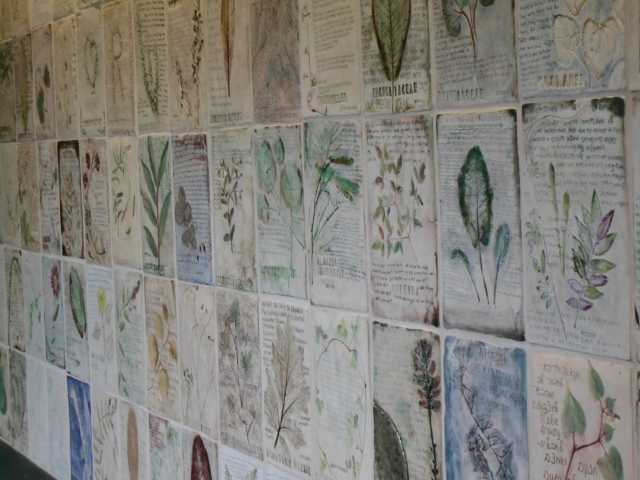
We took time to pay our respects in a different sort of garden, this one at the USF Mount Zion Medical Center. The Healing Garden there features an entire wall of botanical tiles, 500 in all, that tell stories of hope, love, despair, yearning, courage, strength, faith, and celebration of life. Ann Chamberlain, beloved San Francisco artist, gathered these poignant reflections from women being treated for cancer and commemorated them with botanical artwork. Ann died of breast cancer in the spring of 2008 at age 56.

The Maestra, in all her glory

The Maestra, in all her glory

If Ann Chamberlain’s work expresses her belief that nature and art can change lives, then Maestrapeace, the four-story mural on the Women’s Building on 18th Street celebrates the healing power of women. It’s a vibrant tribute to sisterhood and the strength of women, seamlessly linking myth and culture by endless twists and turns of ribbon patterned with—yes—flowers, bold and stylized.

Like The Healing Garden, Maestrapeace was community-supported. Only after thousands of surveys were combed for suggestions did painting begin. The seven artists and their assistants were serenaded, cooked for, and given flowers. In 1994, when the mural was unveiled, the Center celebrated the final payments on its mortgage.

Grateful Dead. . .In a restaurant bathroom. Photo by Susan

Reminiscent of the Grateful Dead? We found this in  a restaurant bathroom. Photo by Susan

San Francisco, we decided, is a city of murals. We found them in alleyways, avenues, parking lots and a BART station in the Mission district. They transform nondescript buildings and rancid alleys into eye-popping personal statements. They’re bold, psychedelic, apocalyptic, whimsical, macabre, fanciful, mellow, futuristic, angry, humorous, pastoral, primitive, sophisticated, thoughtful, in-your-face. They tackle GMOs, sexuality, war, pacifism, big business, bigotry, injustice, farming, immigration, murder and mayhem. Their manner and their message aim to puncture comfortable horizons.

We stopped for pastry in North Beach, then browsed

A great place to browse after a mid-afternoon stop for pastry. Photo by Susan

Which brings us to the City Lights Bookstore where a new age of writers was puncturing comfortable horizons in the fifties and sixties. Here is where Allen Ginsberg’s poem, Howl, (and the landmark free-speech trial– successful– that followed) jolted literary and cultural taboos. Today this bookstore that’s named for a Charlie Chaplin movie is a city landmark in North Beach. a neighborhood that has an Old World feel to it. Times are tamer, but the Dickensian ambiance invited us to slow down and poke around.

Amazing detail

Amazing detail and color. Can you spot the Daily Worker tucked into the top tier of the newsstand?

Puncturing horizons must be in the bones of the city. Two decades earlier, the WPA hired talented art students to paint murals on the walls of Coit Tower, a four-star stop on today’s tourist agenda. Detailed and clever, the murals picture life in the thirties: farm hands, meat packers, factory assembly lines, crowds on city streets, the rich and the poor. Doggone, if these kids didn’t turn the assignment into sly and not-so- sly social commentary. The murals that cover the walls are as grand as the views from the tower.

Somebody likes to paint. . .

Somebody likes to paint. . .

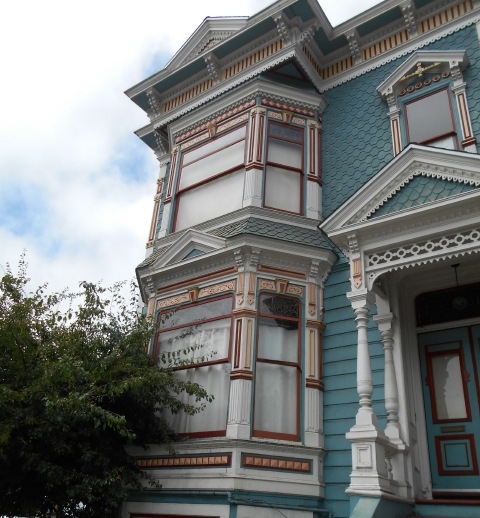
And then there was the Summer of Love in 1967, preceded by all those hippies camping in faded Haight-Ashbury who, among other pursuits, began to jazz up the facades of gloomy old Victorians, for fun and to—well—prick establishment horizons. And soon after, Painted Ladies became au courant.

We have gone afield from our garden mania, but how could we not? If you are wondering whether we crossed the Golden Gate Bridge, we did. In fog. (Multi-tasking.) Then we cruised under it on a bright afternoon to look back at this city on a bay and watch birds and kites whipping in and out of the sun.

In fairness, we had to give equal time to the Bay Bridge. As we walked along the Embarcadero after dusk toward the Ferry Building, we watched the world’s largest LED light sculpture, Bay Lights on the Bridge, twinkle against a porcelain sky.

An evening stroll along the Embarcadero. Hard to believe this is all on fill

An evening stroll along the Embarcadero. Hard to believe this is all on fill

Mesmerized by man-made stars, we temporarily forgot that under our feet lay the eastern origins of the city, once a cove called Yerba Buena by the Spanish, its marshes, along with sailing ships abandoned during the gold rush, filled with spoils to create a town.

After climbing Nob Hill we were happy to retreat to photography

After climbing Nob Hill we were happy to take a picture and move on

We climbed Alamo Square for a look at the fabled post-card Painted Ladies, decided they needed facelifts and moved on to discover some beauties on a guided walking tour and on our own. We lunched on fresh fish at that historic, bustling restaurant of Gold Rush vintage in the Financial District, Tadich Grill, and we had some great meals in local, unheralded eateries. And we confess to sampling scrumptious confections in a North Beach coffee shop of Old World vintage. Hey, we needed the energy for all the walking we were doing. Right?

We missed Alcatraz. Instead, we bus-toured to Muir Woods and saw a lumberjack’s dream and an environmentalist’s prize. Somehow, people chatter and paved walks did not conjure visions of John Muir. Maybe if we’d caught shafts of sunlight. . .

They grip those 300-pound levers and they take photos, too

Not only do they manage 300-pound grips to move us along, they take photos of tourists, too

We scrambled onto a cablecar and marveled at the mechanism, had to visit the museum that told us all about it, but we didn’t hang onto the running boards. And we climbed Nob Hill, though we didn’t intend to, and we wondered why some people would actually jog up this hill. We stopped at Top of the Mark, but we felt too hot and rumpled to go up for the view. (After freezing at a bus stop the previous night, we over-dressed for daytime; I guess you can count that as a bonified tourist experience.)

The girl with blue hair on the bus. Photo by Susan

The girl with blue hair on the bus. Photo by Susan

Oh, did I mention that we rode buses and chatted up people along the way?( Except for those who spoke in tongues. Fortunately, they didn’t seem to need answers.)

As I said, it was a perfectly lovely adventure. Some day we are hoping to go back and retrieve our hearts.


We always seemed to find our way to Union Square, where, maybe, our hearts can be found

We seemed often to find our way to busy Union Square, where hearts can be found

Posted in San Francisco, Uncategorized | Tagged , , , , , , , , , , , , , , , , , , | Leave a comment

Serendipity Twice Around

Fifteen years ago I did a piece for a garden column about three native fall-bloomers that I discovered in the rich remains of a defunct compost pile. The trio tickled me each time I passed them. They seemed to hum along like great chums in a barbershop, well, trio. Like other plants that ramble through my garden, they had settled in as wayfarers looking for new digs. How nice that they chose to be neighbors near a path.

Dependable in my summer garden: crepe myrtle, rudbeckia, phlox

Dependable in my summer garden: crepe myrtle, rudbeckia, phlox

The following summer they were gone. Not a stem, not a leaf, not a seedling. Hastily, I looked over my shoulder. I breathed a sigh of relief. There were no garden police checking out the whereabouts of the serendipitous trio I had glorified in print the previous year. Apparently, these vixens had enjoyed their fifteen minutes of fame and vamoosed. Ingrates! Plants like these make me grateful for reliable old friends that emerge on time and in place each season.

Also dependable in my summer garden

Also dependable in my summer garden

For a few years I kept a watch, anticipated, hoped, even took to excusing the weeds that grew in their place, not wanting to disturb seedlings that might be growing among them. After a while, I just forgot.

Then a funny thing happened this summer. Was it that long, cold winter (southern style)? Or was it two good years of rain after eight years of scroogy sprinkles? Or did some X factor beyond our ken have a hand? Plants that had been lost for many years became “found.” Summer bleeding heart, New Guinea impatiens, a favorite phlox, and my celebrated trio. They weren’t neighbors any more, that would be too much to expect. But they had returned.

Stars scatteronce again in my late summer garden

Stars scatter once again in my late summer garden

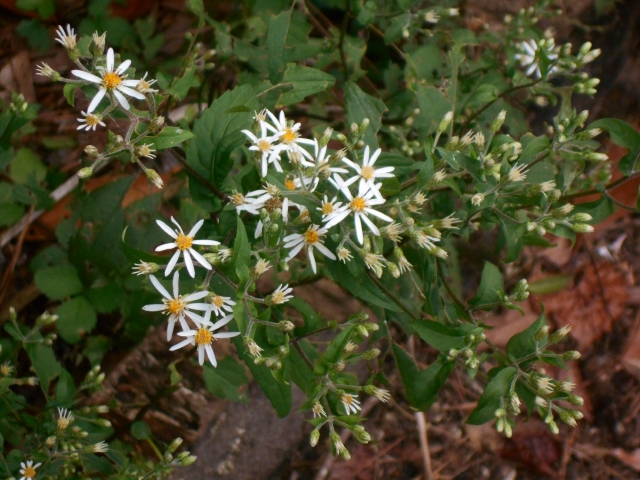
When I considered buying that small, waifish white wood aster (Aster divaricatus) a couple of decades ago, I wondered if it could survive our sticky soil. Never mind the soil, what would happen when rabbits found it? What the heck, it’s only a couple of bucks and a few minutes’ planting time, I’ll go for it.

Rabbits have to eat, too, I reasoned as I planted it in dry, dappled shade, which is what it likes in the wild.

This year it's sharing center stage with lycoris

This year it’s sharing center stage with lycoris, or spider lily, sometimes called naked ladies

It became a real success story, surviving soil and rabbits, strong and rough-hewn, with sharp-toothed, heart-shaped leaves (that I assumed were not palatable to rabbits raised on hosta) and sprawly stems that defied taming. Those starry white blooms won my heart, perhaps because they shine in fall when the rest of the garden is going to sleep.

I had to have more. I dug and divided and replanted. Not once did I consider giving this aster a taste of good soil and maybe a soupcon of sun. Good-naturedly, the divisions accepted this second-rate treatment. However, my inadvertent aster-advertising was so effective that rabbits discovered they were missing a treat. A decade of scant rain added the coup de grace and they went missing.

A stunner fighting for territory against Goliaths of the garden

A stunner fighting for territory against Goliaths of the garden

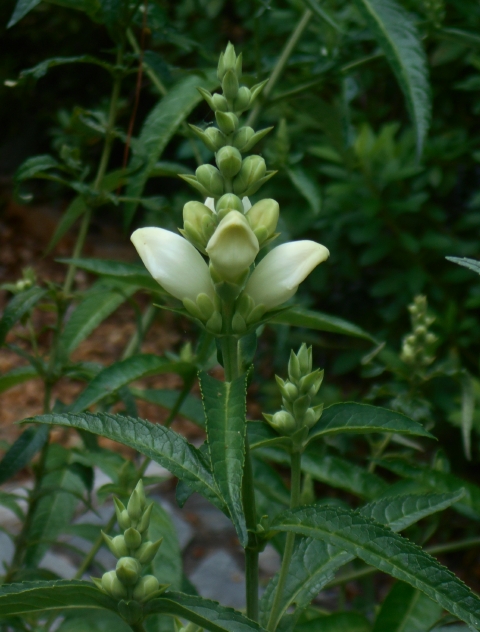
Pink turtlehead (Chelone lyonii) gets its name, say the books, because its rosy blooms look like turtle heads. And they do, except I never saw a turtle whose lower jaw stuck out beyond its head, or one who had yellow bristles in its mouth. The flowers are actually pretty nifty, the upper and lower “jaws” forming a little sac that holds the reproductive business of the bloom. The sacs seem tailor-made for nectar-sipping pollen-seeking bumblebees who practically disappear inside them as they forage. What bliss that must be for a foraging bee.

Turtleheads are arranged along short spikes, and they bloom languidly, a few at a time over a long period, travelling up the stem .

White turtlehead, (chelone glabra) a newcomer to the garden loves the moist spot it's in

White turtlehead, (chelone glabra) a pampered newcomer to the garden loves the moist spot it’s in

If you like tidiness in the garden, you will want to remove browned-out petals that distract your eye from fresh blooms, a task that takes no time at all as you walk along, but which I never do, though I might if I had notice that the queen was coming for a visit.

Pinching emerging stems in spring keeps the plant sturdy and bushy even as it grows four feet tall with dark glossy leaves. Since I don’t like to be pinched, I rarely pinch, which is a big mistake, so I am told.

When the trio existed, some stems good-naturedly jostled the wild asters, who, for their part, seemed to poke back. So much for poking and pinching. Fortunately, turtleheads are not a favored food of deer that do the poking in my garden.

I could deadhead, but they are having such a good time here I won't disturb them

I could deadhead, but they are having such a good time here I won’t disturb them

I almost missed pink turtlehead’s bloom this year. Just a hint of pink shone among the tangle of native hibiscus, swamp sunflower, pineapple sage and joepye weed, temporary holds that had grown big-time in a propagation bed.

Had I followed my plan, I would have long ago excised those big boys. The struggling turtlehead upstart would have become an unknown casualty and I would be the poorer for it.

My mystery plant, appropriately veiled by wayward heavy metal panic grass

My mystery plant, appropriately veiled by wayward heavy metal panic grass

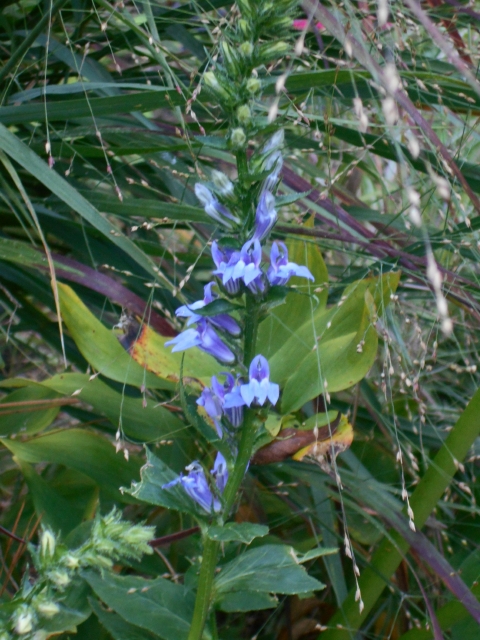
Early this spring, I had no idea that the unknown weed sprouting near the path was great blue lobelia (Lobelia syphilitica) coming home. Good garden practice would insist that I pull it immediately, but I am still kind to unknown weeds, despite the stoop-shouldered walk I suffer from routing – too late — mysterious plants that delay revealing their true identities as marauding urchins of the soil.

Curiosity piqued, I not only tolerated the invader, I supported it with a stake when it began to lean over the path, an effort that some alert deer took note of and very much appreciated. When, finally it bloomed on a compact, bushy plant (deer excel at pinching) it was so foreign to me that I had to consult my dog-earred Newcomb’s Wildflower Guide to identify it. Well, hello old friend! Like pink turtlehead, great blues have two lips that form an inviting tube for pollinators.

A bushy plant, courtesy of a deer pincher

A bushy plant, courtesy of a deer pincher. Depth of color varies but is more vibrant in light shade

Years ago, when I first met great blue, I had my choice of a pot with one large plant, or one with lots of small plants. I took the latter; if one died, I’d have plenty more to try. I needn’t have worried. As soon as that first group hit the soil, we were in great blues, forever, I thought. Those seedlings begat seedlings, which begat more seedlings, and so on. I confess to regretfully pulling some of the seedlings, easy work. Now I wish I had them back, for, like its cousin, the brilliant cardinal flower, the plant is short-lived.

The great blues that escaped the yank waltzed carelessly up and down beds, elbowing law-abiding plants with their pale blue spikes, eventually sidling up to turtlehead It was an obvious pairing, since both plants like rich moist soil and partial shade.

Sorry folks, a terrible picture but it clearly shows the rosettes that will (hopefully) carry through winter for new plants next year

Sorry folks, a terrible picture but it clearly shows the rosettes that will (hopefully) carry through winter for new plants next year

They are gone now, the stars have faded on the asters and dried seed heads and fat green pods are all that are left on great blue and turtlehead. If I’m lucky, the plants will come back. If not, I’ve harvested the fruits and sown them in a special bed with nice moist soil. Maybe next spring they’ll reward my nurturing. Or maybe not.


Just a hint of pink as white turtlehead flowers mature

Just a hint of pink as white turtlehead flowers mature

Turtlehead seed pods develop in the order of bloom, from bottom to top

Turtlehead seed pods develop in the order of bloom, from bottom to top

Posted in Native Plants, summer bloom, wildflowers | Tagged , , , , , , , | Leave a comment

A Pollinator’s Heaven

I wish we could say we were brilliant and actually planned this little bit of heaven. Like everything else in our garden, it simply evolved.

Our pre-Isabel shady nook

Our pre-Isabel shady nook

It happened this way. Several trees, their structure internally damaged by Hurricane Isabel, had to be cut down. In their after-lives they became edgers for paths, but their departure created an unexpected patch of sunlight.

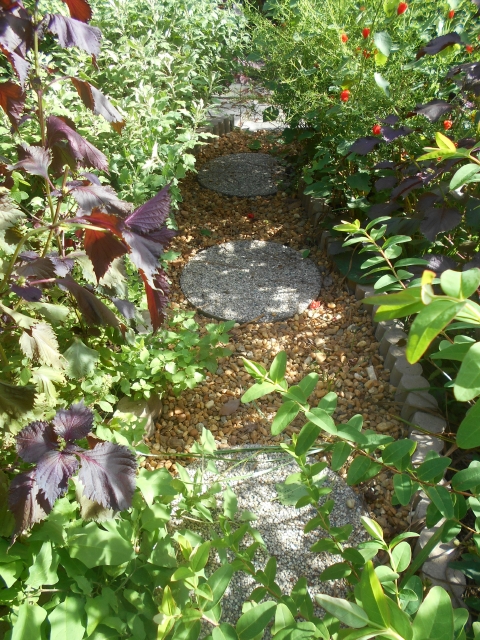
This particular plot is an irregular rectangle about 15 by 25 feet that slopes down to the dock in our backyard and is best viewed from the gazebo. It is divided in half by a small path of pavers set in river rock. To maintain the path, we have barricaded the plants on either side with sturdy, unobtrusive concrete edging.

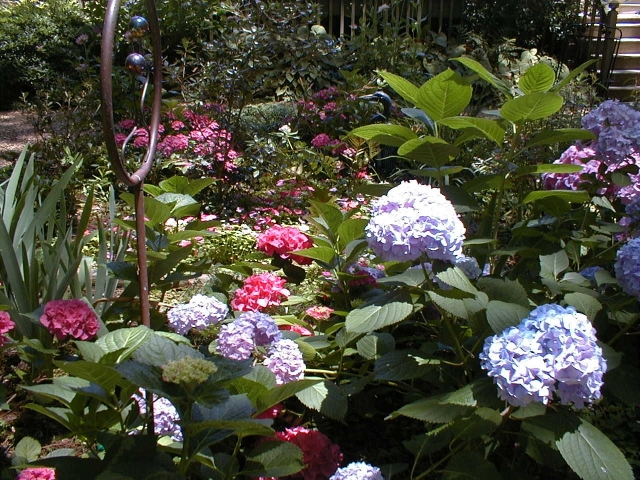
Hydrangeas loved this spot

Hydrangeas loved this spot

We had lavished compost, peanut hulls, potting soil and sand on this shady nook, hoping it would become a showpiece. And it was. Hydrangeas, hosta and fern had flourished here, but in hot sunlight they fried. It’s not pleasant to look at crispies while you are eating breakfast. We dug them out, pruned them back, and put them in our pot ghetto. Don’t worry, we said reassuringly, you’re among friends, you’ll be comfortable here, and some day we may even find a spot where you might be happy.

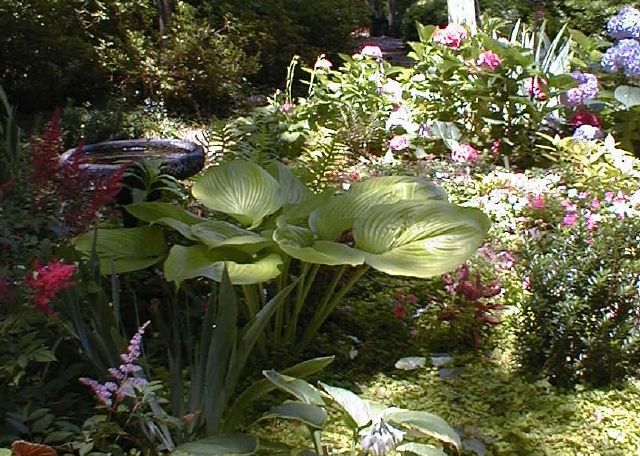
Hosta, astilbe, impatiens did fine here

Hosta, astilbe, impatiens did fine here

This left empty space, abhorrent to a plant addict who lives by the motto No Idle Real Estate.

We began by relying on our standard inventory of propagated workhorse plants — quince, spirea, carpet roses, dwarf crepe myrtle. . .

Ho hum. . . . .Couldn’t we do better with that sunny spot?

Just one more memory before we face the future

Just one more trip down lane memory before we face the future

Just as she was stifling a yawn, this addict read about the annual native plant sale at the North Carolina aquarium in Manteo. What timing! New blood! New blood! she cried, she who needs at least one of every plant rated for Zone 8, and, for good measure, as many from Zones 7 and 9 as is unreasonable and impractical.

In the next few years the addict began collecting plants and playing. Baptisia, skullcap, little joepyeweed, Turk’s cap hibiscus, woodland sunflower, swamp sunflower, cutleaf coneflower, mullein, boltonia, stokes aster, rose mallow, rudbeckia, New York ironweed,  salvia black and blue, a roadside aster, shrubby St. Johnswort, amsonia hubrichtii, and amsonia blue star.

The path is river run and stepping stones with concrete edgers to keep the trespassers out

Today, concrete edgers frame the small path of river run and stepping stones to keep wayward plants in place(?)

She soon made several discoveries. For one thing, deer ignore these plants (zippetydoodah!). For another, buzzers have their own monopolies. Mostly, they follow the sun, but sometimes only bumblebees work a plant, a day later wasps might take possession, another day moths will hover, or maybe solitary bees. All of them have one thing in common: they revel in large groupings of the same plant. Masses of blooms are easier to find than the lonely solitaire, and once buzzers are accustomed to a flower’s architecture, continually ripening banquets offer feasts for days.

For added interest, the addict threw in some non-natives, Tatarian daisy (aster), a quince with multi-colored blooms for spring interest, a couple of roses, perilla that dropped in and decided to stay, daylilies and chrysanthemums from friends, a couple of kinds of spireas, a couple of kinds of azaleas, a couple of kinds of hydrangeas. (I know, I know, we’d just dug them out, but the old crabapple that had been whacked by a second hurricane was growing back and giving some shade.)

Shrubby St. Johnswort, a native standout but not often seen in gardens

Shrubby St. Johnswort, a native standout but not often seen in gardens

If you are not already aghast at the sheer numbers I’ve listed, you must be suspecting some pretty vicious warfare in this bed, including the dreaded tottering, flopping, and sprawling. You would be correct. In my defense, not all of these plants occupied this site at the same time. There was constant rotation.

Furthermore, some in this inventory chose to barge in without my permission. Being a softie, I gave them leave, which always tends to complicate matters. Also, this was a second go-round for some plants that had not previously survived extreme soil (see Beach Sand…Clay Pots), so you must forgive my misplaced enthusiasm for compensating their descendants. Tenement conditions, yes. Unhappy roots, no.

Clockwise from bottom right: chrysanthemums, perilla with starry aster and red turks cap, St Johnswort, Joepye weed, woodland sunflower

Clockwise from bottom right: chrysanthemums, perilla with starry aster and red turks cap, St Johnswort, Joepye weed, woodland sunflower

Finally, not to be negative, but I am always surprised when plants live, so I over-compensate by over-planting. When this sunny patch opened, my priority was not planting for wildlife. (Except maybe for deer by default.) My priority was filling space with plants that would live. Memories of struggling to find workhorses that would survive in foundation plantings were still too fresh to ignore.

Digression: For the not-yet-glassy-eyed, here is still another list, this of those early survivors in pretty much pure clay with peat moss rototilled in: nandina, gold coast juniper, glossy abelia, Manhattan euonymus, dwarfs Burford and yaupon hollies and pittosporum, crabapple and crepe myrtle.

Turks cap and perilla hopped into the bed, so they stayed

Turks cap and perilla hopped into the bed, so they stayed

Let the records show that two decades later, these plants were still thriving, until we chose to eliminate certain ones because they had become bed hogs, were threatening to bury the house, were too rangy, or were perennially buggy.

Please forgive the gloating, but we are still smarting from the fact that we never caught on to the weedy wire grass that was steamrolling over the lovingly planted fescue until it was too late. As lame compensation, we planted winter rye one year, which caused the wire grass to go into a sulk, which then allowed crab grass to invade and conquer. We surrendered. It is green, it covers the septic field, and we do not wish to be drawn into the dreaded grass wars. End of Digression.

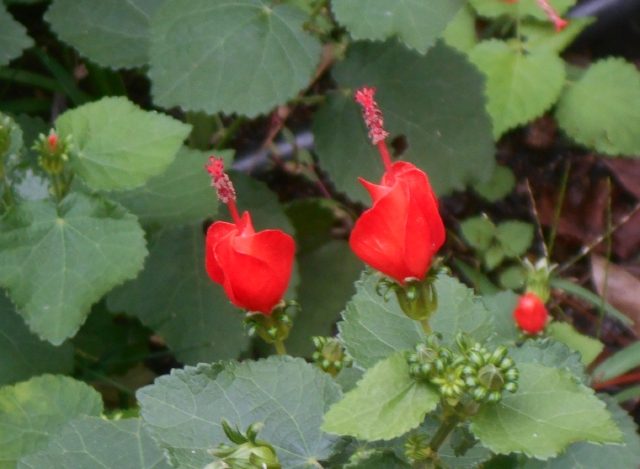
The always unfurled blooms of Turks cap remind me of pinwheels. Is the long pistil poking fun at us?

The always furled petals of Turks cap remind me of pinwheels. Is that long pistil poking fun at us?

I hope you did not skip that list of plants above; I had a reason for giving it. (Which list? you ask, somewhat addled. The survivors’ list, two paragraphs above, thank you for asking.)

Some of those plants — burford holly and crabapple that buzzed in spring, and glossy abelia that buzzed in summer — nudged us, ever so gently, into creating a little way station for wild honeybees. But the nudging didn’t work until that sunny patch opened up.

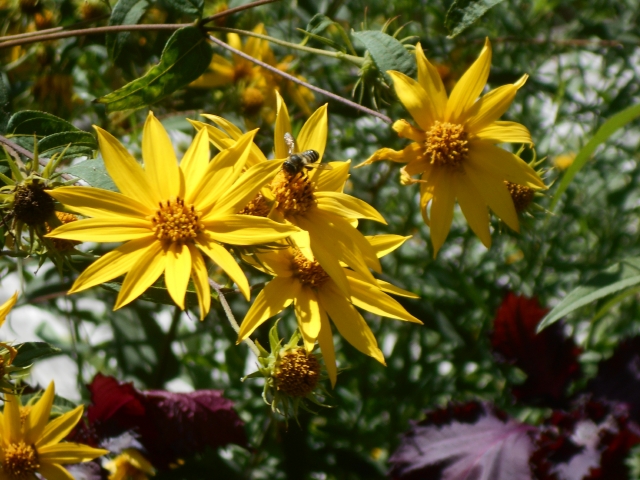
Woodland sunflower, happiest plant in the garden, goes wherever it wants and smiles all the time

Woodland sunflower, happiest plant in the garden, goes wherever it wants and smiles all the time

When we began planting, we saw butterflies dropping by. And we heard that familiar happy buzzing. This from harmless bees and wasps sipping nectar and gathering pollen. Our native pollinators were visiting and liking what they found. It seemed that in among the woods, they had found a little bit of heaven.

So here’s another list for you. This, I promise, is the final list of the final choices in the final planting. They are mostly natives, and they were chosen for pollinator appeal and robust growth that is non-scraggly (though opinions could differ on this) and dense enough to keep weed seed in its place – underground. Occasionally during the summer, as plants fall out of bloom, or just plain fall over, they will need bushwhacking, but I try to leave the seeds as long as possible for goldfinches and groundfeeding birds.

Here’s the list —

One of my all-time favorites, (butterflies, too) little Joepye weed

One of my all-time favorites, (butterflies, too) little Joepye weed

Little Joepye weed: a star in lavender, but hardly little at 6 feet, one of the best buzzers and a rich source of seeds for birds as blooms fade. I stake single stems when necessary and leave blooms until they look haggard, then add them to a brush pile in a hidden corner of the yard.

Shrubby St. Johnswort: an interloper sprung from some long-ago plant purchase, buzzes  at about 3 feet; bright yellow puffy brushes seem to come and go forever, followed by hard, smooth decorative seed capsules. Spent blooms, though small, can be distracting, but they supply welcome seedlings which I pot in case the plant decides to check out, usually during a wet winter. A close relative, Golden St. Johnswort with bluish foliage, blooms earlier, is tidier, longer lasting, but I am not sure if its appeal is as strong.

Salvia guaranitica comes to us from South America but bees don't care

Salvia guaranitica comes to us from South America but bees don’t care

Salvia black and blue: a non-native, aggressive in good soil, excellent salvia for the South, sharp contrast to bright yellows. I like to watch bees work the base of its tubular flowers from the outside. Maybe they’re claustrophobic and don’t want to poke around inside this typical mint-family bloom.

Woodland sunflower: tall and wandery, jovial, splashing clear yellow over the bed; easy to pull when it gets too tipsy but can be a bear if it roots where you don’t want it.

Boltonia: tall, sturdy, and expansive, its tiny daisy-like flowers create a poof of white, provide snacks when other blooms are fading

New York ironweed: an interloper, yes, but basically a loner, strong grower and floriferous, small purple flowers calm the bold yellows, attract hummingbirds, too, I cut stems early in season for lower bloom (when I think of it).

September blooming Boltonia seems to take forever to come into bloom, but when it does, it's a treat

September blooming Boltonia seems to take forever to come into bloom, but when it does, it’s a treat

Starry white aster: my name for this roadside transplant, an explosion of froth in fall when bug vittles can be scarce; its airy leaves are fillers in a border bouquet but it does not mind being cut back during the growing season. Recently some creature has been gnawing at it: deer? rabbit? woodchuck?

Tatarian daisy: unlike my roadside white aster, is a sturdy solid tall mass reminiscent of stern Victorian nannies. Its pale lavender daisies could be sprigs in an Easter bonnet. Like starry white aster, it blooms late in the season and, bless its heart, it never needs staking.

Native skullcap is another favorite with pollinators, grows elsewhere in our garden

Native skullcap (Scuttelaria) is another favorite with pollinators, grows elsewhere in our garden

Turks cap: not a true buzzer, but a sweet, three-foot-high hibiscus whose small red flowers look like pinwheels from above. Its long red pistil sticks out its tongue (enticing hummingbirds?). Nice nestled among starry white asters

Hidcote St. Johnswort: simple striking blooms in late spring, stems grow up quickly in summer to become a handsome shrub when pruned that brings order to the territory. Seems to age poorly after several years.

Mr. Crookneck, the Tall Mullein:  just one, just for fun, permanently frozen in an erratic lean created by my erratic staking.

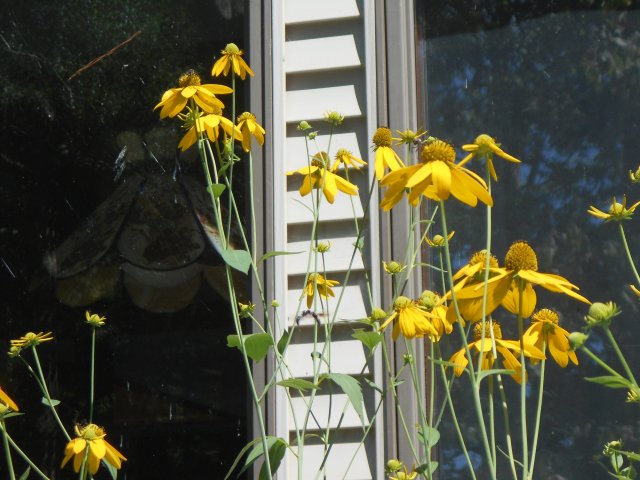
Insects and finches put on a show outside our window when they visit  cut leaf coneflower

Insects and finches put on a show outside our window when they visit cut leaf coneflower

As for the also-ran natives, spring-blooming amsonia and baptisia took up too much real estate in a summer border. Rudbeckia, swamp sunflower, native hibiscus, and green-eyed coneflower, great buzzers, live elsewhere in my garden where their aggressive natures can be ignored. Stokes aster, a nonentity with little personality, is tolerated. And two heavenly buzzers, large, white-blooming shrubs, ti ti, a plant of pocosin swamps, and clethra, or summersweet, a plant of moist wood edges would add stature and mass, but need too much space and would shade out smaller natives.

Earthtone daylilies, of little interest to pollinators, add a different flower form to the bed

Earthtone daylilies, of little interest to pollinators, are a bold contrast with diminutive native flowers

Daylilies’ range of oranges and reds, especially the tall red along the edge of the dock, compliment the natives, and chrysanthemums add tight mass, so they have a place here, though by fall,daylily foliage can scarcely be found.

Roses and azaleas, on the other hand, lured deer, so they were out. The quince has to be disciplined, but it gives cheer in spring and, unless some animal(s) steal its fruits, it provides the makings of jelly for a friend.

Seen in afternoon sun, perilla shines

Seen in afternoon sun, perilla shines

Perilla has hutzpah. It barges in annually, luring me with its deep purple pizzazz. By the end of summer, even if I manage to pull selectively, it is quite comfortable upstaging plants past their prime. I know I should trim them, uproot them, do something, but their insignificant, not particularly attractive bloom spikes attract so many different kinds of pollinators and nectar-sippers that I hate to cut the party short. With that attitude, I will always have plenty of perilla.

Recently I added a double reeves spirea with the plan that its profuse white blooms would compliment a flambuoyant show of late-spring daffodils that have been quietly multiplying.

Maybe not so pretty as in its prime, joepye weed's fuzzy brown seed heads are food for many birds

Maybe not so pretty in old age, the seeds in joepye weed’s fuzzy flower  heads are food for many birds

Today it is being smothered by summer madness, but I know it won’t take that knocking about for long. In fact, it could even muscle out the buzzers. Hmmm, I will have to think on this. I notice too, that blue mist flower, uninvited, is ready to explode into soft blue blooms that buzzers and butterflies love. I’ll wait to pull it till after it sets seed. Then I will have some next year. . . .

Oh, I said this was a final list, didn’t I. . .

Posted in Creating a Garden, fall bloom, Native Plants, Native pollinators, summer bloom, Uncategorized, wildflowers | Tagged , , , , , , , , , , , , , , , , , | Leave a comment

From Beach Sand to Clay Pots

Sandy soil at the top of the world

Sandy soil at the top of our world

Our first home and garden was set on top of one of the highest hills on Long Island. It sat in pine barrens more than 100 feet above sea level, and the breeze was lovely.

In 25 years we never saw a puddle. Flooding appeared only in isolated news reports, and we wondered why people would choose to live so near water.

The soil was so sandy, a little boy asked if he could bring his pail and shovel and play on our beach.

Sure, we said, not yet understanding the challenges of gardening where drainage is so  sharp that the grass crunches when you walk on it after a rainstorm.

Only half of that default gardening term “moist but well drained” applied here, and plants reacted with appropriate wilting or stunting or worse. Amendments like compost drained away with the water. Stingy, that soil was.

Ten years ago the canoe platform was visible; today it is below water

Twenty years ago, as you can see, the canoe platform was visible; today it is below water

Our current garden is maybe about eight feet above sea level on a canal off Albemarle Sound.

Lately we have learned that it is part of a much larger land mass that geologists say is subsiding, or sinking, even as sea level rises.

In the past two decades, we’ve sloshed through pond-sized puddles and sympathized with Noah more than once as floodwaters surged during hurricanes.

(So much for tsk tsking about living in flood zones.)

Sometimes groundwater is so high we can’t dig a dry hole. When it rains toads and frogs it turns into slime that sucks us in and mucks our shoes.

The soil is modeling clay, smooth and slabby, and we have molded fanciful bowls from it. (Note to Potters:  No need to worry. We’re too busy sloshing and shoveling to compete.)

During droughty times it cracks, and then we imagine that we are in the Sierra Nevada desert with Bogart and banditos.

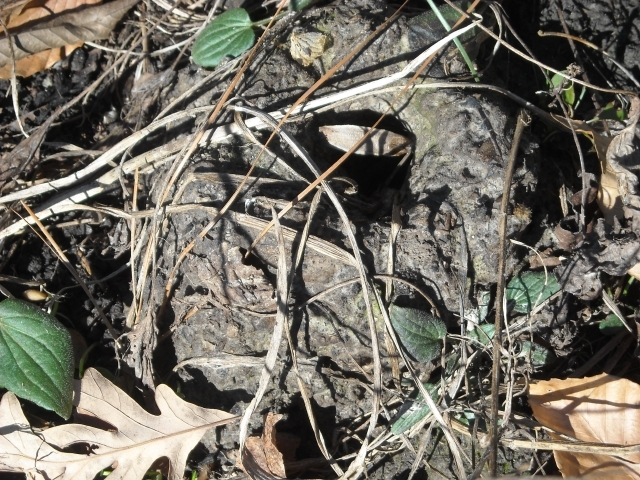
Crayfish mounds of clay are not much different from our early clods

Crayfish castles of clay are not much different from our early clods

Poles apart, these sand-clay gardening experiences.

But we knew none of this when we began clearing concrete construction debris from the property after we moved in.

After a while, we began to suspect that all lumps were not concrete. So we hurled the strange gray rocky clods at pine trees to see if they would break up.

If they did, they stayed with the land. If not, they were tossed in the concrete pile. We have always wondered how much actual concrete we threw out.

It never occurred to us that the combination of impervious clay and a high water table would create the perfect storm in our garden.

Happily, we dug nice wide deep holes for our hopeful, mail-ordered fruit trees (which were not appropriate varieties for our area, but that’s another story).

We filled our textbook holes with good stuff that came in bags and we sat back and tasted the fruit.

We naively thought that adding potting soil (left) or compost (right) to planting holes would solve our problems

We naively thought that adding potting soil (left) or compost (right) to planting holes would solve our problems

Instead, the fruit trees began to die off. Ah yes, our Cooperative Extension agent told us, clay takes a long time to drain.

You’ve created soup bowls in the clay. With so much water taking the place of air in the soil, plant roots drown.

That was not such good news.

Local nurserymen who knew the lay of our land sympathized.

They suggested creating raised planting beds, a practice that was gaining popularity in the eighties.

Alternatively, we could set single plants on top of the ground and mound soil around them. The thought of a garden with berms and mounds was not visually appealing.

Isn’t there supposed to be something called “top soil” here? I whined.

Apparently not. Needles from our spindly 15-year-old pine trees were not inclined to decompose with any speed. Instead they lay in thin, stiff mats on top of the clay.

The good part? We had no weeds. Fifteen years would go by before we had a single dandelion.

We've hunted up organic matter from wherever we could find it -- including from under uprooted trees

We’ve hunted up organic matter from wherever we could find it — including from under uprooted trees

Never mind, we said with the dizzying optimism of the unschooled. We’ll make that dirt good. We’ll add some peat moss. It’s supposed to loosen the soil. And it’s organic. That must be good.

We brought in so many bales of Canadian peat moss for an 8 x 25-foot bed in front of our house that I began to feel guilty about tearing up northern peat bogs. (Not that guilty.)

We borrowed a rototiller and blenderized the peat with the muck until we created a beautiful raised bed. Were we proud.

Like good gardeners, we sent the goop away for a soil test. The test came back saying the soil was 99.3 percent mineral. That would be .7 percent organic (for the mathematicians in the group.)

No organics! After all that Canadian bog-robbing.

The raised bed turned out to be a mirage. The fluffed-up soil settled back down to a soggy lump after a few rains.

A survivor, twenty years later

Our crabapple, a  survivor, twenty-five years later

We planted in it anyway.

Dogwoods died, cherry trees died, azaleas died. Most everything we planted died.

The scrawnies that struggled were more embarrassing than the drowned dead and gone. Despite all our work, we hadn’t dug our garden out of the soup-bowl syndrome.

We tried another avenue. We bought farmer’s soil and heaped that on. We had no idea what farmer’s soil was, but people said it was good.

It grew lots of weeds, which gave us hope. Descendants of those buttercups still appear each spring. And it tested organic. That was progress, we thought. We had been told that adding organic matter like compost was the best way to improve drainage because compost holds so much water for release later.

Do I really have to grind all this?

Do I really have to grind all this?

We became owners of a rototiller and a chipper-shredder, and we (Bob) kept them in action.

Every bit of garden waste went into the chipper-shredder and back on the land.

Then we discovered we were recycling weeds. Sigh. The weed seeds loved our mix. So we sorted garden waste from leaves and twigs before shredding, kind of like separating dark socks from white shirts when you’re doing laundry.

We added manure gussied up in bags. We collected the raw stuff from friends who had chickens, horses and sheep. After it sat a while we turned it into the soup bowl.

People told us that alfalfa pellets would hurry composting along and gypsum would loosen the clay. Maybe they did. Maybe they didn’t.

We brought in pickup truckloads of “cotton dirt,” fertile leavings from cotton milling, known for giving plants a temporary shot.

Sometimes we added sand, which could have been dicey because sand can turn clay into concrete unless you add generous helpings of organic matter. We were already knee deep in piles of ground leaves, twigs, branches so that did not apply to us.

Hurricane debris would have done wonders for our garden, but it was just too much of a good thing

Grinding hurricane debris would have done wonders for soil, but it was just too much. . .

Occasionally we paid for topsoil of questionable quality.

One day the driver of a large truckload announced he couldn’t put it where we wanted because “This truck don’t dump so good.”

We switched to potting media produced locally. Our reliable ’92 Ford Ranger trundled it into our garden by the cubic yard and this seemed heaven-sent.

We wheedled piles of grindings from tree-trimmers doing work for the power company.

We thought about chipping fallen gifts from hurricane Isabel, but the sheer volume overwhelmed us, though the combination of leaves, bark and branches makes delicious mulch that morphs quickly into compost.

Peanut hulls look sharp on paths, are good soil conditioners

Peanut hulls look sharp on paths, are good soil conditioners

When we got around to establishing paths, we topped them with peanut hulls carted from a distant peanut processor. A nice touch that is sometimes mistaken for river rock.

The hulls decomposed so nicely against damp soil we figured we were missing the boat and began using them on beds.

In the fall we piled leaves on beds and let them decompose in place. If we were ambitious and wanted the beds to look super-neat (not high priority), we shredded the leaves before dumping.

Our most successful venture turned out to be a sand-compost mixture we experimented with for a deep raised bed.

Except — without clay, it drained and dried too quickly. Well, we had the perfect remedy: add some clods of clay. Were we jumping back into the frying pan?

Heavens to Betsy, after a lashing rainfall, the clods melted and floated to the top and created cement icing. We sighed and scuffed them back in again and hoped they would behave. And yes, eventually the clay became one with the original mixture.

In our quest to raise beds we became brick layers

In our quest to raise beds we became brick layers

A second reasonably successful bed was planted where an old compost pile had been worked.

Should’ve planned on movable compost piles right away. Oh, and, incidentally, we added builder’s sand to that bed also, and to others along the way.

Still, no matter what we did, for a long time it was pretty common for heavy rains to float clay to the top of a bed and mire us in muck.

Early on we planted a grouping of three toddler-size Burkwood viburnum. Soon we began calling them Papa, Mama, and Baby. Papa was growing big and healthy, Mama was holding her own, and Baby was languishing.

Why? The bed sloped imperceptibly. Papa was planted a couple of inches higher than Mama, who was planted a couple of inches higher than Baby, whose roots were probably stuck in the muck. Such little difference in height made so much difference in survival.

They're actually growing!

Plants actually like our soil and are growing!

Most of what we added seemed to vanish under relentless heat and dry weather.

Or, the bits and pieces that remained would be glued into slabs of hard dry clay and tangled plant roots, or cemented into layers that we had to chop through.

If we cut down trees, we were left with quagmires where once their roots had moderated moisture in the soil.

And yet, doggone it, when we pulled beautiful, healthy weeds from beds with motley soil combinations, their roots chose to cling to — you guessed it — clods of clay.

You may get the feeling we were clutching at straws, and you would be right.

One day I was digging in a flower bed in daughter Susan’s New Hampshire garden. The soil was dusty and flyaway, very different from our stolid clay. Terrible, I said. You’ll never get anything to grow in this.

(Do you think this might be the pot calling the kettle black?)

The firs year our brick bed produced a hollyhock that climbed to upper-story windows

The first year our brick bed produced a hollyhock that climbed to upper-story windows

Son Steven, who is a soil and drainage expert, told me that the unruly dust was silt. Silt is an important ingredient in loam, he explained, that precious combination of sand, silt and clay that every gardener covets because plants love it.

I had never seen silt in our gardens, but when I saw how Susan’s garden grew, I, too, coveted that dust that reminded me of velvet when my fingers played with it.

We would never have velvet soil.

But a funny thing was happening during all these years.

That gooey, pasty, concrete clay eventually began to crumble. And one day, twenty-five years after throwing those clods around, we looked at that dirt and said, “This is good soil. This is really good soil. Other people said so, too.

“We were pleased and quietly proud.

Fungi like these mushrooms play a big role in breaking down organics into nutrients that plants can use

Fungi like these mushrooms play a big role in breaking down organics into nutrients that plants can use

But, as they say on Awards Night, we couldn’t have done it without lots of help.

From changing seasons — heat, sun, rain and snow.

From little underground beasties, growing, eating, tunneling, pooping, dying and decomposing.

From plant roots pushing their way through the clay, and from their dead, shed leaves breaking down.

And from a quarter century of time. Clay and compost and sand had homogenized, molecule by molecule until they merged seamlessly.

This doesn’t mean we can take a vacation. Like all soil, our soil will need rejuvenation from compost and/or mulch.

Snow in April? No, even fallen petals from our crabapple will help improve our soil in their small way

Snow in April? No, even fallen petals from our crabapple will help improve soil in their small way

And it doesn’t mean that the basic character of our soil or drainage has changed.

It hasn’t and it won’t.

In many places, the clods are simply smaller and blacker, stained from compost.

Good soil is only a few inches deep and planting holes still fill with water.

But that’s fine. We accept what we have. We work with it, plant the willing and cull the weak.

We have learned that some things, like building soil, you just can’t rush. You have to trust and be humble and patient and respectful.

Aw, gee whiz, ain’t that nice. But it’s the truth, too.

Next time we’ll skip all of the above and grow our garden on an abandoned horse farm with loamy soil. We’ll nuke the weeds with black plastic in hot sun and hire a nursery man to put down store-bought mulch and our plants will be happy as larks right away. Maybe.

Posted in Compost, Creating a Garden, Creating soil, Soil, Uncategorized | Tagged , , , , , , | Leave a comment

Evolution of a Gardener

I was completely brainwashed about pesticides back in the seventies, bought the whole post-war chemical boom as great stuff. Yet, here I was, leading walks and giving talks about the wonders of nature in the woodlands, wetlands and seashores of Long Island. Would I have used pesticides in the woods? Of course not.

Flame azaleas native to eastern woodlands do not need an arsenal of chemicals to keep them happy

Flame azaleas native to eastern woodlands do not need an arsenal of chemicals to keep them happy

But gardening was different, distinct from natural areas where a certain tolerance for casual diversity (weeds) and healthy invaders (bugs) is taken for granted. Not so in gardens. Gardening was about control, tidiness, improving the landscape. (Such hubris!) Back then, if you followed the rules, and we who were brought up in the forties excelled at following rules, you would find perfection.

It would take a praying mantis to teach me otherwise.

Praying mantis egg case (Wikipedia photo)

Praying mantis egg case (Wikipedia photo)

Years ago most gardening books promoted liberal use of deadly, all-purpose stews of chemicals that one could use to combat armies of insects and diseases. One book I read actually gave do-it-yourself instructions for mixing up a stew from, for instance, DDT, malathion, zineb, nicotine and/or sulfur, with a soupcon of fungicide added for good measure. Yummy.

If I’m going to garden, I’d better follow the rules, I thought, so I bought a bag of some pre-mixed poison. The thing is, the stuff smelled awful to me, and when I thought about it, I really didn’t want to be bothered mixing and hauling and spraying. I left the chemicals on the shelf. Lazy. Lazy. Lazy. I chided myself. What kind of gardener was I? Teams of bugs were winning while I sat on the sidelines. I finally broke down and got the sprayer out.

Female praying mantis (Wikipedia photo)

Female praying mantis (Wikipedia photo)

Doggone if I wasn’t five minutes into spraying when a weak and wobbly praying mantis struggled out of his camouflaged seat on a branch. Horrified, I watched him stagger onto my hand. This stuff is supposed to kill chewing and sucking insects, not praying mantis, I silently sputtered. Even though they eat their sisters and brothers, I have a fondness for praying mantis. I like to sit and watch one watching the world before it takes that quick bite. Those moments are a grand way to recover from a gardener’s perennial complaint, Sorbackus chronicus.

I watched as he crumpled. In an ill-thought gesture of remediation I sprinkled water on him, hoping to dilute the poison. (You may remember the accepted panacea of those heady, chemicals-are-great days: “Dilution is the solution to pollution.”) It was too late. Now, instead of watching my friend, I had just killed him. What kind of gardener was I?

EVGskullwikiAbout the same time, a scientist who worked for Fish and Wildlife told me that fungicides were some of the most deadly chemicals on the market, and a plant propagator who was a dedicated poison-sprayer learned that her child had developed leukemia. Coincidence? She didn’t think so. She put away her sprayer and I put away mine. Enough. I brought the leftover chemicals to a hazardous waste collection site. I washed my hands.

I was back to being a lazy gardener, but at least I had a clear conscience.

Contentment at the edge of our little pond

Contentment at the edge of our little pond

In my lazy-gardening mode I began to think about what our little space on earth stood for. My ponderings were not as profound as those of Walt Whitman, but they suggested new directions. Mostly I thought about the animals that rented our land for, what? Loafing. . . Refueling. . . Meeting. . . Mating. . . Birthing. . . Hiding. . . Curling up at night. . . Sunning. . . Escaping a north wind. . . Having fun. . .

Those were only the animals that I could watch easily. Under the ground, life was even busier. Each of our tenants above and below ground knew their spheres. They lined out their territories. They mapped out favorite routes. They established routines. They trusted that the land would take care of them.

Sometimes they got dealt a dirty hand (I’m thinking hurricane, tornado), and they’d have to swallow their losses without sympathy and get on with their lives without help from FEMA.

New chemicals on the shelves, neonicotinoids, easy-to-use, long-lived, beckon gardeners who want to maintain "decorum"

New chemicals on the shelves, neonicotinoids, easy-to-use, long-lived, beckon gardeners who want to maintain “decorum”

They could get a dirty deal from us, too. We are lords of the manor — and of the tractor, the bull dozer, and the sprayer, too. We could raze woods, plant grass, and scatter chemicals as we pleased. There might be a certain shared tenancy between us and them, but we held final control. We could carve up the land any way we wanted. We could bend wild nature to our will and establish decorum and order. Hear! Hear! 

Masterful artistry and control at the entrance to Goodnestone Park, but few percs for wildlife

Masterful artistry and control at the entrance to Goodnestone Park, but few percs for wildlife

There’s a hitch. Too much decorum and our tenants would leave. We’d lose all that income we took for granted: the chatter, the songs, the daily visits, the antics of new arrivals, the surprise visitors, and a hundred other mini-payments that make up their shares of the rent. And we would become slaves to the order we had so designed.

So we walk a middle line. In a sense, we backed into our casual, mostly organic, loose approach. It comes down to managing a triumvirate of soil, plants, and chemicals. Seasons and climate we can’t do anything about. Drainage and exposure we can modify, but that can take time and dollars, so we don’t waste much energy trying to rearrange the land.

Late afternoon in spring, the gate is open, we can move forward one step at a time

Late afternoon in spring, the gate is open, we can move forward one step at a time

Seems simple, doesn’t it? Improving soil, choosing proper plants, and controlling weeds and bugs in our large garden are not exactly cataclysmic goals. But doggone it, juggling them all so the garden maintains some sort of order and still plays host to wildlife is tricky. How we try to make it work is a whole other story, which we’ll tell in future posts.

Posted in Uncategorized | Leave a comment