Spunky and Pokey: Fawns of the Year

Sometimes the latch sticks, so this evening it took me a moment to make sure the gate was properly closed. When I turned to go, the fawn was standing in the middle of the path. We were about four or five feet from each other, and it did not occur to either of us to give way.

Spunky, with spots, on one of his first visits to the garden

Is that you Spunky, all grown up, missing your spots? Here again? I asked in exasperation. How many times have I told you not to trespass. You belong in the woods. I’m telling you for the umpteenth time, this is not your property, and don’t even think about jumping that fence.

With wide-eyed innocence, Spunky listened to me attentively, as if this conversation were a perfectly natural part of his day. Which it was—for both of us.

To reinforce my lecture, I took a few steps toward him. Too close. Too close. He jumped playfully, darted away, just out of reach, stopped and looked back. Well, are you coming? You betcha I’m coming, you little rascal. I’m scoping out your route so I have some idea of what your winter plans for the garden are. He frisked off, stopping once more to see if I was still giving chase. I was.

Meanwhile, on these first visits, Mom waits patiently for the fawns to follow her

Even in play he was too fast for me. I lost sight of him until we were on neutral territory (neighbors’ property). He was waiting. Ready to go again? Nope, you win, I said.

When we met last I was hunkered down sorting through deer damage in a garden bed, straw hat on my head, idle chitterings of chickadees and titmice brushing my ears. A subtle shift in light gave me pause. Was I being watched?

I was. The fawn, Spunky? stood about twenty feet away, watching me. In spite of myself I had to smile. He was absolutely endearing, legs still slightly splayed, afternoon sunlight spilling over his spotted coat, head cocked, quizzical.

Well, she’s waiting. I guess I’ll have to go now

He was quite at home, and though I knew he was just a little tyke exploring his world, I couldn’t help giving him some sassy lines. Hi, watcha doin? Plantin’ anything I might like? Will you be outta my way soon?

I gave him the blah-blah lecture and started toward him. Uh oh, she’s coming. He jumped, turned, and loped away. Far enough for safety before he turned to look for me. Yes, yes, she’s in for the chase! He was off. Another stop to check. Yes, she’s still following. I’ll fly. Sure-footed, he bounded through garden and woods, weaving expertly along a path invisible to me but well known to him, neatly avoiding trippers and bumpers that would have felled me, and leaving me in the dust.

Did he meet up with Mom later and excitedly tell her of his great escape from the crazy lady with the straw hat who talks gibberish and has no idea of how to run through the woods?
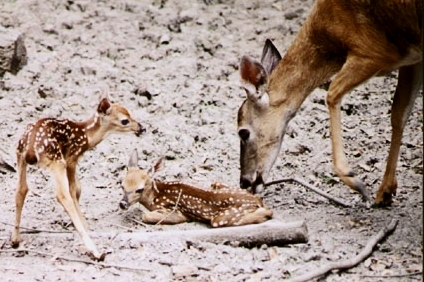
Great picture of newborns on Suwanee River Ranch, Florida, Good website for information on deer life history

I can’t blame him for thinking he owns the place. Mom brought the twins, late babies born in July, to our garden when they were just beyond wobbly. To introduce them to us?

We watch the fawns from the window while the doe watches us watching them.

While we are all watching each other, she tears a tough, strappy leaf off an amaryllis bulb and propels it to her jaws, grinds and swallows in one fluid motion. She repeats the process with another leaf. So that’s what’s happening to the amaryllis.

Moments after birth the fawns are up and starting to nurse. Another great photo from Suwanee River Ranch, Florida

Young as the fawns are, we see differences. Spunky isn’t quite sure what he should be doing, but he is having a grand time doing it. Oh, right, I’m supposed to be tasting, that’s it. He pokes around with gusto, ecstatic with the newness of it all – and the variety — plum forgetting about Mom.

Pokey hangs back, half-hearted, not sure about this big-wide-world stuff. Neither of them feel comfortable venturing more than about 15 feet from Mom. Lamely, Pokey nudges a not-very-appetizing chewed-up hosta (wonder whose handiwork that was?) jumps back in alarm when a broken stem tickles his muzzle.

That’s it. Enough of prickly plants. No more browsing. He waits, aimless, ready to leave. Whether a signal flies between doe and fawn I don’t know, but suddenly Pokey is nursing.

Meanwhile, Spunky is rummaging about trying One from Column A and Two from Column B. When he finally looks up: O boy. Me too. Me too. Mom nurses both for a few moments until she walks off, leaving the two, motionless, before they collect themselves and follow her into the woods. Spunky gets shorted, but he doesn’t seem to care. 

Every few days the doe brings the fawns back. Is she giving them botany lessons? She tolerates my presence to within a few feet, but too close, she breaks. Is she giving the fawns life lessons?
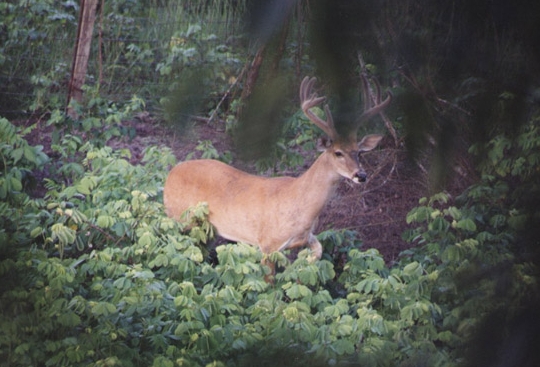
This is just about how our buck looked, smaller rack though, coming out of the woods very determined. Photo from Suwanee River Ranch

Enter the stag looking every bit like Bambi’s father. Muscular. Healthy. Handsome. With a respectable rack. The fawns stare transfixed as he approaches. Who is this big guy? Too close. Too big. Too close. Curiosity flips to terror. Panicked, the fawns flee in opposite directions, become invisible in a moment.

The stag is not interested in fawns. The doe is not interested in the stag, we hope. She easily jumps the fence and lopes into the woods. The stag follows, but the doe will have the upper hand. Will she brush him off? Hard to say. He is good looking, and he does have that studly way about him. . . . We’ll find out next April.

Pretty soon we could have a deer traffic jam in the garden. There are two other does around that we haven’t seen recently. In early summer we watched as three does (or two does and one very mature fawn) patrolled the paths playing follow-the-leader, largest doe first, smallest bringing up the rear.
Tender new oak leaves with only small amounts of tannins are one favorite among many low-fiber shoots and leaves. Acorns, too, though not a steady diet, as overload on tannins can be poisonous. Suwanee River Ranch photo

Soon we began to suspect that the small deer lived in never-never land. Uh, oh, bumped into them again. I wonder why they stopped. Hmm, they’re looking around. I guess I’m supposed to look around, too. There’s a nice patch of grass. I’ll go graze. Patiently, the two older does break stride and wait until the little one is satisfied. In their eyes, stubby grass is not worth bothering with when there are hostas and hydrangeas to be had. Where are these deer today? Is one of them the mother of Spunky and Pokey?

We may have gotten a partial answer the other day. In the morning we planted a new camellia. By mid-afternoon three deer were examining it. This is new, isn’t it? Yeah, but not too tasty. Might not taste so bad in winter, though.

Two full-grown does run off as I approach. The other goes in an opposite direction. When I check I see that it is not a doe, but Spunky chewing on a sweet autumn clematis vine I’d pulled off azaleas earlier in the day. He looks like a little kid wallowing in a bowl of spaghetti; the salad of vines and leaves hangs out of his mouth in a delicious tangle. This is good stuff.

I’m about seven or eight paces away, arms akimbo. When he looks up and sees me, he makes a heroic effort to collect the tangle in his mouth, but it’s no good. Busted again. Heavenly indulgence sinks to sheepish disappointment. Aw shucks, he seems to say. This is so good, and there’s lots of it. I can see that wariness is creeping into his spirit. Reluctantly, oh so reluctantly, he drops the feast and moves on, measuring his paces.

Deer damage, probably the work of Spunky’s mom. Note leaves are stripped but blossoms remain in tact, commonly the case. Too much aluminum in the blooms? Not enough nourishment to make chewing worth while? Unpleasant texture? Nearby camellias, gardenias and Southern Indica azaleas are not touched

When he comes up against a great log, a grandfather oak in better times, he stops. He hesitates. I know he is longing for that stash of clematis. He knows I am watching. He makes the decision. He clears the downed tree easily and becomes invisible, deep in the woods.

Spunky is growing up and soon there will come a great divide between us. Some day “he” might even be nurturing fawns of her own. Today, though, it’s the loss of clematis that consumes him. When I go to retrieve the vine next day, it is naked, stripped of leaves. He has won again.

We can only speculate on what may have happened to Spunky’s twin, Pokey. Last time we saw the fawn it still had spots. Oh well, we say philosophically, It looks like this winter there may be one less mouth. . . .
 

Posted in Deer in Garden, Hydrangeas, Summer, Wildlife | Tagged , , , , , , , | Leave a comment

Dry Leaves: Garden Heroes

A Trail of Discovery

Coins of gold, ready to fall

I began to figure it out about 40 years ago, when our kids were young and we thought we were still the bosses in the family. We were middle class America living in classic suburbia. If your lawn wasn’t mowed in summer and raked in fall, you were positively unamerican.

To keep us neat and patriotic, the town generously delivered free packages of leaf bags to residents. Then the town would designate special days to collect the stuffed bags which we dutifully lined up on the sidewalks. Special trucks would whisk said bags out of sight to be deposited, where? In the next town, for all we knew or cared.

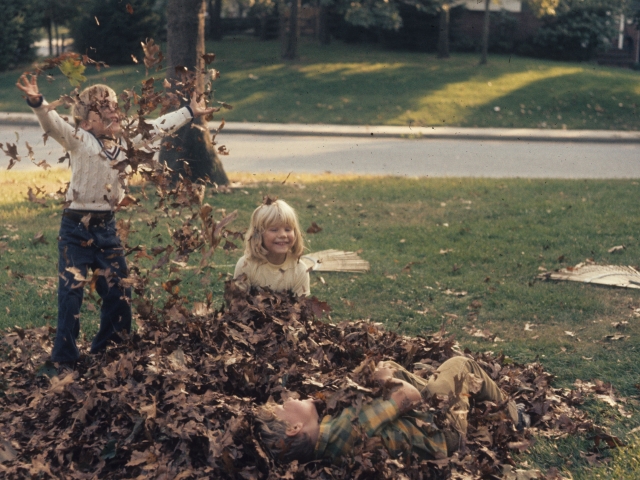
Every fall, raking leaves became a family affair, a kind of Norman Rockwell moment for our family. One year the kids raked with unusual joie de vivre. They seemed to revel in the drudgery, raking a big pile into the center of the lawn. We smiled, a bit smugly I guess, at our bright and beautiful and obedient and efficient children.

Note the tossed rakes in the background, forgotten

We’ll win this one hands down, we thought, savoring the idea of late-afternoon leisure moments. Sudden bursts of outrageous giggling brought us back to reality. Raking leaves wasn’t that much fun. What in the world was going on? There they were, our bright and beautiful and obedient children, joined by one of the neighborhood kids, burrowing and tumbling and rolling in that mighty pile of leaves they’d just raked, that pile of leaves that had been one step from bagging. There they were, scooping and tossing leaves hither and yon. When the fun was over, they raced off to another yard. Darn it, they’d outsmarted us again.

The two of us were left holding the flimsy, slippery, over-sized bags. Wait, we said, there’s a better way. How about just sweeping the leaves into the sandbox? This was a play area so-named because the soil looked like beach sand. The kids hardly ever use it these days. They can play with the leaves there if they want. The lawn will be respectable again, and we can toss the leaf bags.

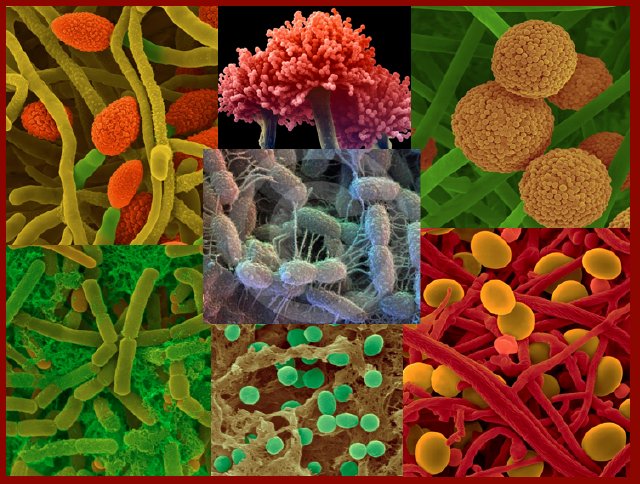
Earthworms are musclemen when it comes to breaking down organic matter into soil, but the real necessary work is done by microscopic microbes

Not sure how much the children ever played in those leaves. But a couple of surprises down the road made me think that we were on to something bigger than simply scrapping leaf bags.

It was last minute on a cold January morning. I was chopping through frozen earth to collect soil for a science program I was about to teach. Sheer futility. In desperation I tried the old sandbox. Maybe there was some loose sand lying around. I was ecstatic. In no time I had a pail of dirt. My savvy program assistant was ecstatic, too. She recognized it as wonderful fertile soil. To me it was simply dirt that had saved the day. 

Dramatic collage of soil microbes put together by Aurora MacRae-Crerar, doctoral student in Korea. Check out piremongolia.wordpress.com

The following spring a peony bloomed in the sandbox. A peony! I’d been trying to grow peonies for years, but even with amendments our sandy soil was too stingy. In a fit of pique one fall day, I had thrown the smallest and worst looking tuber into the sand pile.

After that those dry leaves became gold coin to me. Funny thing is, I don’t recall ever using that wonderful soil beneath them. I would go back and look at it and rub the velvet between my fingers and watch the worms and centipedes, but it seemed too precious to cast around a garden.

I was so protective of the miracle in the sandbox that I instructed our son, whose chore it was to mow the lawn, not to mix grass clippings with leaves. No contamination, I said.

Who knows what a 16-year-old is thinking? If he even listened to me, he probably thought I was a nut case and wouldn’t remember a word of what I’d said.

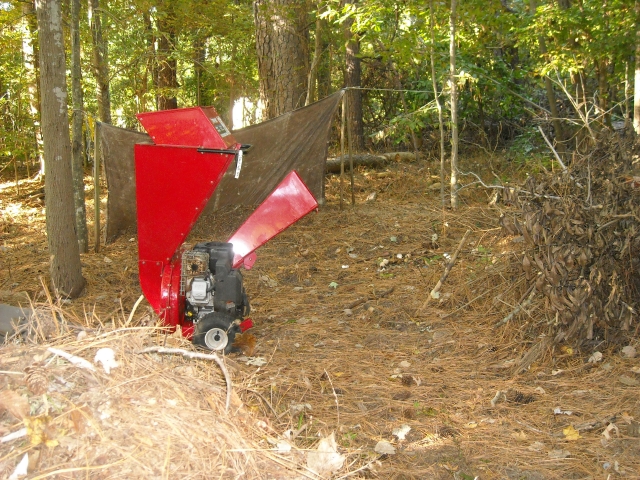
For many years this chipper did yeoman work grinding garden leavings that we then layered on clay soil as compost

Well, I did remember, and I was appalled when I saw my leaf fortunes tainted with grass clippings. But I never said anything. With teenagers, life is already too complicated. Good thing, too, because the miracle in the sandbox worked double-time. I had accidentally discovered the secrets of composting. Later, after Earth Day, I would put a name to the process.

I had discovered something else. There were no longer any weeds in the sandbox.

A whole new way of gardening opened up to us. Being young and efficient and impatient, we vowed to streamline nature’s operation. So we speeded the process up by first shredding leaves in a noisy machine, then spreading them on garden beds. This got rid of the piles fast, and it modestly improved the soil. But weeds still popped up.

When the stepping stones are hidden by piles of leaves, we rake them onto the camellia beds on either side of the path

We are older now, slower, a little more patient, but a little less tolerant about doing unnecessary work — though we still do it – so we’ve changed our approach. Today we do not rake leaves off garden beds. We let them be. When it gets to the point that we are scuffing layers of leaves along paths we sweep them onto garden beds, atop the leaves already there, loosely arranging them so they look like somebody cares. No hauling, no grinding, no pails, no wheelbarrows. The first rain flattens and tidies them.

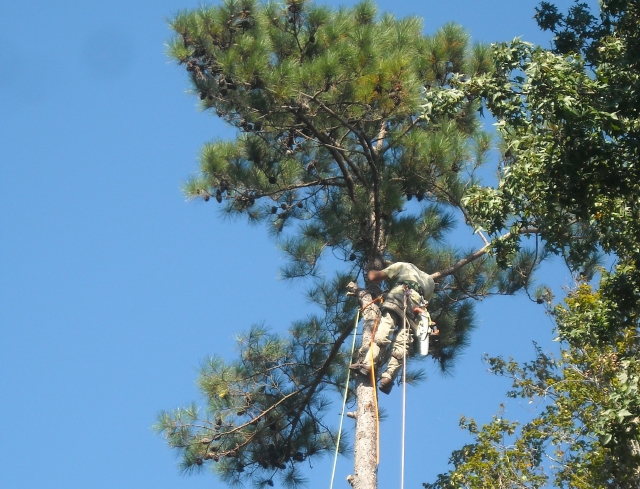
I must confess that I am having almost as much fun raking as the kids did years ago, though we do make one concession to “work.” When we hire lumberjacks, we ask them to leave the grindings from trees in a pile in our yard. We must shovel and haul and spread, but what a grand mulch they make!

Grindings from tree-cutting, a combination of green leaves and brown wood, generously spread on our clay, creates wonderful soil in a season

We never need to tote bags of store-bought mulch now. Weed seed can’t find purchase to sprout. Our garden beds are rich with compost. And our plants are healthier and more resistant to predators. What more could we ask?

Recently I spoke with a gardener who is establishing plantings under hundred-year-old oaks. You must be having a terrible time, I said. Those oaks steal everything: water, nutrients, sunlight. On the contrary, she replied. For a hundred years their leaves have been falling on that ground. The soil is so full of life there’s more than enough of everything to go around.

Our own ancient oak drops copious leaves each fall, and sometimes tree-size limbs, too


Posted in Compost, Creating compost, Creating soil, Soil, Uncategorized | Tagged , , , , , , , , , , , , , , | Leave a comment

We Look for Gardens Everywhere

Visiting gardens for us is like collecting plants. We can never see enough or have enough.

England. . .

Quite regularly, Susan and I go hunting for plants, whether we need them or not. Usually we can find several that we didn’t realize we needed, and it soon becomes imperative that we must have them. It occurred to us one day that if we also hunted for gardens, we could probably discover more plants that we didn’t know we needed. Daughter Susan admits this is a sickness. If so, I think it must be inherited.

Pennsylvania. . .

Neither of us is considering therapy. We are very happy with our impairment. In fact, we thought it would be fun to do some sharing of sorts. So, as we roam, we are compiling the best of our pictures and organizing them into slide shows, Great Gardens from around the world. Just click on your choice in the sidebar to find out about a particular garden.

Canada. . .

We’ve poked through all kinds of gardens in all kinds of settings. World famous classics. Hidden gems. Formal gardens with breathtaking views. Simple homespun gardens. Sometimes we find great possibilities in untamed waysides strung out with wildflowers and weeds.

We’ve seen gardens on rainy, misty, cloudy days or on sweltering days when haze hung heavy. And sometimes we hit lovely, sunny days when we could ramble for hours. Well, we ramble in the rain, too.

France. . .

They’ve been an inspiration to us, not directly, because, like fingerprints and people, no two gardens are alike. Maybe it’s a grand vista, or a special planting, or a ravishing pergola that hypnotize us into wanting to see more. There is always another secret around the bend.

So we come back to our own gardens energized and inspired. Suddenly we need another plant here (or two or three or more), or an arbor over there, or maybe some stepping stones. . .or a painted chair. . .

South Carolina. . .

Of course, there is the small matter of budgets and staffing. We’ve never considered taking loans for garden projects–so far. But we’ve come pretty close. Bob the Builder, whom you may have already met in previous stories, and Mike, Susan’s husband, are both pretty agreeable. Occasionally they ask us to please remember that the staff for our gardens is, shall we say, limited? and that there are other activities in life besides digging and planting–and replanting. Only occasionally, though. Mostly they scratch their heads and accept that we are beyond hope of rehabilitation.

Ireland. . .

So, if you have a spare moment, come along for some armchair visits to great gardens, as we add new ones from time to time. You just might see a plant, or two or three, that you never knew you needed.

Posted in Alpine Gardens, Brookgreen, Butchart Gardens, Canada, Chanticleer, England, France, Ireland, Visiting Gardens | Tagged , , , , , , | Leave a comment

Intrigue at the Blue Mist Discos

It’s September and Blue Mist Discos are open everywhere, reminding me that, yes, it is September, and it is their time to open. Next spring I’ll be pulling tired old skeletons left from fall carousing and waiting till next fall for a new show to begin.

An early prize from our roadside escapades

Twenty-five years ago, my friend Jean and I would hunt for plants in ditches. Sounds kind of crazy now, but we thought it was quite the adventure at the time. Well, after all, we could have been shot at.

Serious business, this was. Lots of independent research before an outing. As we went our separate ways on otherwise humdrum errands, we did visual sweeps of roads. We got pretty good at high-speed scanning without running off the highway. Then we’d compare notes on what we’d seen, get out the shovels and go on a rescue mission.

The plants we rescued didn’t know they needed rescuing. Sometimes, when they were stubborn, we got the distinct feeling they didn’t want to be rescued. But we forgave them for that because they probably didn’t realize they were growing in the mow/trim zone of a highway right-of-way or on property that was going to be bull dozed.

Another coup, gallardia, this from a sandy road side

It was kind of like digging for Christmas presents.

We lavished them with tender loving care in our gardens. Some of them loved it, took off and never stopped spreading, rudely jostling neighbors until they had to be disciplined with the ultimate punishment. Some we couldn’t please at all. We never saw them again.

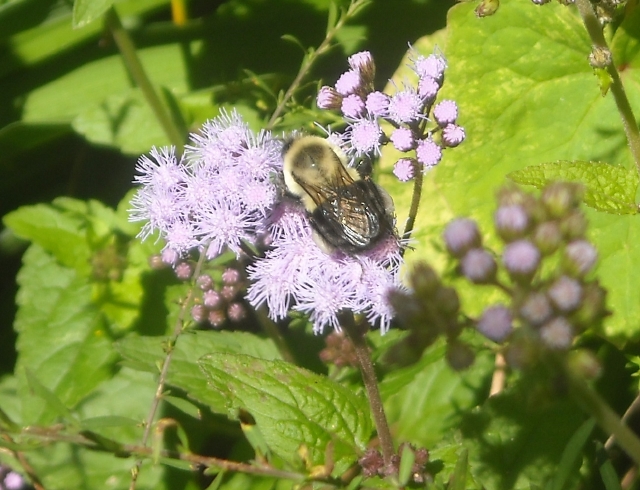
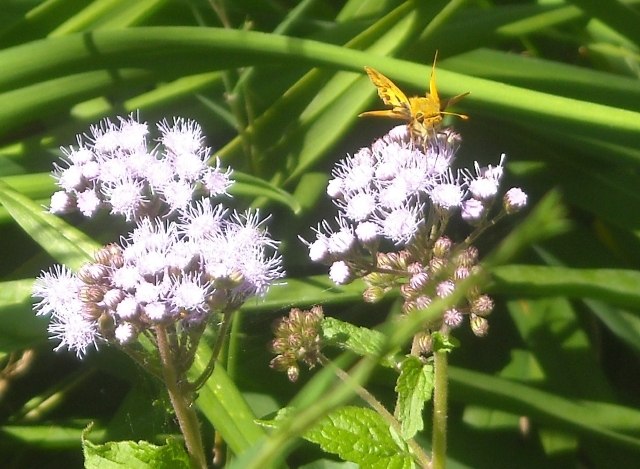
Native mistflower, an all-time favorite with insects, here providing a meal for a bumblebee

Some plants melted but came back as seedlings. That was how Eupatorium coelestinum, or mistflower, a lanky impersonator of garden variety ageratum, came to our gardens. Well, maybe not exactly.

Both our husbands thought our forays were—well—interesting. But Jim, Jean’s husband, was always enthusiastic about looking over our prize pickins.’ When he saw mistflower—blue mist I call it — he kind of smiled and then drily remarked, Did you know you already have this weed, over there? Hmm-m, if Jean had it, I probably had it, too. Never mind. This was a minor detail irrelevant to the adventurous plant explorers.

This funny little fellow is a frequent visitor

From the beginning, mistflower let me know it was the boss. No transplanting the seedlings. They practically died in my arms. No weeding around them either, or re-arranging, or clipping to get them off other plants; they’d sulk at the least disturbance.

But they didn’t cost anything, they were no-care, they hid other weeds, and they exploded with color when the growing season was winding down.

These bugs are all over the flowers

On sunny fall days, I began to notice a whirr of activity around the flowers. Every time I passed by, I would see butterflies, bumblebees, beetles, wasps bouncing off the blossoms. Lots of them. Not the big, bright, slow-moving butterflies that dazzle us in summer. These were small, fast and sassy. Painted Ladies and other thistle butterflies, elfins and skippers, and more I couldn’t name, coming and going in a frenzy.

One of the prettiest visitors to mistflower

I began to watch them more closely. Well, let me tell you, there’s a lot more going on in them thar flowers than sippin’ nectar. These butterflies and bugs flit around so fast you can’t keep track of them. When they’re not flitting, they’re flirting, or stalking in a hang-dog, lovesick sort of way, or wing-dancing, or, if he can ever get her to sit still on a flower, caressing. And when tempers flare, there may even be a skirmish or two, ever so brief, no gunfights at Blue Mist Discos!

So, for many of these butterflies and bugs, our Blue Mist Discos might be their last stop for a high old time before they mate, lay eggs, and cold weather closes in on their lives.

Jean shared her coreopsis which splashed through her garden in spring

I must finish my story now. When Jean and I exhausted the roadsides, we graduated to nursery hopping far afield, with long lunches in local eateries in small towns. When our gardens were chock full, we skipped the plant stuff and headed straight to lunch and long conversations to catch up on the latest, be it episodes of our lives, our families, or the politics of the day.

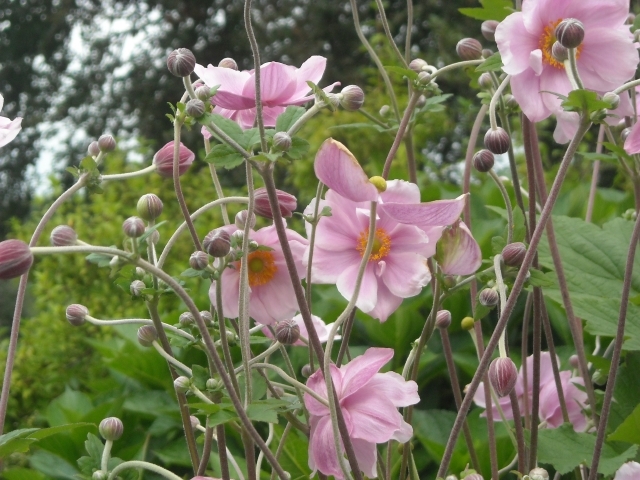
Between trips we would compare notes and share plants. Jean gave me some of the first plants I grew in my garden. Her Japanese anemone was a standout and her coreopsis a sensation.

Japanese anemone is another gift from Jean

She diligently hunted for and planted the first lacecap hydrangea I’d seen. So, of course, I had to follow. When I discovered viburnums, she let me persuade her to try some. Most recently, my Bob and Jean dug kerria from her backyard, which we potted for our annual plant sale. Then she surprised us, strictly over our protests, by buying one back.

I guess there will be no more roadside forays, or nursery trips, or lunches, or sharing plants and lives. After 85 years, Jean left us this September. But I will always have the memories, and I will think of her when Blue Mist Discos open for business each fall.

More visitors to mistflower. Note the curled proboscis, or straw that the butterfly uses to sip nectar

Posted in wildflowers, Wildlife | Tagged , , , , , , , , | 1 Comment

The Grand Hydrangeas of Ireland

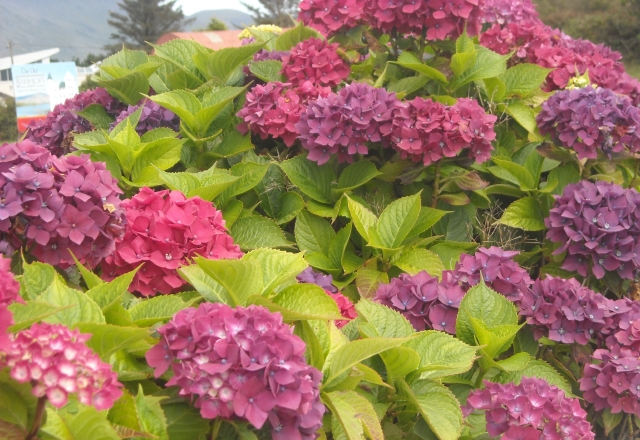
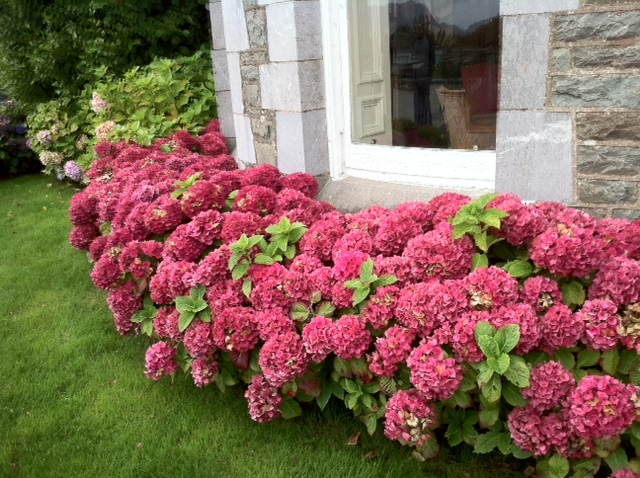
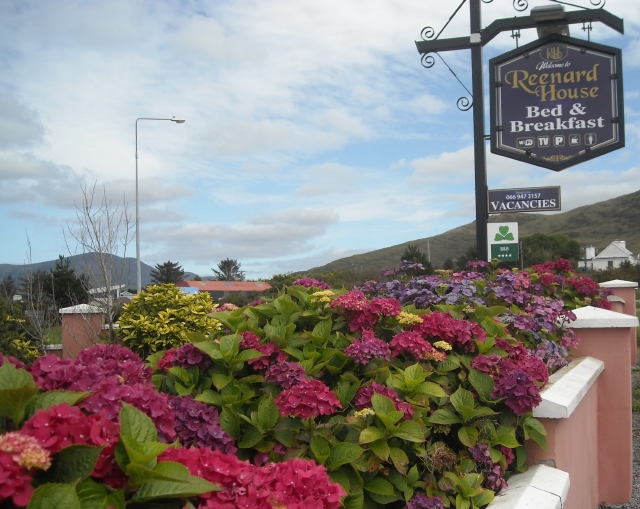
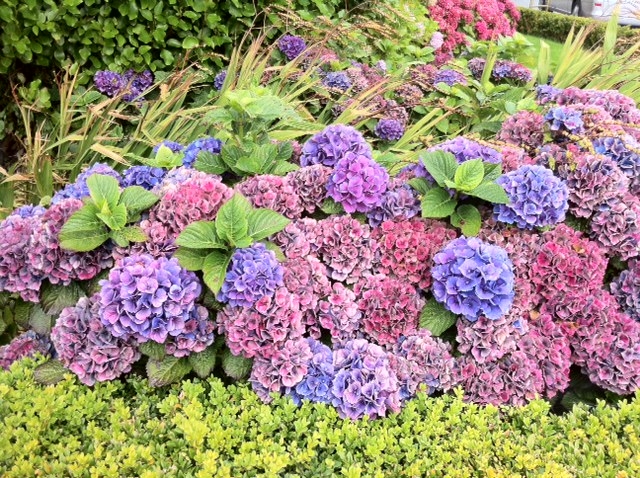
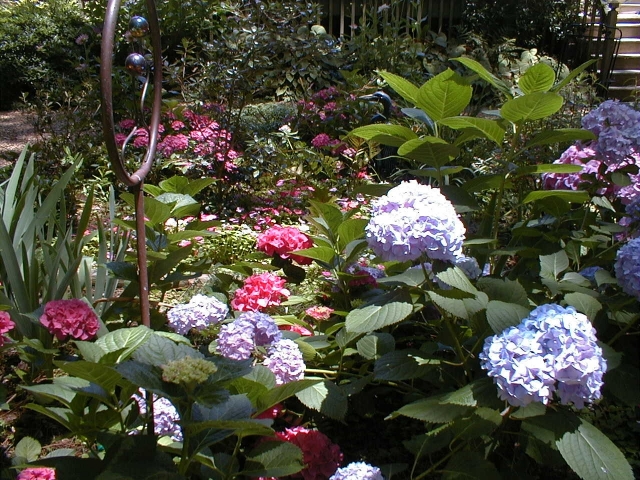
A rainbow of reds

Michael said he would think of me whenever he saw a hydrangea in bloom.

I will never forget the hydrangeas of Ireland. They seduced me. And to think it was only by chance that we saw them in full and glorious bloom on that trip.

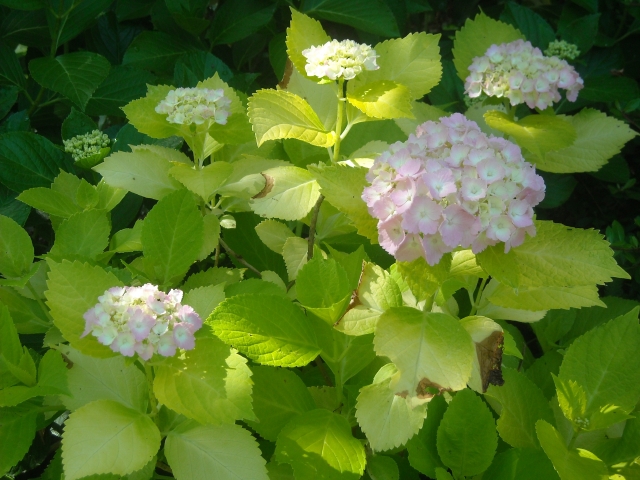
They were voluptuous. Huge blooms hid beautiful deep green  foliage that sometimes took on a yellow cast as it aged.

red around turret

Reds massed around the turret of a castle B&B. Photo by Michael

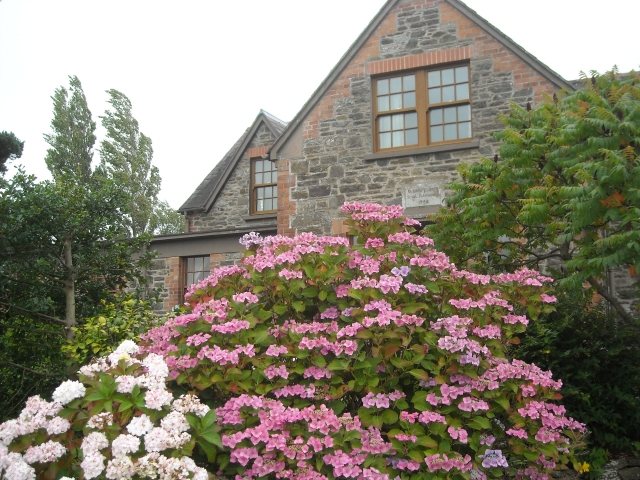
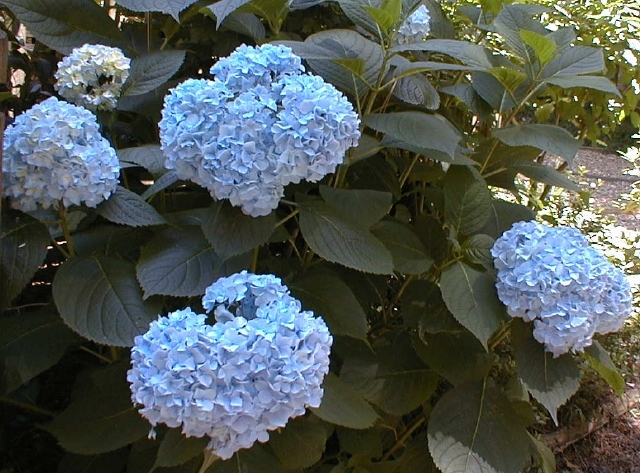
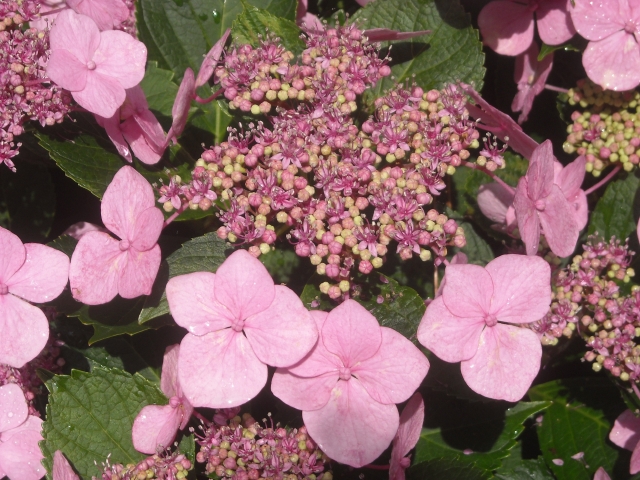
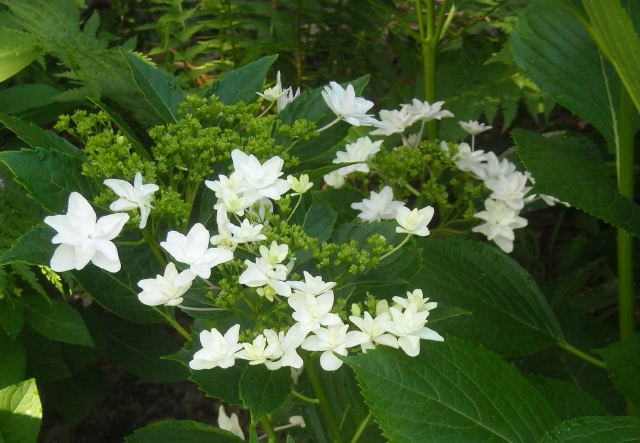
Lace cap blossoms the size of dinner plates, sterile flowers around the edges so large, the “lace” almost covered a “cap” of tiny fertile flowers. Mophead blossoms so luscious and full they would take center stage in any Victorian garden.

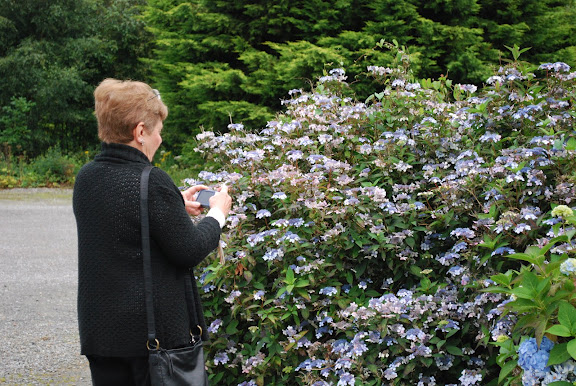
Me taking pix

Caught in the act, trying for a close-up. Photo by Susan

We stopped for me to photograph them. I could not photograph them often enough.

But I could never quite capture their magnificence.

It’s just about a year since Susan and I visited Ireland, and I still have sharp memories of hydrangeas that seemed to be everywhere —

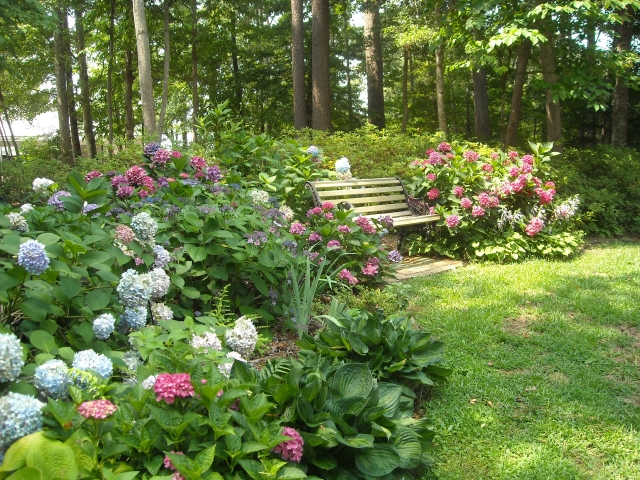
—  on manicured castle grounds, on roadside lots sharing space with fuschias that grew wild, in private gardens, in abbey courtyards.

I shot two dozen pictures here in four minutes. A record for me

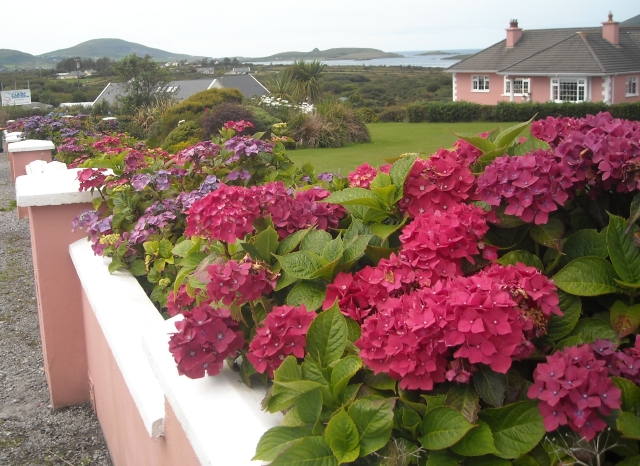
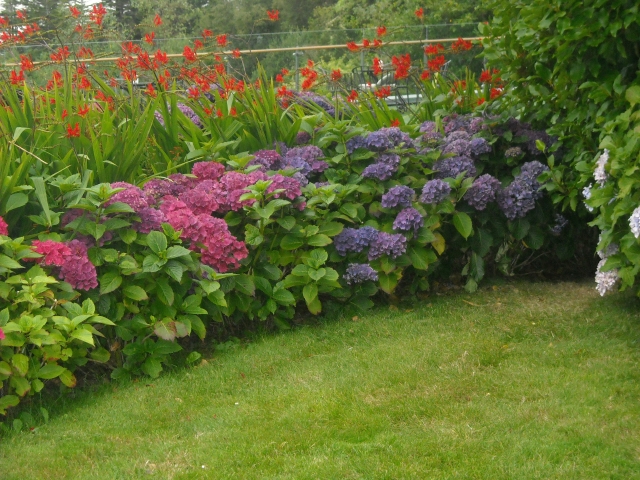
One morning, on the way to the ferry that would take us to Valencia Island I happened to glance down a side street. There, behind a solid pink wall was a hydrangea bonanza that took my breath away. A hedge of them in bloom on the grounds of a bed and breakfast. A whole collection of them. Would we have time to make the detour and take some pictures?

I felt palpitations as I took photographs, working quickly, almost frantically. I wasn’t worried about missing the ferry; that possibility hadn’t entered my mind. My eyes and my camera were overwhelmed with this floral sensation.

B&B Wall

A fine view from any window of this B&B, if not hydrangeas then hills and water in the distance

But photographs weren’t enough. I reached for a stem. Oh, the temptation.

Never mind the idiocy of carrying a slip, or two, or maybe more, around in a car for a week. Never mind telling fibs on the forms we would have to submit to customs.

These were prizes I had to have. In fact, I probably already had these varieties at home, but the grass is always greener on vacation.

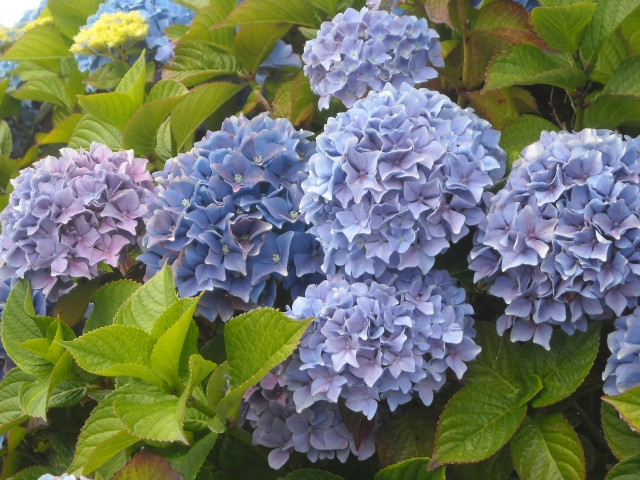
Mass of blue

A medley of blues

Saved by the voices. Uh oh, had anyone seen me reaching? The owners had come out to see what we were all about and were chatting with Susan and Michael.

They were so pleased when we told them we were admiring their hydrangeas. Had they spotted my wayward fingers? Apparently not. There were no visual pat-downs that would indicate suspicion.

Michael mass wild

Near the edge of the road. On its own? Photo by Michael

Do you know the names? I asked. No, they said, and it didn’t seem to matter. Nobody we met seemed much interested in knowing the names of their hydrangeas. They simply enjoyed their beautiful, dependable blooms.

We thought we had grand hydrangeas at home. We had spent years coddling them. When they fussed, we dug and replanted them, pruning, fertilizing, watering and mulching.

We watched them grow, and we were pretty proud of them. But hot dry summers take their toll on hydrangeas. We never realized how pinched they looked until we did mental comparisons with the grand hydrangeas of Ireland.

vacant house

Still blooming fierce, though the pretty stone house is vacant

And to think we might have missed them. We had booked our trip into Dublin for June, with plans to take tour buses cross country. Threat of a strike by Aer Lingus and a stiff bump-up in tour prices caused us to push back to August and consider alternatives to organized tours.

So we hired patient Michael Hennessey to chauffeur us around Ireland. Do you think a bus driver would have taken a detour so I could take these pictures?

Or go out of his way to find a school crossing sign so I could photograph it?

multi with crocosmia

This mix growing with crocosmia at a castle turned B&B

Just to set the record straight, we did not just do hydrangeas. We did what all visitors to Ireland do. Connemara. Galway. The Burren and the Cliffs of Moher. The Ring of Kerry.  Cork. Kilkenny, County Wicklow, Dublin.

And more. Michael took us to some of his favorite spots. We never quite knew what he would come up with. Eight hours after we set foot in Dublin we were visiting an off-beat haunted castle and leaving with some pretty big holes in our initial skepticism.

leprechaun

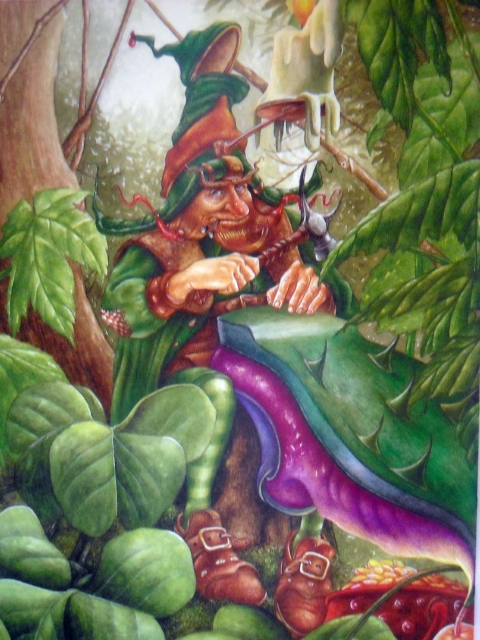
Leprechaun artwork by Andrew Whitson, from Irish Fairies

Later in the trip he would ask, How would you like to visit an abandoned rock quarry?

An abandoned rock quarry? Well-ll, that sounds like an adventure, why not? The visit was memorable. Scenic views, a wealth of history, wildflowers cascading down a hillside.

And a leprechaun who kissed me on the cheek. (To you, dear reader, he might have been a frail old man with a twinkle in his blue eyes who helped me up a stone outcrop even as I tried to help him climb down, but to me he will always be a leprechaun.)

Of course, my leprechaun did not cobble shoes, as they do in Irish lore, but he twinkled nonetheless.

crappr

Castle with a genu-wine crapper. Note chandelier in the loo  

More of Michael’s favorites—an isolated, crumbling abbey, a favorite bookstore, an ancient stone circle with dolmen and wishing tree. As we looked at the trinkets and tags left on the tree, we could only imagine what the wishes might be.

And I can’t forget the gardens we visited. Kylemore Abbey and Powerscourt were lovely, each in their own way.

Each day we were immersed in centuries of Irish history and lore.

Sharing a pint of Guiness and some laughs in the evenings during dinner at an inn he’d booked for us always managed to rekindle our energies.

blushing bride

A ‘Blushing Bride’ in Ireland? Photo by Michael

A month after we were home, after we had unpacked our souvenirs and our memories, Michael was taking pictures of hydrangeas, still in perfect bloom in September.

Later he would send word that he had planted one of his own.

Michael’s web site is http://www.vipchauffeur.net

closeup of blue lacecap

You might also enjoy these entries on hydrangeas:

Hydrangea arborescens ‘Annabelle’

Hydrangea paniculata

Oak Leaf Hydrangea

The Hydrangea that Climbs

Why Don’t My Hydrangeas Bloom? Part I

Why Don’t My Hydrangeas Bloom? Part II

Why Don’t My Hydrangeas Bloom? Part II

Putting the Blue in your Hydrangea Blooms

Drying Hydrangeas

The Romantic Hydrangeas

The Grand Hydrangeas of Ireland

Letter to Lovers of the Blue

Posted in Hydrangeas, Ireland, lacecap hydrangeas, mophead hydrangeas, Uncategorized | Tagged , , , , , | 2 Comments

More Meatballs and Lollipops, Please

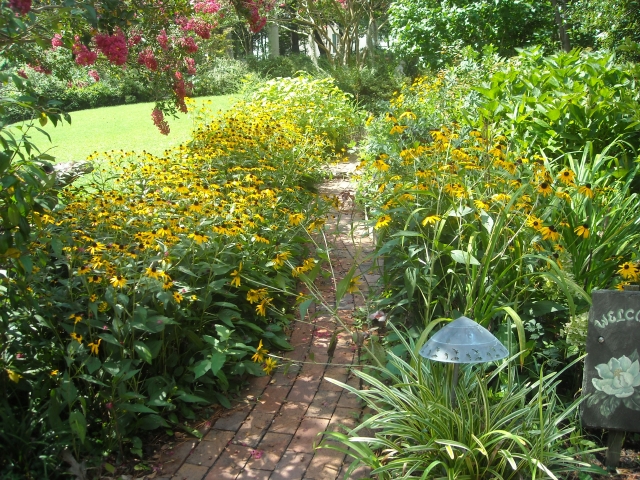
Would anyone dare venture down this path? Visitors use an alternate in summer

Years ago, a certain company offered two types of fantastic seed tapes. Each one was guaranteed to produce instant results for cottage gardeners and formal gardeners alike. In case you want to follow up on this terrific offer, the order number for the cottage garden was MESS. The order number for the formal garden was STIF.

Joking aside, right about now I could use some of those STIF meatballs and lollipops in my garden, which today is decidedly of the sprawling MESS variety.

Fennel bloom fronts a victim of jungle life: once pretty now chewed up hibiscus moscheutos

Rain has come punctually this summer, strong, long and hard, a novelty after several years of summers with only occasional dribbles, and my, how the garden has turned jungle. It outgrows and outpaces us. Insects chew, bore and suck. Storms tousle our best blooms just as they arrive, or drop tree limbs on camellias. Mosquitos and chiggers suck us dry. And deer multiply and browse. Clearly, an untidy situation.

Now, don’t get me wrong, I’m not complaining. We happen to like the jungle look, but we like jungles better if they behave. So do our neighbors.

Whenever I am tempted to grumble, I think of Jane and Mary, fellow Master Gardeners and  friends from Montana, where it is so dry the rain in thunderstorms evaporates before it hits the ground. They are both remarkably philosophical about their gardening situation. I guess they would order GREEN.

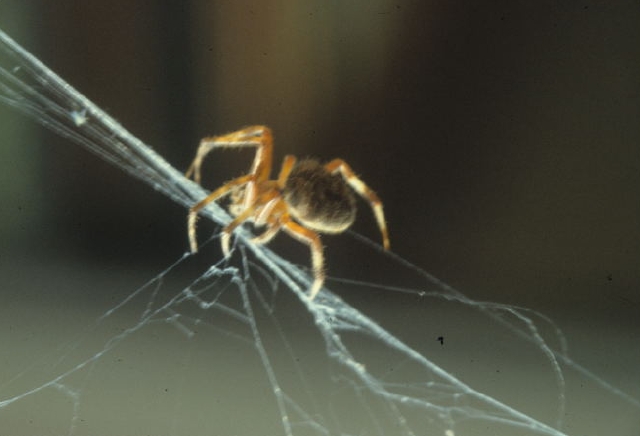
We duck this web near the front door each morning

Now, I love working in the garden, so you would think I would be in my glory pulling up and chopping out. Problem is, when it’s not raining here, it’s hazy, hot, and humid. Chiggery amd buggy, too, but that is never mentioned in weather forecasts. It takes Olympic determination to get out there and work. Before I can even start to chop out the floppers, tear through the vines and pull up the weeds, I have to bat down the spider webs. I much prefer being a couch potato to an Olympic gardener.

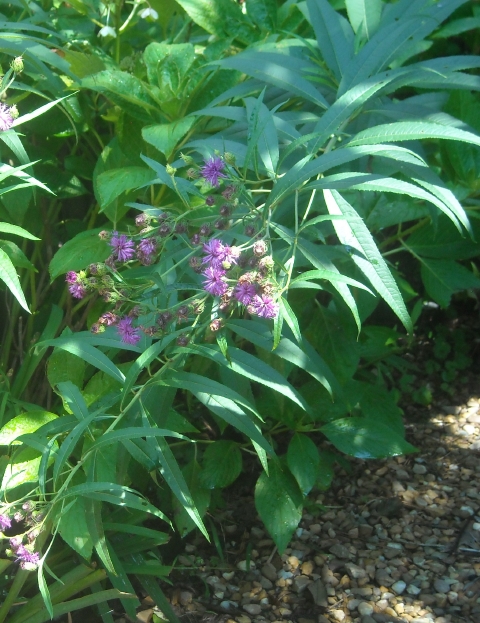
New York ironweed muscling its way into a hydrangea, splays over the path, but the hummingbirds like it . . .

Mid-July I had a brief burst of ambition and hacked my way through the jungle, piling wheelbarrows high with detritus. Surely all this intense labor merited a bronze medal. (I’m being modest.) Turned my back for a couple of weeks and the jungle was misbehaving again, badly.

My nemesis: trumpet creeper vines. We inherited these along with our pine trees. It was fun at first to see their orange flowers festooning pine branches. The hummingbirds loved them. Now the pines are gone, but the frustrated vines remain, weaving in and out, creeping over and under, rooting and rerooting, searching for sun.

At least our trumpet creeper isn’t invading the house. Pretty, though, and people pay money to grow it. Photo from U of Illinois Extension site

To eradicate them, I must crawl through the chigger-infested spider-web-laced jungle, trace the intruders at their source and balance pruners, paint brush and a small, uncovered jar of herbicide while I paint straight glyphosate on cuts made close to the ground. It’s the only time I use glyphosate in the garden, and most of the time it works, but it’s akin to being traffic cop to lemmings on the run.

Now, if only the deer liked trumpet creepers. . . and speaking of deer. . .
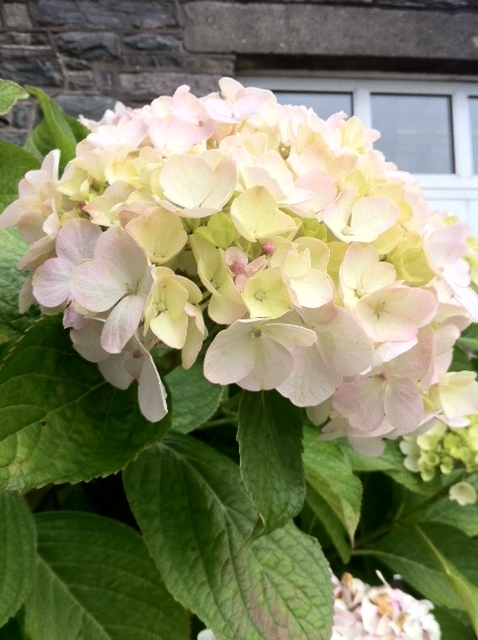
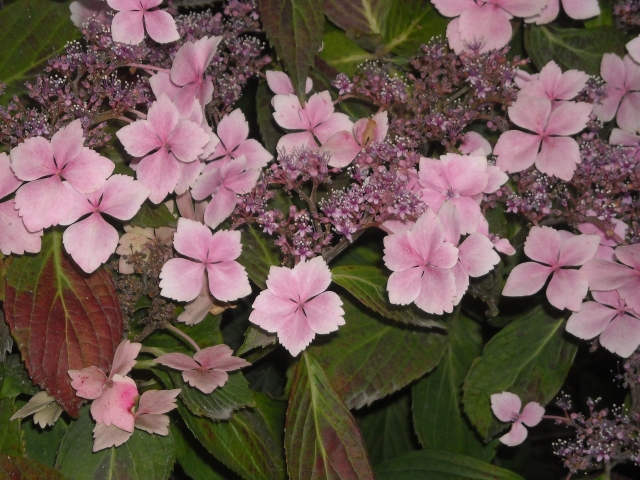
At least the deer keave crepe myrtle alone. This lavender low-grower got banged up in a downpour

Mom Doe has ranged all summer, efficiently chopping up and chowing down, but her tastes (hosta, hydrangea and phlox) are not necessarily my priorities for pruning. New fawns, prospective plant-grinders Spunky and Pokey teeter bowlegged, while Mom patiently watches, but hey, those amaryllis leaves look tasty.

A little side dish during the vigil? She tears off a tough, strappy leaf,

Almost ripe elderberries, backed by a tangle of clematis, Virginia creeper and wax myrtle are out of deer’s reach but will soon be devoured by our resident mockingbird

propels it to her jaws, grinds and swallows in one fluid motion, then repeats the process with another leaf. (So that’s what happened to the amaryllis. I didn’t do stupid pruning after all.) While we watch, she comes up to the window and watches us watching her. Thanks, we imagine her doe eyes saying. But keep it coming, keep it coming. She won’t allow pictures, though.

Spunky considers the garden his/her great wide world to taste

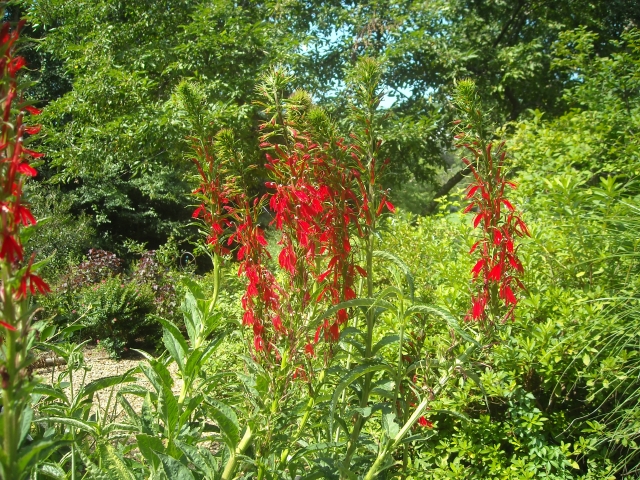
Cardinal flower emerges happy with all the rain. A favorite with hummingbirds

and explore. Pokey, not sure, hangs back, halfhearted, jumps with surprise when a cut hosta stem (Mom’s work, not mine) tickles the muzzle. He/she still prefers nursing, stands disconcerted when Mom walks away after only a few gulps.

No hesitation when Dad gets too close, though. They both scatter and bolt into the woods. We suspect Dad is just as happy to get the kids out of the way as he jumps the fence to follow Mom.

Agastache blooms are pit stops for all sorts of bees and beneficial wasps. It’s a fine addition to the jungle

Memories of last spring tease us. The garden bloomed and behaved and was perfect (in our reminisces). The jungle didn’t need taming yet, and we didn’t need meatballs and lollipops, didn’t even think about them.

Still, do we really want meatballs? Would we have beneficial bees and wasps, hummingbirds and swallowtails, box turtles and green tree frogs, praying mantis, black racers or darning needles, and all the wild creatures we have never seen, and yes, even the spiders, if we were spiffy and STIF? I don’t think so.

That spider by the front door won’t give up making repairs no matter how many times we crash his pad. His territory, I guess. We”ve gotten used to sharing

Posted in Birds, Creating a Garden, Hosta, Hydrangeas, Native Plants, Summer, Uncategorized, wildflowers, Wildlife | Tagged , , , , , , , , , , , , | Leave a comment

A Letter to Lovers of the Blue

(Pink, Red and White, Too)

Dear Reader,

I do hope you are keeping your mopheads safe and locked tight.
Perhaps an insurance policy, or maybe two
On them? A simple wire cage will never do.
One never knows when a thief will stalk in the night
And pilfer a single, stunning, blue,
Or an entire bush outright.

Ah, you are thinking, She has been gardening for too long in the sun.


Hush. Let me tell you the tale.
Not so long ago, these bloomnappers were truly alive and pruning.
They favored Cape Cod, where sea breezes keep beauties a-blooming
Where mists of minerals, unseen, like a gossamer veil,
And acid soils are  ever fine-tuning
That electric blue hue to full-scale.


A cunning lot, these plant pirates.
They sharpen their shears, case their quarry by daylight
And slither in stealth by shadow of moonlight.
Many’s the time they’ve struck!
Many’s the bloom they’ve plucked,
Leaving nary a footprint, nary a track.


With the eyes of an owl, the speed of a skink.
They would choose the prize blues,
Leaving lesser contenders: white, purple, and pink
To the gardener-in-snooze,
Who wakened next morn
To plants tousled and torn.


Their trophies they sold to florists and crafters
Who fashioned bouquets or hung them from rafters
Till they were ready for wreaths or for swags.
And the rich scalawags?
They winked as they strolled to the bank
With their swag.


And that, Dear Reader, is the end of this tale
Of the Cape Cod robbers who left nary a trail.
No one was caught with a bundle of sticks,
But wait, I’ve just read that plant heists are widespread,
And cunning plant pirates, mean and ill-bred
Still carry big bags full of tricks.


Ah, but now I digress.
For I must tell you of mopheads and lacecaps,
all in full dress.
Victorians loved them, filled gardens and vases.
We kids picked bouquets, to us magic blue blazes
With zillions of petals that spoke of sweet summer bliss
And fresh peaches and picnics in secret green places.


We knew not of lacecaps, long gone from the scene.
Too modest, perhaps? Like an old-fashioned bonnet?
Though the lacey-like caps alight with wee blooms
Would fit snug as a crown for a fine fairy queen.
And the brim! With such trim! Oh the bobbing and dancing upon it,
Rainbows of sepals like a knight’s dashing plumes.


Then mopheads, those blue standard bearers,
began to be spurned
By wannabe gardeners. How could they have earned
Such disfavor? Too floppy? Too moppy? Of dubious taste
For the all-in-its-place tight-bound modern garden?
Beg pardon?
Will time-tested heirlooms, and passalongs too, soon be replaced?


Like the cavalry rider with impeccable timing
Martha herself heralded purples and mauves, priming
Gardeners to yearn for, return for those dreamy hydrangeas.
Once staples of blue, largely ignored, tucked in garden and farmyard,
They come now in rainbows, must-haves for designer-arrangers
Who may dye them and dry them, shape them and drape them
Till they woo us like sonnets once penned by The Bard.


Now mopheads and lacecaps are back, reign supreme,
With selections beyond any gardener’s wild dream.
And the colors!
Washes splash over blooms on warm summer days,
As delicate palettes paint glowing bouquets.
From Korea, Japan and yes, Germany, France
They bring to our gardens a sense of romance.


pia
Deckle-edged Frillibet, or Ayesha (lilac-cupped)
Starbursts of Hanabi, white globes of Schwann
Bluest of blues Enziandom, Pink Elf’s short, sturdy reds,
Or the knockout rebloomers:
Endless Summer, Blushing Bride, Twist n shout.
Or Sister Theresa, Geisha, and that wild Lady in Red


Pale, elegant, Mme Emile Moulliere, robust Big Daddy, so dapper
Surely now, you are tempted to start a collection five-starred,
But remember, dear reader, be always on guard
Against that wily, that deft, that incomparable hydrangea bloomnapper.

You might also enjoy these (prose) entries on hydrangeas:

Hydrangea arborescens ‘Annabelle’

Hydrangea paniculata

Oak Leaf Hydrangea

The Hydrangea that Climbs

Why Don’t My Hydrangeas Bloom? Part I

Why Don’t My Hydrangeas Bloom? Part II

Why Don’t My Hydrangeas Bloom Part III

Putting the Blue in your Hydrangea Blooms

Drying Hydrangeas

The Romantic Hydrangeas

The Grand Hydrangeas of Ireland

Letter to Lovers of the Blue

Posted in Hydrangeas, lacecap hydrangeas, mophead hydrangeas, Summer, Uncategorized | Tagged , , , , , , , , , , , , , , | Leave a comment

Plants for Pennies

It began in earnest many years ago with a Master Gardener class on how to propagate plants by taking stem cuttings. I must have been having a relapse of Empty Nest syndrome then. Oh, the possibilities!

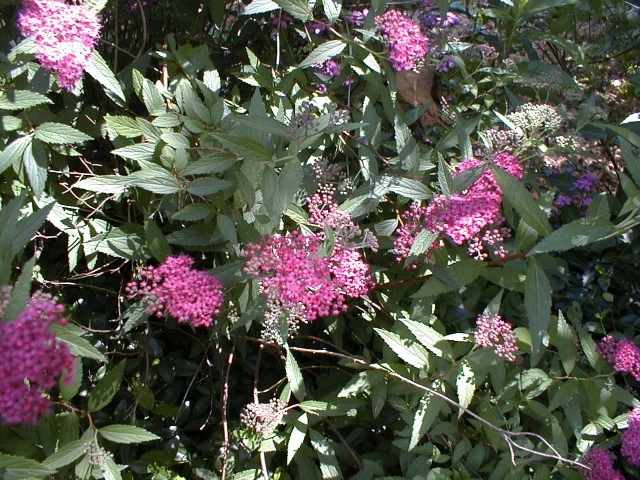
Spirea shibori, one of my first successes

Bob the Builder was not so interested in propagation at the time, but he was enthusiastic about building a 4-foot by 8-foot bed for me to fill with little stem cuttings. Do you know how many stem cuttings can fit into a bed that size? I can’t count that high. What a family we would have!

I was hooked. Never a kitchen goddess, now I had an excuse to play hooky. Taking cuttings on a glorious spring day was much more important than sweeping the floor or weeding flower beds. If, on that rare occasion, I felt I needed to justify chopping big stems into little stems, I called it selective pruning.

Any plant was fair game.

I began to fill the garden with plants for pennies. With the money I saved I could buy even more plants and save even more money by propagating the new plants. Hydrangeas, azaleas, spireas, was there no end to this multiplication? I became so addicted I was designing garden beds around new cuttings before they ever grew a root.

How could I resist this lovely hydrangea?

Now I could raid plants from gardens of friends and family, roadside verges, old fields, even parking lots.

I sank into moral depravity. I became a thief. Sometimes my sister, who carried a large purse, was my accomplice. This was good, because if I went to jail, she could keep me company.

On a visit to New Castle, Delaware, the two of us spotted a stunning red hydrangea in a garden enclosed by a wrought iron fence. One luscious stem reached through the bars, beseeching me. We must rescue this innocent from its cruel bonds, I said. My sister was right on with her satchel, but I was woefully unprepared for such rugged heroism, and there was no phone booth nearby.

Furtively I rooted around my purse for a tool. Aha! A manicure scissor! Furtively, my sister and I scanned the neighborhood. No bystanders pretending not to watch. No fluttering curtains behind open windows. Satisfied we were in the clear, I made some quick, if ragged, cuts. My sister caught the drop, and we made a clean getaway.

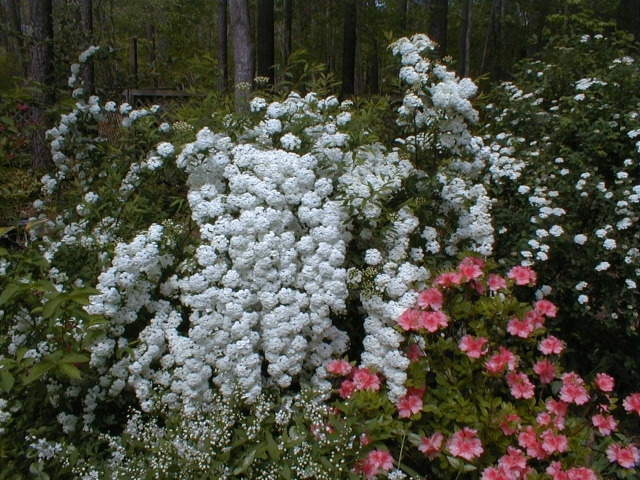
Double reeves spirea, a slip of a gift from campus, now full-grown in our garden plays off a salmon-pink azalea

Success begat confidence. Neither of us had made conscious plans to repeat the stem-snitching, but we seemed powerless to stop it when we got together. The next affair took place on a college campus in Virginia where we were overcome by fountains of white-blooming spirea. Not a moment’s hesitation this time. We replayed the New-Castle caper with a precision that astounded even us, and we knew then that we were on our way to becoming hardened criminals.

We never felt a twinge of guilt. Our motives were pure. We were noble. We were releasing plants from their bondage (though, curiously, they seemed not to be aware of their plights), and if they made it into my garden, well, there they would thrive, wouldn’t they? My sister was even more selfless. She lives in an apartment in New York City—with a charming garden, it’s true, but much too small for such grand shrubs. She willed the booty to me.

Cranberry viburnum, its spring bloom as luscious as its fall berries

One bright autumn day, a handsome viburnum lush with bright red berries next to a fence in a corporate parking area beckoned to me. This time Bob was partner to the caper. He does not carry a big purse, but he does have a sharp knife. Amazingly, nobody was doing surveillance. We could take our time, choose our cuttings with care.

Well, that wasn’t exactly the case. Once we brushed against the fence, we learned later, security cameras began to roll. Apparently a couple of geezers skulking around a plant did not constitute a serious threat to corporate security. We escaped to enjoy another stunning addition to the garden.

I’m sure there were other escapades, but you can’t expect me to remember them all.

Do you suppose they mean ME?

Now Bob was snared. Failures disappointed us, but they didn’t stop us. We developed a nothing-ventured-nothing-gained philosophy. Successes were grand, and they fed our addiction.

The garden was getting too crowded with plants, and we had just the solution. We would share!

We shared with just about everyone who owned a trowel. Everyone was so enthusiastic about our offerings. At first. After a while, we got the feeling, just a feeling, mind you, that people were backing away when we proffered plants. Hm-m. This called for a different strategy.

Our nursery overflows with offspring

So, on occasion, we sold to the public. We sold the young plants at garden days in malls and at fairs and garden shows. In 2003 we hosted a sale day in our garden and have continued the tradition. Here, people can see mature plants in a garden setting before buying and, because our prices are reasonable, they can experiment with new plants without reaching deep.

Our plant sale

The proceeds finance projects sponsored by our local environmental group. Some of these have included multiple printings of our educational publications, taxidermy for a park visitor center, scholarships, opposition to a proposed military landing field, and contributions to environmental advocacy groups in North Carolina.

So, what have we learned during our years of propagating?

That there is infinite variety and beauty in the plant world.

That each plant has it own particular requirements and, yes, temperament.

That it’s all about juggling the big four: temperature, soil moisture, humidity, and light.

(Plus an X factor we haven’t yet figured out.)

That our failures have been the best teachers.

That it’s a lot quicker to dig and divide.

That low-tech propagating can be the greatest suspense story going.

That we are still hooked on propagating with stem cuttings.

That it’s all one grand experiment.

For more information on propagation, check out our topics on the sidebar:   Propagation: Stem Cuttings     Pamper your Pruners      Using Hormones   Soilless Media?    Homes for Cuttings     Choosing Candidates     Taking Cuttings     Potting New Plants

Posted in Creating a Garden, Hydrangeas, Native Plants, propagation, Spring shrubs | Tagged , , , | 2 Comments

To the Trenches, Mates, for the Annual Hosta-Slug Fest

Great shot by Jeff Hahn

Yes folks, we have revolutionary new weaponry to combat slug-attacks on hostas. It’s safe for us humans and safe for the environment. It recycles natural resources, and it’s readily available in many gardens, so there’s absolutely no cost. What more could we gardeners want?

It’s called the gumball bomb strategy. For those who are uninitiated (happily, trust me) to the reproductive habits of the sweet gum tree, it spreads its genes by bombing us with countless spikey balls that give everyone the grumbles. (Everyone, that is, except for creative recyclers who spray them with gold paint and use them in wreaths for the holidays.)

Gumballs on a sweet gum stump. Top two show wear and tear. Bottom two are worthy of gilding or weaponry

Either we roll on gumballs when we walk, or the gumballs scatter like marbles when we rake. According to something I think I have read recently, slugs, too, share our dislike of gumballs, not because they roll and scatter, but because their spikes are a bed of nails that pierce the crawlers’ bodies and cause dehydration and death.

Bob is not as enthusiastic as I about the gumball treatment for hostas, but he is a good guy. This being a banner year for all three: gumballs, hosta, and slugs, he collects gumballs for me in a pickle pail. (No, I’m not pregnant and we don’t eat pickles for breakfast. We get the pails from a local sandwich market whose owners believe in recycling and re-using.)

Immediately I begin my campaign. I could see that this is going to be a bad season for slugs.

Bob is a purist and collected only the best. I threw in the pine cones–heck, they’re spikey, too. and they add volume.

Then I stop short. How, exactly would this work? I had assumed I could just throw a few spikey balls helter skelter around the plants, and that would be that. But wouldn’t any self-respecting slug simply slither around the gumballs to get at the prize–literally, since slugs only go for those hostas a gardener prizes most.

I realize that I am beginning to think like a slug, which is probably not very different from the way I usually think. If I were a slug, would a single necklace of gumballs around a hosta be enough to deter me? Or would double, even triple rows be needed? Armed or unarmed, hostas planted near fences would be easy chewin’, since I could detour along the rails.

This is clearly getting complicated, too many decisions to make, too much planning to do. I am beginning to be impressed by how thoughtful slugs must be.

Enough of this analyzing, my slug-brain chides, get to work. After I arm five hostas using a variety of thoughtful approaches, my back aches, my knees are sore, and my brain is buzzy. I had gone through half a pail of gumballs and I still had about fifty or sixty hostas to arm.

I do lightning-fast calculations based on my version of Einstein’s theory of relativity, you know, E=MC squared, where E is my energy, M is my mass, and C is my interpretation of the speed of light. At this rate, in round numbers, I would need a million gumballs in five hundred pickle pails, and it would take me a thousand hours to collect and spread them. That may be a small exaggeration.

My high-tech supplies. The bag is several years old but the contents are still good.

Then it hit me. I’d heard only one testimonial about these weapons of slug destruction, and I couldn’t even remember the basics of the story: who, what, where or when. What kind of sluggish thinking was this? Why am I not using the perfectly adequate remedy that is sitting in my garden shed?

Spreading diatomaceous earth on soil has always worked well for me. Why am I bedazzled by the latest magic bullet? Why? Why? Why? Because I am a gardener-addict? Because I love experimenting? Because the lure of a new idea is a siren call I can’t resist? Because the stuff in the shed is old hat? Maybe another gardener knows the answer.

Diatomaceous earth is a fine powder ground from fossilized diatoms, exquisite, tiny phytoplankton, each wrapped up in a silica case. DE works the same way as the spikes on gumballs. Smooth to my fingers, the sharp silica is lethal pins and needles to a slug.

Diatoms under the microscope. These exquisite phytoplankton are the critical foundation for all life in our oceans. NOAA photo

It doesn’t take much to be effective. Applicators are available but they have moving parts that don’t seem to work for me and clog, so I settle for a mayonnaise jar with holes punched in the lid, which also clogs but only has one moving part that stays put. I do a combination of banging and shaking, usually on a dry, windless day, or I let light breezes float the DE to rest. (One is advised to wear a mask and safety glasses to avoid silica in the lungs or eyes. I think one should always say these things these days.)

Every time I operate in de-slug mode, I get the bright idea that one of those utensils for sprinkling confectioners sugar on cakes might solve the clogging problem. Since that would require me to hunt for, purchase, and store yet another gimmick, in a nano-second I forget I even had such an idea.

Besides, one application every few years in spring to get slug babies seems to knock our slug population down. The coarse leaf and twig mulch we use, which can include spiny holly leaves, may deter slugs, along with the phalanx of hungry box turtles that roam our garden. Hey, maybe this is my version of the gumball bomb strategy, with tank troops for good measure.

This path in our woods takes us through sweet gum, hickory, ironwood, hophornbeam, pine, holly, persimmon,  an old oak, and blueberry bushes

DE is not poisonous, like metaldehyde bait, and it’s not messy or smelly like beer, and you don’t have to go prowling around your garden with a salt shaker in the dead of night. It’s safe and dependable and doesn’t seem to bother earthworms. (To be scrupulously honest, I must qualify my crowing by acknowledging that, unlike our friends in the Northwest, we here in the Southeast do not have slugs that will carry off a house.)

As I come to my senses and pitch the rest of the gumballs into the compost pile, I ponder the one-sided view we gardeners have of the sweet gum tree. If you look beyond the gumballs, it really is a good guy.

Who can deny the utter beauty of this luna moth. Photo from Lifeinthenorthwoods.com

Its resin has been used for medicines, soap, glues, and chewing gum. Its wood became furniture for colonists and plywood for barrels and boxes. It is the host plant for spectacular moths, including the lovely Luna Moth, which we once found napping on our front door, antennae folded, like eye shades against the sunny morning.

And those pesky gumballs! Why, they provide dinner to all manner of small birds on a cold winter’s eve. Acrobats on gumballs–chickadees, titmice and finches–they never fail to delight this woodland watcher.

And now I must tell you the rest of the story.

The rabbits ate the hosta.

To the Prize!

Once handsome, now devoured by the pair above. Note gumballs arranged thoughtfully in litter. Two days later the leaf on the left was slugged.

Posted in Hosta, Slugs | Tagged , , , , , , , , | Leave a comment

In Praise of Winter Stalwarts

Old man sun crossed the equinox right on schedule early last week. The spring parade begins. Redbud, crabapple, serviceberry, lady banks rose, forsythia, spireas, flowering almond, liberated by light from winter’s deep sleep, are racing to be brightest and best.

Native azalea canescens, a froth of color, can fade quickly in warm spring weather

Over them all, big pines are casting pollen into the wind. Water swirls with windrows of yellow streamers as breezes toss the minute, dusty grains at will. Changing constellations of spent Carolina jessamine blossoms, sharp and bright yellow in a western sun, bob through patterns of pollen.

Turtles, shells shiny wet, climb out of the water to bask on their logs. Turtles do not have a reputation for great activity once settled, so as their shells dry, they take on the dusty patina of pine pollen. This seems most appropriate for turtles who are probably happier to be basking under a spring rain of pollen than mucking around in winter-cold mud. But who am I to presume to know a turtle’s mind.

One of the trees that had to go after Irene hit. Actually had a hole through the middle of its trunk at ground level

It’s so intoxicating, I want it to last forever. But much as I love the flamboyant spring bloomers, I know they are fickle. They flash and fall in the heat of a day or the blast of a storm.

Unlike the stalwarts of winter that bloom early, stay late, and defy impossible weather.

During cold rainy months, these were the plants that brightened our days and polished our tarnished yard.

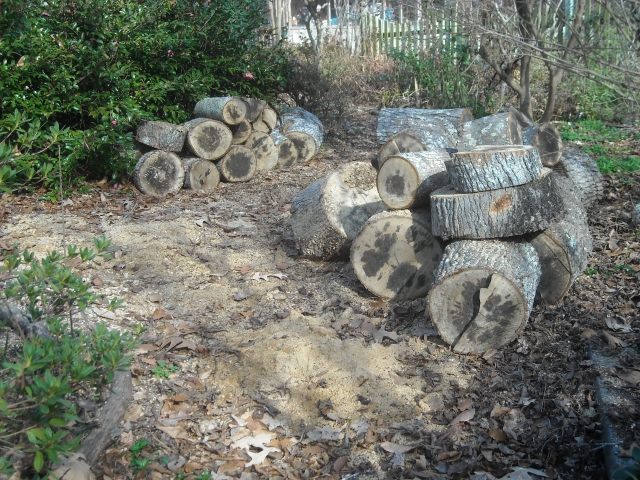
For the garden was at a low point this winter. Parts of it were/are still mired in the flotsam of Hurricane Irene. Fallen trees had to be cut into manageable chunks for hauling out of sight. Sawdust piled up and heavy limbs littered paths and beds. Carefully chosen logs that once defined paths had gone off with waves that surged during the storm. Carefully laid mulch had followed the logs or stayed behind and settled where it didn’t belong.

The scattered remains of trees, still too heavy for us to haul off, wait to be downsized

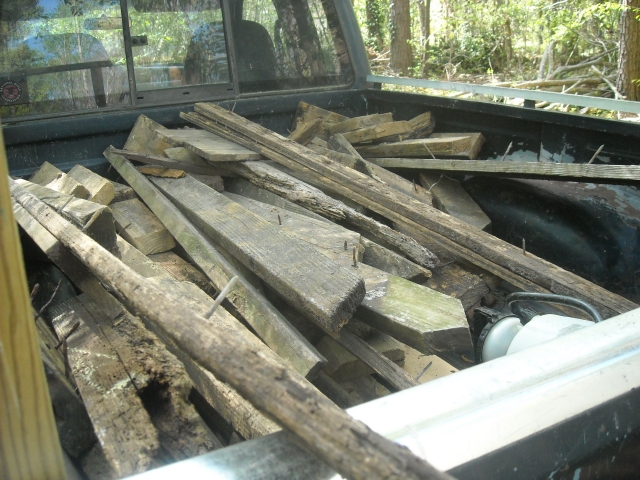
Our dock had some time ago gone atilt (a-slipping and sliding in the mud?) so it was a bit tricky to maneuver without taking a tumble. Old rotted planks, rusty nails looming, had to be torn up and there they lay in piles like jackstraws until a new dock emerged after endless afternoons of figuring and sawing, figuring and hammering, figuring and perfecting, all performed by the outstanding team of Bob the Builder and Tim his Friend.

The old dock

On top of these scattered ruins, an endless shower of leaves piled up and a rank army of weeds invaded. We wondered if we would ever get things right again.

When the winter stalwarts began to bloom, the mess didn’t seem to matter so much. Our eyes left the eyesores and focused on fresh new color from plants that are comfortable in our garden. They don’t demand much except reasonably good garden soil, maybe some fertilizer, maybe not, and decent drainage. How they love

Team Bob and Tim. Things are looking up

blooming under an open, twiggy, leafless sky with that winter sun all to themselves. They ask so little, yet they remain handsome through heat and drought and humidity.

I hope you enjoy this gallery of my winter favorites. They never fail to lift our spirits during the gray days of winter as we stroll paths or look out the windows from a cozy vantage point. 

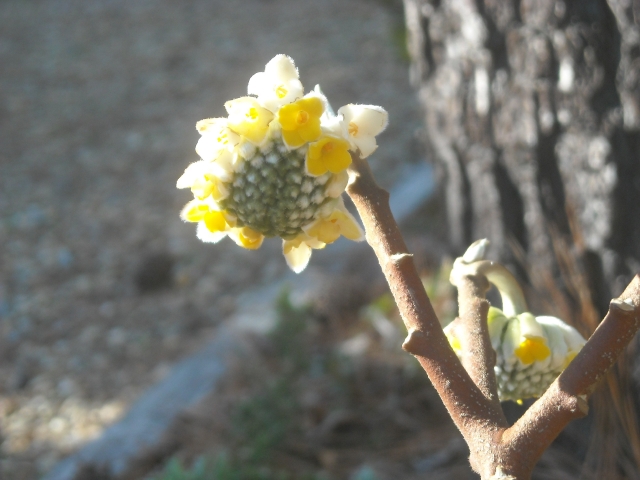
Edgeworthia

Edgeworthia: Without leaves, a funny looking pile of sticks, but fragrant, oh so fragrant from January to early March. We planted it near our front door, its stark lines softened by a backdrop of camellias, for instant sensory gratification.

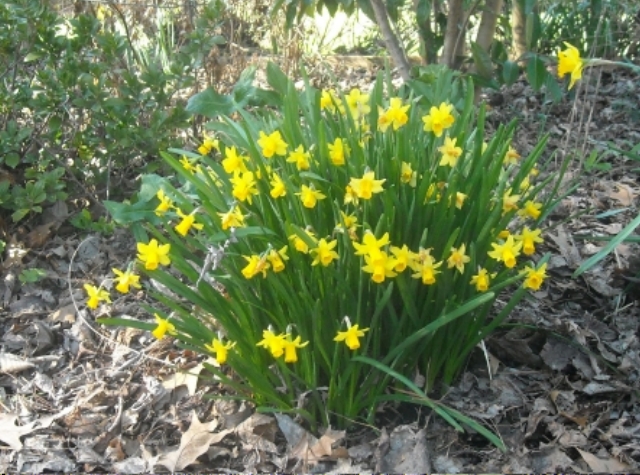
Daffodils Tete a Tete

Daffodils: For us, diminutive, wandery Tete a Tete and fragrant Ice Follies and Carlton are reliable standouts in sub-freezing weather, dry summers and wet winters. I like the masses of blue-green vertical accents in the early spring garden.

Lenten Rose (Helleborus orientalis)

Lenten Rose: Such subtle shades and subtle changes to the flowers as they age. The plants went missing after Hurricane Isabel, are back now with vigor. We remove ratty leaves, cut blooms after they drop and transplant seedlings after a couple of years growing.

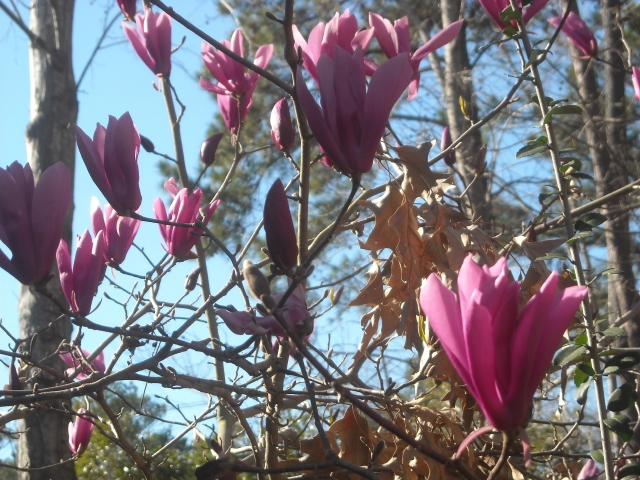
Magnolia ‘Jane’

Magnolia Jane: Never fails to inspire us. One of the popular little girl hybrids with tulip-like flowers that’s sold everywhere. It blooms sporadically through summer.

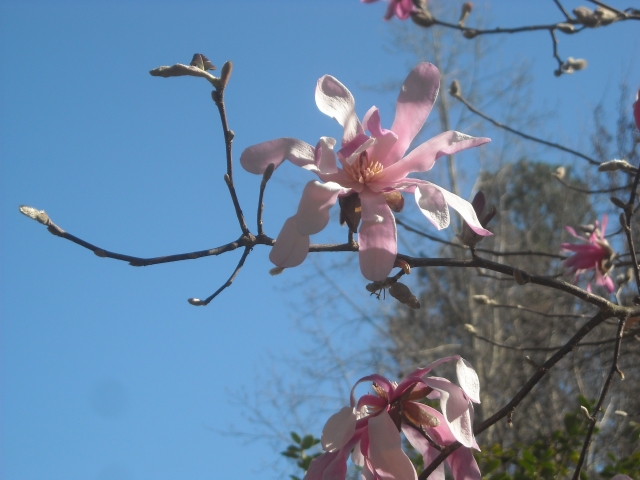
Magnolia ‘Leonard Messel’

Magnolia Leonard Messel: Early bloomer, a mass of pale pink and white strap flowers dainty and fragrant. I planted a ten-incher in rich soil ten years ago and now it’s more than ten feet.

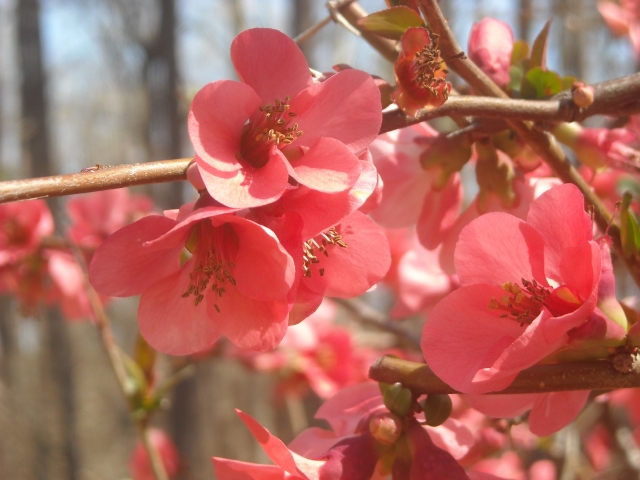
Quince ‘Jet Trail’

Quince: Thorny, twiggy, tangly, but such a reliable workhorse. Jet Trail and Common Quince begin blooming punctually on January 1st. In our neck of the woods, Common Quince defoliates in the heat and drought of summer.

Common Quince

Each of these quinces follows its own course of bloom: Common slowly reaches a crescendo and holds a high note till mid-March. Jet Trail sends out sparks, then explodes into one long fireworks display that gradually disappears in April.

Camellia japonica ‘Anticipation’

Camellia: A tough, handsome, evergreen, a southern favorite. Hard freezes kill flowers but tight buds survive to bloom another day. Drought tolerant. We fertilize in spring use horticultural oil spray for tea scale and prune when needed. See our Camellia discussion.

Loropetalum var. rubrum ‘Ruby’

Loropetalum: Imposing. Extravagant. Explodes into bloom in February. In our garden shiny deep ruby red leaves, magenta flowers under magnolia Jane’s blossoms create a wild winter display. Disease-free, deer-resistant.

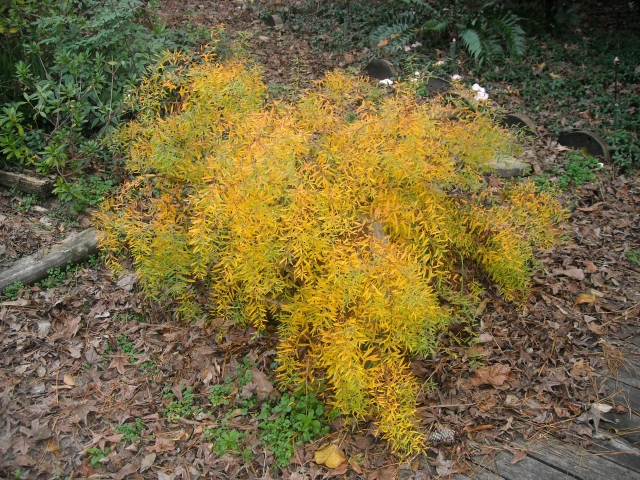
Spirea ‘Ogon’

Spirea ‘ogon’: Earliest blooming spirea we know of, a fountain of tiny white blooms in February followed by glowing chartreuse leaves all season. Modest size.

Spirea 'Ogon' shines during its first autumnEach fall Spirea ‘Ogon’ delights us yet again with its orange glow. A fast grower, ‘Ogon’ had been in our garden for only 6 months when this picture was taken. 

Winter Honeysuckle

Winter honeysuckle: A way-station for hungry bees. Blooms hidden under old ratty leaves from January through March but oh, so fragrant. Rangy, suckering, unkempt until new leaves glow in a spring sun.

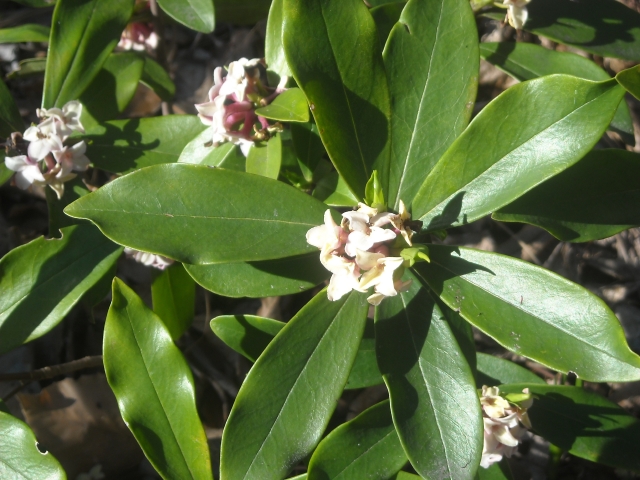
Winter Daphne

Winter daphne: Our one finicky plant. Planted high and dry to keep the wilts away. And still it may succumb. Its fragrance wafts across the yard on the slightest winter breeze so we pamper it a bit.

To all of you stalwarts: I have welcomed the good cheer you’ve given us in the past and I look forward to your visits next winter.

Posted in Winter | Tagged , , , , , , , , , , , | Leave a comment