Snapshots from our New Hampshire Garden Part I

The Privet and the Maple

I once said that I would never live in a ranch house or a red brick house, and I would never have a garden with a Norway maple or a privet hedge or a big lawn. I should learn to restrain myself.

We are currently known as the people who live in the brick ranch on the corner. We have a Norway maple and a privet hedge in the front yard and a great lawn in the back yard, and, as people say these days, it’s all good.

Our ranch on the corner backed by trees in neighboring yards, privet and maples to the right are just out of view

Here is how it happened. We were not planning to relocate and it never occurred to us that we were aging. Daughter Susan and husband Mike in New Hampshire, a little more forward-thinking, suggested, delicately, that we might prefer not to be living so far from relatives in a semi-remote area of North Carolina and might like to try snowy New Hampshire.

We said yes, you are probably right. (Even the snowy part sounded somewhat romantic because we could take a reprieve from interminable chopping and weeding necessary in a southern garden.)

But we would need space because we are not ready to part with our life stories (clutter). And we would need room for a wood shop. And we don’t want to give up gardening. And, if possible, could you find something on or near a lake (New Hampshire has a lot of lakes, doesn’t it?). For not too much money.

That is a tall order, they said, but we will try.

Two days later they called to say they had found a recently renovated, well groomed, mid-twentieth-century house only ten minutes from their home. It had ample living space and a full basement (for wood shop and library). It was on a half-acre-plus lot, across the street from a lake and a mile from a quintessential New England town with a river running through it and a well stocked old-time grocery store and a delicious hardware store and a century old library, also well stocked, with columns and a grand entry.

Slide show of the lake, which was the site of July 4th festivities

This slideshow requires JavaScript.

Yes, the lake is lovely, but the house was a red brick ranch with not one but two Norway maple trees and a six-foot-tall privet hedge and lots of burning bushes and a huge rolling lawn.

Isn’t there anything else around, say, with more of a New England flavor? My second-guess internet searches turned up quaint colonials that begged for rose-pink ramblers embracing the front door, but, oh my, what fixer-uppers they were, on wooded hillsides that would keep us snowbound all winter. Not so romantic.

So we came back to reality. Apparently there were a lot of other people who were not concerned about red brick clashing with pink roses, or  maples and privets in the garden. We jumped smack into a fierce bidding war. Like big-time brokers we fielded numbers climbing at warp speed. On property we’d only seen through real estate photos! Were we turning dotty in our golden years?

Not at all, said our children, four of them, with equally enthusiastic spouses, who had checked out the house for us and were already comfortable in a society that tosses big numbers around like confetti. They desperately wanted to see more of us without having to caravan south and seemed not especially concerned with pink roses languishing against red brick, or Norway maples and tall privet hedges, or globes of burning bushes.

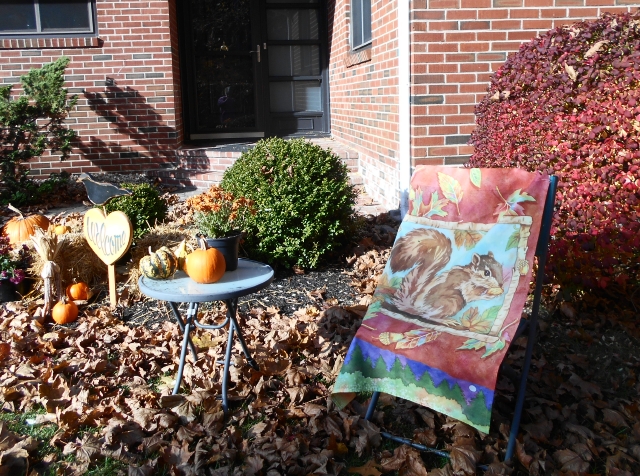
Meanwhile, to ease the transition, Susan compiled a bible with pages of phone numbers, from neighbors to doctors to contractors to local nurseries (hat page is already dog-eared) and transformed our front entry into an autumn welcome center.

Note the boxwood and burning bush backdrop against the brick

So we settled in during a 2021 New England November whose gray clouds kept us focused on re-arranging our life stories inside this brick house which turned out to be winter-snug and cozy. Lovely, because my heart was not quite ready to give up our former garden to tackle a new one.

Our southern garden of thirty-five years had been made and remade in meandery response to tropical storms and changing climate and our personal whims. It was a garden chock full of plants that toppled through life, elbowing each other, with woodland paths and surprises around corners and hot pink roses and just enough grass to service our septic system.

It was a garden that seemed on the verge of bursting out of bounds, reined in imperfectly by a gardener who liked growing more than taming. By a curious gardener who luxuriated in a leisurely work-in-progress that spanned decades.

In this garden of surprises there was no privet or maple, though occasional seeds from burning bush berries plopped by birds would grow into graceful, almost balletic understory trees, short-lived because they were too polite, or exhausted, to compete with rowdies in heat and humidity.

Slide show of our last autumn in North Carolina

This slideshow requires JavaScript.

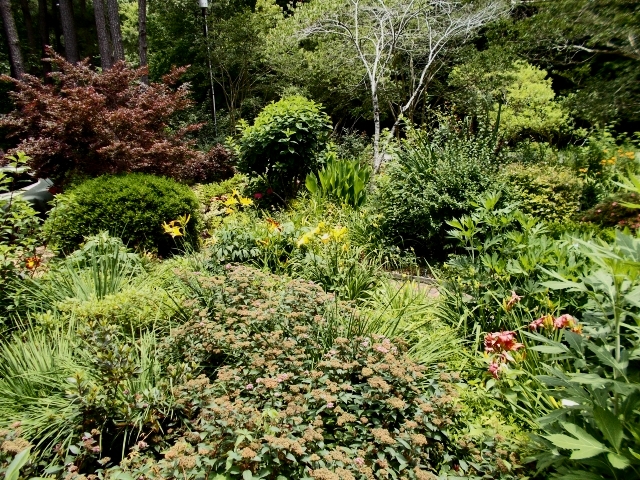
On the other hand, our New Hampshire garden is orderly and spacious. There is a classic feel to it. Magnificent trees like a Norway spruce with graceful boughs and an ancient green ash and a perfect hemlock speak of age and cycles and death. Handsome old shrubs and small trees hug the periphery of an expansive lawn, and mature trees on neighboring properties enhance the landscape.

Plants don’t bump up against other plants, or hang over them like drunken sailors. The orderly design has a European flair, and I find that gazing across our spacious lawn produces far less sweat in mid-summer than machete-ing a jungle.

Slide show of our New Hampshire garden

This slideshow requires JavaScript.

But this garden was not ours, and we did not have the luxury of decades to fine-tune it.

Off with their heads, out with their roots, I cried like Alice’s wacky Queen of Hearts. The order included 18 or 20 globes of burning bushes, arborvitae that blocked windows, assorted large shrubs that required regular, thoughtful shaping (that kind of pruning is not in our horticultural repertoire), and, of course, the privets and the Norway maples.

It would be the first time we paid for garden work that was not related to hurricane damage, and the first time Ranger wasn’t on hauling detail, having been left in good automotive hands in North Carolina.

Brandon from the bible was anxious to try out a brand new scoop with a mean dinosaur claw that could, in the hands of a skilled operator, excavate shrubs and tear out fences (a last-minute request) and smooth out disturbed ground with equal dexterity.

Slide Show of the Mighty Excavator

This slideshow requires JavaScript.

But at the end of the day, there was no time for pulling privet or maples and no space in the big pickup truck for their remains. Anyway, the maples were too big and needed to be taken down by an arborist.

 When we were young marrieds and living in suburbia, our house featured a sweeping front lawn with Norway maples planted by the town for beautification and shade. These were tough street trees (as we called them), planted because they survived.

Late winter they were leafless and twiggy and, unless frosted by storm, not very appealing

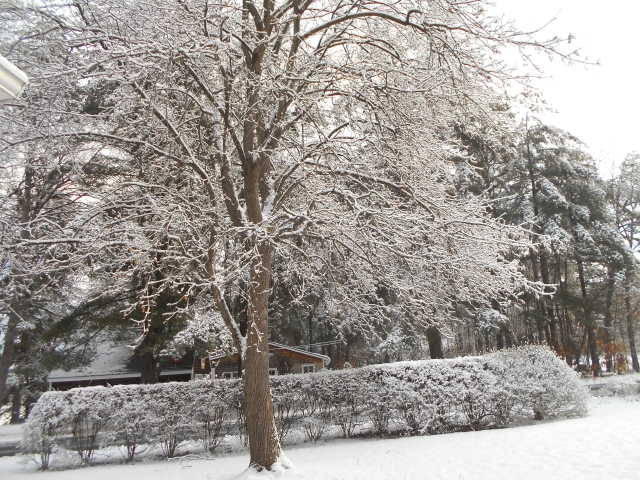
Maple and privet photogenic during an ice storm

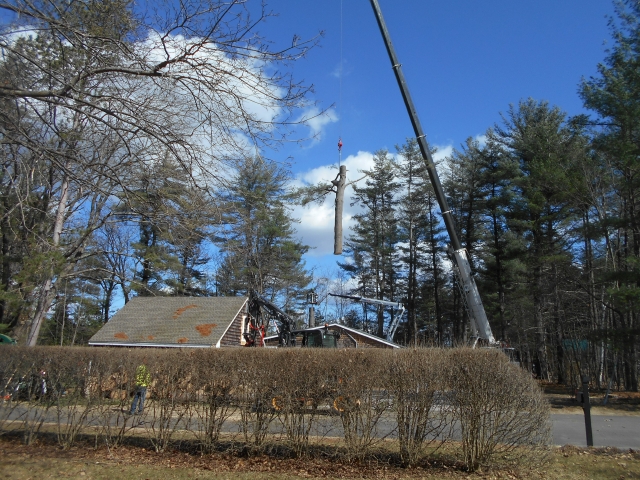
When Boisvert Brothers took trees down across the street from us, we were so impressed with their work we hired them to do in the maples.

Logs from hundred year old trees were hauled to the road from over the house across the street

I thought the company name, which means green woods, was an especially clever choice, until I learned that there really is a long line of Boisverts in the forest industry, descendants of French immigrants that settled here generations ago.

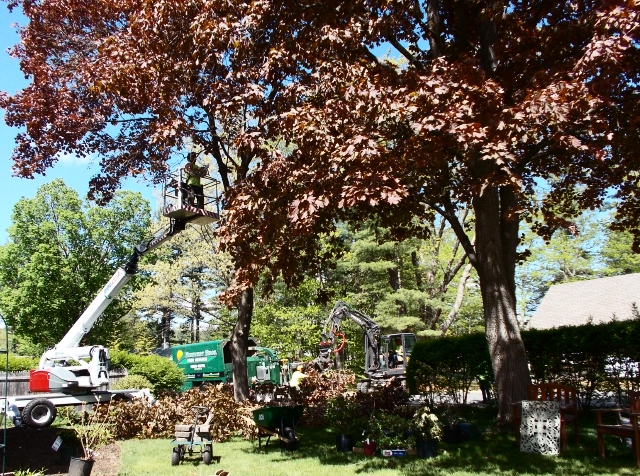
And then a funny thing happened a few days before the take-down. The trees leafed out and showcased a display of knock-your-socks off crimson wine that became stars in the early spring garden.

Maples bloom in spring fronted by privet that has leafed out

(Note for Botanical Latin Lovers: The variety of Norway maple, Acer platanoides ‘Schwedleri,’ in our garden has been around since mid-19th century. Its leaves emerge crimson and turn dark green in summer. ‘Schwedleri’ is the parent of the popular ‘Crimson King,’ introduced mid-twentieth century, whose leaves remain crimson all season.)

The old Queen took a step back. But we don’t need two! she asserted. We’ll keep the larger maple in front of the house. 

Taking down the maple

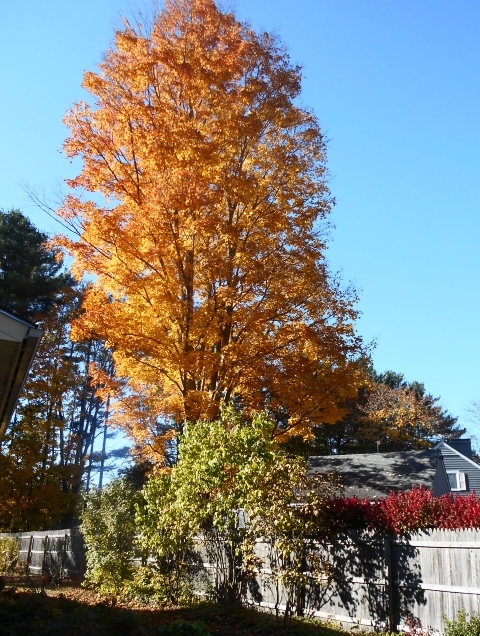
Which turned out to be a lucky call. That maple has benevolently shaded us during languid summer afternoons, before it turned to gold in the fall.

Old gold in autumn with the neighbor’s burning bush behind the fence in the background

The six-foot-and-growing privet still goes out, the baleful Queen added. No reprieve.

And then another funny thing happened a scant twenty-four hours before Brandon was scheduled a second time to excavate privet. I was browsing Google earth photos that showed our fifties ranch with the young maples and privets. I studied the picture for a while and I had an epiphany of sorts.

Our jaunty mailbox backed by now overgrown privet (Ligustrum amurensis)

We were living in one of the last great examples of mid-century gardening history! People planted maples and privet hedges regularly in front of their houses then.

When I was growing up I can remember parading around with pollynoses from maples stuck on my nose. (Technically these seed-bearing wings are called samaras, but pollynoses are far more fun, unless you happen to be raking zillions from a lawn.)

And sometimes, in the background, I could hear the sharp snap of heavy shears as my father rhythmically clipped the privet hedge near the sidewalk. No power tools in those days.

This minimalist brick ranch was in vogue then, too. Maples and privets once had their place in time, as did our brick ranch, and they belonged together. The Queen retreated. The privet will stay, she said, but cut down to a manageable height.

And so we would preserve this sliver of gardening history. But not quite yet.

Blue jays, who cared nothing for the Queen’s commands, were meanwhile building a nest high in the hedge, with plans to spend most of the summer raising a family there. The trimming would have to wait.

But we were ready now to make a plan of sorts and create a garden that would build on the history of the land and become a piece of our gardening history, too..

Nothing can top the autumn glow of trees in New England


Posted in New Hampshire garden, Norway Maple, Privet Hedge, Uncategorized | Tagged , , | 11 Comments

Gork, A Special Blue Jay

How a Baby Bird Stole our Hearts


It is not every day that a ball of fluff enters your heart and takes you by the hand and leads you into a world you could not possibly have imagined. This is a diary about a baby blue jay we rescued, and how we as a family, six of us, raised this young nestling to adulthood.

Along the way, there were adventures that threatened our adopted charge — and gave us a goodly share of anxiety.  As a bonus, we got to meet first-hand the lively gang of young and old blue jays living in oak woods that framed our first garden.

That was 50 years ago in a brand new suburb of Long Island. Its backyard featured a lawn big enough for hit-or-miss badminton games and, behind that, a scruffy area with an old jungle gym and piles of  cast-off leaves that eventually gave us rich compost and earthworms.

Native and non-native shrubs and trees were clustered in groups along the property line. They offered comfortable perches for newly fledged birds, and safe hideaways for them to view the great world beyond the nest, and spots for afternoon naps, too. Berries and seeds came along in season.

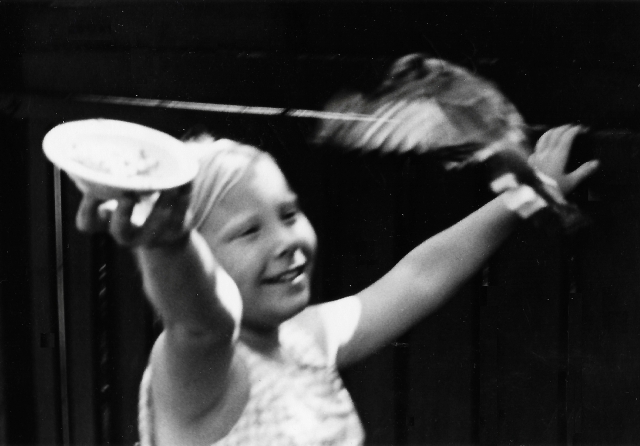
But the real action that summer took place on our back porch. Once Gork began exploring our world, other birds soon learned there was easy feeding here. Our big round redwood table, summer anchor for peanut-butter-and-jelly-sandwich lunches and family cookouts, became an exclusive, unruly banquet for birds.

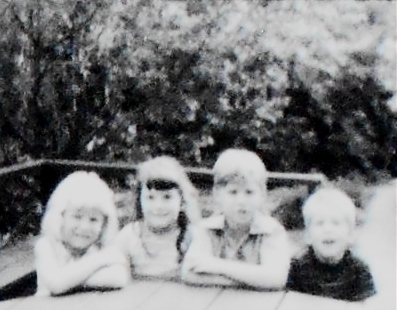
Susan and Philip, six-year-old twins, left and center right, waiting for lunch with playmates Maureen and Andrew

The memories of that golden summer half a century past had long since slipped into mists.  Serendipitously, as we packed  for a recent move, we found my diary and some old photos of those days stashed in the bottom of a box in our attic.  

As I read my entries, I began to relive the discoveries we made as a family: the caring, the worries, the suspense, the laughter, and the final twist.  And so I am sharing with you this small tribute to a plucky survivor. 

The story begins on Sunday, July 8, 1973.

1. The Rescue

The jay had been squawking for over an hour. It was, otherwise, a summer Sunday like any other. The kids were making the rounds of the neighborhood with friends. We were at peace, puttering, loafing.

Except for that incessant squawking. Was there a cat around? Vaguely we wondered where the neighbors’ cats were hiding. Half-heartedly we checked the grounds, but finding none in their usual nooks we chalked the squawks up to ill temper.

Only after the jay stopped did we pay attention. The sudden sharp absence of noise and a call to us from our nine-year-old son, Steven, to come see what he had found under a bush got us moving.

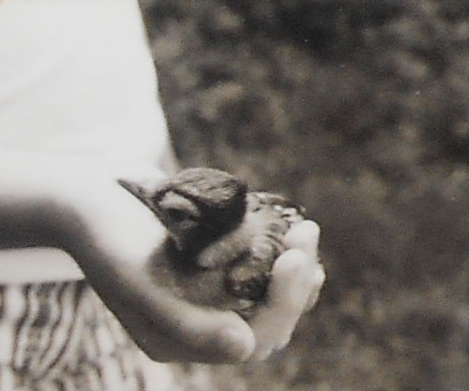
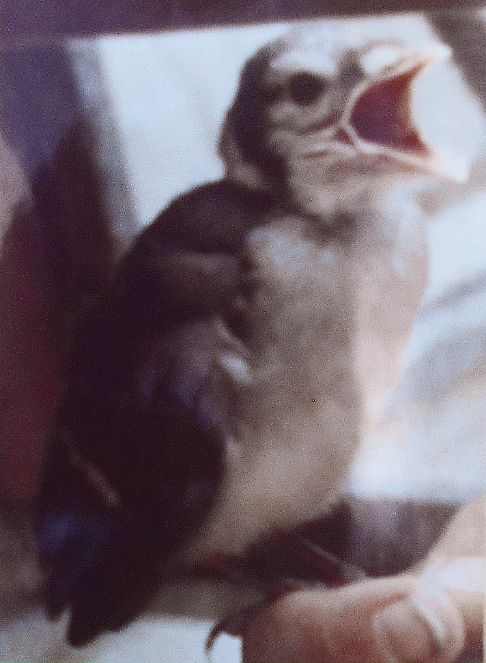
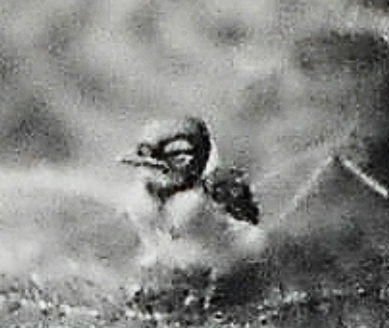
There, half-hidden in the underbrush was a bundle of fluff smaller than a tennis ball, clear-eyed, unafraid, right wing drooping. He made no move to run but gazed on us with frank interest. Only when we tried to catch him did he prove fleet of foot, if not of wing.

He dashed through the bushes, instinct apparently telling him that a precarious freedom was more desirable than capture by Big People. It was about the only instinct he seemed to possess at that point, for later events would show that he was unafraid of cats.

When he tried to fly, he didn’t stay up for long. His tail was no more than a stick, and no matter how he tried to flap his wings, he would thud to the ground. After a chase in and around shrubbery, we captured him, a bit rudely, with a small pail and a cover.

A ball of feathers

We tried to put him on the branch of an oak tree, a few feet up from the ground, thinking his parents could find him there. But we couldn’t manage to get him balanced enough to perch properly. Perhaps that droopy wing was causing trouble, or maybe he didn’t yet know what was expected of him as a bird.

He held on tentatively, but when we let go, he swayed, swung round the branch and, for a brief moment, hung upside down like a bat, observing us with those innocent, appealing eyes.

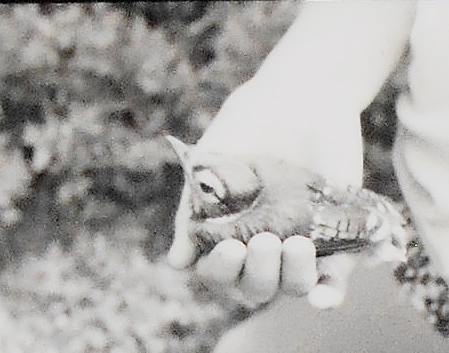
We couldn’t help but laugh at his absurd position before he floated gently to the ground. He ran a bit, but he was tired by now and had lost some of his spunk. It was easy to catch him a second time. Gingerly we cupped our hands around him and carried him to an empty rabbit cage set on a wood and wire mesh bench.

Tiny but unafraid

He did not resist when we placed him in the cage with a dish of water. Judging by his immaturity, we assumed he had fallen or been elbowed out of the nest a few days before he was due to leave.

Again, he looked at each of us with frank curiosity, innocent, completely devoid of fear. We found that by touching his breast he would climb onto our fingers and could perch there if we gently clamped his claws with a thumb to help him balance. We marveled that this wild creature should accept us so readily.

We had no idea that this bird would enter our lives and steal our hearts so completely.

We moistened dog food and put it in the cage. This is probably less palatable to a baby jay than cherries or grapes or bugs or sunflower seeds, but it is nutritionally complete and it fills the tummy. Since we occasionally cared for animals from a nearby environmental center, we kept a supply of dry dog food in the pantry.

We assumed he would feed himself, but when he did not touch the food, we guessed he was still too young to have mastered that operation.

We tentatively touched his beak with small mouthfuls of food. He opened wide, and we could see the pink insides of his gullet and his long, shiny, pointed tongue that darted back and forth.

Ffeisty fellow

But he still couldn’t figure out how to get the food down. Gingerly we pushed a fingerful of food into his beak, nudging the food to the back of his throat. Ah-h-h. Ah-h, that was the touch. He gulped the moistened dog food greedily, squealing and flapping his wings as he worked it down to his stomach.

If a fingerful was too big or the food too pasty he would have to stop a moment and swallow hard, though this did not particularly upset him. The point was, his empty stomach was being satisfied, if a bit clumsily.

Toward evening some jays (self-appointed lookouts?) arrived and began a series of calls. While daylight turned dusky we pondered the fate of this foundling. As the sky darkened and the world grew quiet he fell asleep, snug in our cupped hands.

Some cuddling for a bird after a long day

We placed him gently in the cage. Tomorrow we would figure things out.

A long day ends

To read the complete diary with photos and meet the cast of characters,  go to the black banner across the top and click on Gork, a Special Blue Jay.

Copyright @ A Herons Garden 2022

Posted in B;lue Jay Behavior, Caring for Baby Blue Jays, Uncategorized | Tagged , | Leave a comment

How Do You Say Goodbye to a Garden?

Our Southern Garden Gave Us Rich Memories

It was high dusk on a gray November day. We had countless plants we’d collected on the fly from our thirty-five-year-old garden tightly wedged into the back seat of the car. There was no looking back as we drove off to our new home in New Hampshire. We had already brushed vestiges of mud from our clothes.

The mud had not come, as you would suspect, from a wistful farewell ramble through garden beds we would never see again. The leavetaking was much too hectic for such leisure. It came from the mundane – and muddy — task of trying to read a drowned water meter. This was a final, futile favor to a county water department that had occasionally been generous to us when we left our hoses running through a summer night.

Now, the paths, the steps, the open space, the beds and borders, the woodlands, and all creatures who lived among them would be cast behind to awaken only in memories and old photos, some reproduced here in slide shows.

The Garden We Were Leaving


This slideshow requires JavaScript.

Faithful Ranger, not the garden, got the last formal goodbye. After three decades of reliable service, we were giving our ’92 Ford truck to our magician-mechanic in hopes that he would find a good home for it. Now, during this last stop, we were turning the title over to him. We gave him one last hug, and with a quick pat to Ranger’s fender we took leave.

Ranger had hauled peanut hulls, cotton dirt, manure, mulch, sand, bricks, landscape ties, fence posts, shingles, lumber and garden trash, and he had plucked stubborn, storm-damaged plants from garden beds with the pulling power of his six-cylinder engine. There probably wouldn’t have been a garden without Ranger.

There Will Never Be Another Ranger


This slideshow requires JavaScript.

Our garden had grown into a bunch of rambunctious, wayward, tumbling rowdies, always threatening to spin out of control. Each year, I vowed would be the year the garden would shape up. That never happened, of course, as plants have a way of growing out of bounds in southern summers.

So we settled into rationalizing that the garden was a work in progress that bugs and people liked, one grand experiment. Bob called it The Jungle.

Mind you, I was forever transplanting and re-organizing, rescuing the timid from thugs, removing innocents caught in the way of my current new wave (a touch of idiocy?), and taming upstarts that hadn’t read the books. But that wistful eye for just another new plant, like wondering what’s around the bend in the road, kept me in a pickle pail full of delightful discoveries, including, outrageously, a Dawn Redwood that eventually shared the skies with oak and maple.

So spirea nudged azalea. kerria tangled with sinocalycanthus. Clematis ‘Nelly Moser’ lounged on ‘Fashion’ azaleas. The tendrils of sweet autumn clematis tried mightily to reach out and embrace the entire garden. Summer natives danced out of bounds. Grasses kissed the sun. And we took pleasure in the tangle.

Lovely Rowdies


This slideshow requires JavaScript.

During the final rolling weeks of packing, plants had become the last things on my mind. Earlier, they had been first priority. So many had been propagated here, they were like a second family. I dug up whatever I thought would survive the move North and, graciously, Steven and Susan transported and cared for my potted addictions (except for last-minute smuggles noted above).

There were not as many as I thought. I’d spent years of hankering after one of those perfect New England gardens featured in glossy magazines only to find that the plants inevitably succumbed to southern heat, humidity and mucky soil. Finally, I had learned the limits of my space and I grew to love the lush growth and lavish parade of bloom that came with these southerly tough/tender plants.

Now that we were moving North, I was saying goodbye to plants I would not soon meet again: camellias, Florida anise, abelias, southern azaleas, and most of my hydrangeas. And especially that grand watermelon crepe myrtle strung with Spanish moss that transformed our modest front lawn into a cliched but gracious southern landscape.

Southern Plants I am Missing Already

This slideshow requires JavaScript.

It wasn’t just plants I was saying good bye to. Years back I came to gardening with a scrubbed face and shining eyes and lots of book-knowledge. I thought I knew it all. Yessiree, I would build beds and borders just right, perfect, with plants that behaved. I had the ultimate Grand Plan.

Then people started giving me plants. I was touched and delighted. But, horrors, their plants were not part of my Grand Plan. Oh dear! Where do I put a plant that is not part of the Grand Plan?

I needn’t have worried. In those first years we had no idea of how to garden in gray clay that dried to pottery shards, so most of my Grand Plans fizzled. I welcomed gifts from knowledgeable gardeners. As I watched the plants grow and bloom, they evoked sweet memories of good friends.

I learned that a garden is a tapestry tight-wove of plants and people and remembrance of good times past. Like the lingering sweet smells of blossoms on a moonlit summer night, memories of people who loved plants, walks and talks with them, visits from Master Gardeners, plant sale days, faux barbecues on the gazebo, even making quince jam, gifts given and received, would fill my spirit as I brushed by familiar plants.

And I will never forget the peace that wrapped itself around one and all as we roamed the paths or relaxed in the gazebo. I can still hear the quiet swish of breezes and wavelets off Albemarle Sound that once lulled us into golden hours, remote from the clutter of everyday life.

Now the memories belong to me, but the plants belong to others.

People in the Garden


This slideshow requires JavaScript.

I had never set out to create a garden for butterflies, or birds, or other animals. I simply collected lots of plants that I liked, and tossed them together into a smorgasbord with woodlands. And life came out of the shadows and into my garden. Swamp red bay (already on the property) and spice bush (purchased as sprigs) attracted swallowtails.

Blue mist flower was a siren that drew every sipping insect with wings, and slender black wasps loved clethra. Wild honeybees gossiped in abelia grandiflora until mites invaded hives and silenced the happy spring buzz. Argioppe spiders, relatives of wise Charlotte who crafted messages in her web, crafted their own messages to lure end-of-summer prey.

As to the unwanted, chiggers and ticks and mosquitos, well, we managed, occasionally having the garden sprayed professionally with garlic and essential oils. There might be holes in some leaves, but mostly the garden remained healthy, possibly because we were faithful about adding compost that nourished plants and erratic about using chemical fertilizers. Camellia tea scale was the only insect we treated with oil spray once or twice a year.

The Small Critters We Loved


This slideshow requires JavaScript.

Come warm sunny days in February I’d be poking around, impatient for new life. If plants weren’t risen and happy I would fret. But with the February sun came the first tentative warblings of newly awakened birds and my spirit would quicken. Territorial stake-outs and mating would lead to summer adventures.

Mockingbirds claimed exclusive rights to elderberries. Baby titmice prattled in baskets of ferns. Cardinals fought their reflections in windows. Woodpeckers woke us, banging on metal drain gutters.

Carolina wrens regularly invaded our garage scouting for nesting niches. Hummingbirds buzzed indignantly when the feeder was empty. During a droughty year a woodcock visited our sparsely watered garden to seek worms nearer the surface than in the dry woods. And, through dusky woodlands, a wood thrush would send us a summer aria.

One year a cowbird deposited her eggs in the nest of a prothonatary warbler. How disappointing to see baby cowbirds instead of baby warblers!

One spring a black snake took up residence in the bluebird box just as the babes were ready to fledge, traumatic for us and the family, and for the local bird population who flew in to – well, we are not sure why. Watch the action? Express outrage? Render vocal support? Get first dibs on an empty birdhouse?

Bob turned the box upside down and banged it until the stubborn snake apparently got addled. As it tried to slither away, he caught it and took it to a distant patch of woods while the birds were reunited. Amazingly, all but one nestling fledged.

Osprey keened when the amelanchier bloomed. And the great blue heron would stop by in summer for fishing and loafing, along with the turtles. One year, when we were cleaning the pond, he skulked behind shrubs and trees, homing in on vulnerable fish. We were on to his tricks but he knew when we were watching and he figured out how to win.

Winter, plants stripped of frippery, would reveal the housekeeping of summer’s smaller tenants: messy, casual, accomplished. Then February would come round again and we’d see the lone pied billed grebe cavorting in our slip and hear the first warblings that heralded a new spring.

Heron and Friends

This slideshow requires JavaScript.

Sometimes, when I puttered during quiet summer evenings, potting or transplanting, a young squirrel, or a solo rabbit would follow me around, so close behind I would have to watch where I stepped. These young critters, recently graduated from cozy nests, seemed to want company, any company. I enjoyed their presence and would murmur nothing-phrases to them as I moved through the garden, though I was happy when they grew into independence.

One summer a frisky fawn latched on to me, one of twins introduced to us on a sunny afternoon by the doe herself. He’d watch me while I gardened, waiting for me to chase him. When I turned round to scold, the game began. One day I found him devouring an entire vine, tendrils dripping deliciously from his mouth. I stood quietly until he finally noticed me. One long moment of indecision, then, with great reluctance, he dropped the vine and took off before I could scold him.

Creatures came and went. There was a part of the property we rarely visited, left it to wildlife. A pair of coyotes camped out for a couple of years, skinny, almost gaunt. I know because I came face to face with one as we crossed paths. I took a silent breath. We stood motionless, both vulnerable, sizing each other up. I dared not turn my back. The coyote, braver, finally turned away and loped off.

Then there was the blind raccoon who hung around for a few weeks and scared a young possum away by accidentally bumping his nose. And the semi-tame rabbit from two properties down who wandered to our place regularly, following us as we worked. And the otters who played on our dock one summer. And the beaver who must have had delusions of grandeur thinking he could gnaw down a forest of mighty sweet gum trees.

The crayfish that were always building castles in clay undermined our paths, but we never managed to spot one. For a while a groundhog was resident, but during a rainy year he left after his underground digs turned muddy. We had tried to catch him but only snagged a baby raccoon, whose mother, distraught, left the grounds permanently, trust broken, even after we freed her youngster.

There was always a frog singing in the pond. One summer we swore he sang to us, since he was quiet until we came round and spoke. Occasionally a fox showed up but we never found a den. And once there was bobcat scat in a planter box, but we never saw the bobcat.

The Bigger Critters


This slideshow requires JavaScript.

If Ranger was the workhorse on wheels, Bob was the builder who quietly did what needed to be done outside, and that is probably my fondest memory of all. Bob gave the garden its structure: gazebo, shed, decks, dock, steps, fences, brick edging for beds, crooked paths with steps, an automatic watering system, and the courtyard off the garage. Sometimes he worked solo; sometimes friends joined him.

Any bright new idea I had he was willing to tackle, transferring my sketchy thoughts with deliberation and a Number Two pencil onto graph paper, until he converted ideas into reality. Our first project, a challenge, was laying brick for a sinuous wall under our large south-facing den windows.

Most years there was damage from storms and Bob would be out lopping and pruning and sawing, sometimes felling entire trees while I held my breath. These were probably his favorite projects. A man and his chain saw. . .

And his chipper-shredder. We would rake and he would shred leaves and branches to make instant mulch, some of which eventually became velvet soil. As trees grew taller, we’d be ankle-deep in leaves. But those leaves were clay-busters. After years of mulching, our soil finally became diggable.

Far less dramatic were my numerous requests to plant and transplant, so Bob made himself a distinctive Master Digger badge to wear during garden tours and plant sales. As he dug, he sent each plant on with a proviso: Don’t get too comfortable, he’d say, because you will probably get moved—again.

Oh, and Bob was good friends with Ranger.

Mr. Bob

This slideshow requires JavaScript.

Three decades of my memories are seamed to the garden with a lock stitch that cannot unravel. Having tossed the rigid Grand Plans and planting for joy instead, I began collecting spectacular (to me) trophies with a sense of adventure and the zeal of a religious convert, haphazardly, from anywhere – weedy fields, abandoned gardens, rural mom-and-pop roadside offerings. If nobody was home we dropped our money in an honor box.

Often I tooled around country roads with a good friend scouring ditches and vacant fields we’d scouted previously (trespassing?) to gather samples of all sorts of interesting plants (weeds? No, natives.), always watching our backs for the muzzle of a shot gun as we dug.

Rose’s Department Store and the old K Mart had interesting plants, too, for practically pennies. . The crab apple in front of our house came from K Mart and was the first tree we planted that lived. It cost $8. It bloomed the first year.

Once we found dogwood saplings for a dollar a piece, but you had to buy ten to get the bargain. Ten dollars! Too much for our thrifty plant pocketbooks! So we divided them between us, and split the bill, and five dollars didn’t seem so outrageous. And yes, most of them lived!

Plants-by-mail were cheap, postage nickels and dimes. As we explored the coast, from Florida to Maine, I inveigled plants from specialty nurseries, motel managers, garden caretakers. Verges along country roads gave up some gems, too. The challenge was in the chase.

I confess today to owning a large wooden box dedicated to certain garden keepsakes: plant labels and price tags (which also remind me of how many I lost along the way).

But, oh my, when I learned how to propagate plants from tiny cuttings, that was the ultimate in plants for pennies. From a couple of purchased George Tabor azaleas I grew great swathes of blooming plants. Roadside plants contributed specimens, as did friends’ gardens, and other nameless gardens. Large carry-alls hid evidence of twig-rescues for a good cause. Each cutting that lived created a special memory.

So the garden grew from cuttings and clippings, and I began giving away plants until I noticed people avoiding me when I had a potted plant in hand. That was when we began holding annual plant sales and donating funds to environmental education.

Many of my trophies perished along the way. But many lived on, too, and those ragamuffin early days of plant hunting hooked me, even as plant prices rose and plants were often strait-jacketed in pots with pretty pictures.

In the beginning, I believed I was the guiding light in the process. But chastened by experience, my focus shifted from collecting to looking, really looking at my garden, absorbing the joys and disappointments as they came along.

On grand scale I rejoiced in a fairyland of dancing lights and shadows over the water on summer afternoons when the sun came in from the west. Then we would sadly clean up the mess when storms struck down the fairyland. On smaller scale, I took delight in blossoms lit by stray sunbeams that tarried after sunset. These picture-memories of fleeting visions I hold close.

Early Gardens and Plant Hunting and Propagation

This slideshow requires JavaScript.

Each spring, we declared, was the best ever! Were we honing our gardening skills? Learning to grow better plants? Coping with clay? Had we become sorcerers? (Such preening!) No, the joie de vivre came not from us but from the timeless rhythms of nature. We were only her stewards seeking pleasure in her handiwork.

By mid-summer, the garden could look tired, with no relief from hot days and hot nights. Fall was a resurrection of sorts, as new blooms and berries and golden leaves shined up the garden. Snow in winter was a treat, though wet winters could send mud up to your ankles.

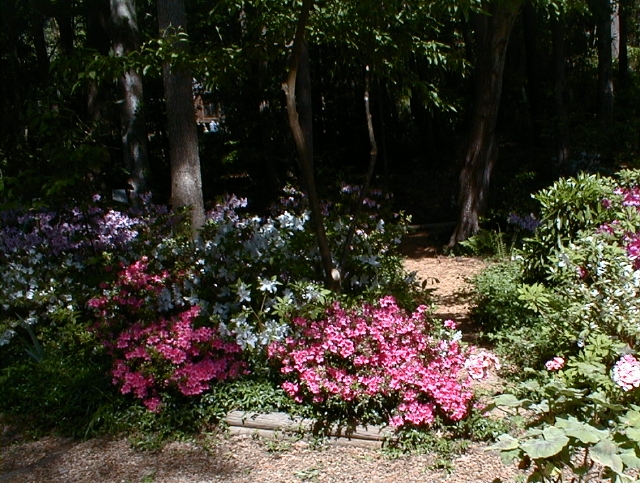
But spring was special because plants were just beginning to stretch out, not yet encroaching on each other. We could enjoy order and leisure and color in a fresh, dewy garden. Weeding and pruning and watering would come later. We could cheer the splendid parade beginning with camellias and on to magnolias, azaleas, clematis, flowering trees and hydrangeas.

Those Glorious Springs

This slideshow requires JavaScript.

The woods were a dark backdrop to the garden during those first few years. Only the trees around the house were cleared. Which goes to show what suburban slickers we were. In hurricane-prone country it is not a good idea to have trees hugging your house.

We built our house with more windows than walls, the better to see the garden and the woods year round, also trees coming down during storms. Our garden in the woods might never have tripled in size if Hurricane Isabel hadn’t taken away some 150 trees and brought us light for growing azaleas and daffodils, which then made way for a new generation of trees.

A third of the trees were doomed immediately, twisted and thrown by embedded tornados or pummeled savagely by winds up to 100 mph until they toppled. Others, seemingly unscathed, were damaged internally, susceptible to insects and disease. They succumbed over time.

Isabel also taught us that trees change, light changes, even soil changes over time. The garden that once was can never come back without persistent masterminding.

Above all, she taught us that trees rule. Thirty-five years ago they were bumptious teenagers, leafy, skinny, and expectant. But our woodland trees were tough and patient. They scrabbled, they elbowed, their roots tangled, embroidering a complex network of self-support. They created their own soil and they inched up to 80-foot towers without our really noticing.

They gave us cool shade and they whispered to us on breezy days, and we used their leaves for mulch. But trees are takers. There is no contest between trees and alien plantings. And no compassion. Trees win unless the gardener is attentive and patient and willing to lose some struggles. We did not know this when we began our journey.

These trees were not picture-book quality. Some appeared to be girdled and half rotten at the base, yet they carried on. One was hunchback. Many had lost big limbs, so they were scarred and misshapen.

The Grandfather Pine that overlooked the north edge of the property spent a couple of years dying before, too late, we noticed that its upper branches looked like pins in a pin cushion on a pole. Bark beetles had clogged its arteries.  A few years after we took it down, termites were working on the remains, turning it to dust and returning it to the forest.

Would we have given up our trees? Given up those afternoon shafts of sunlight sliding among their trunks, washing them with crayola-crayon earthtones? Given up our glimpse into the lives of birds among their branches? Given up following the lives of our trees as they flourished or became vulnerable and declined? You, dear reader, can guess the answer.

Instead, we cleaned up messes from storms and soldiered on to create our Garden in the Woods. Despite some spectacular disappointments, we learned patience and wisdom and acceptance and how to get along with the trees that had become family.

A Garden in the Woods

This slideshow requires JavaScript.

I left a part of my heart in that North Carolina garden. Mostly I miss the light whispering through trees, kissing leaves, dropping diamonds on wavelets. One afternoon a visitor told me that he felt like he was in a fairyland, and that vision will stay with me for the rest of my life.

A clear resin suncatcher with memories pressed from our fall garden, gift from a talented neighbor, sparkles in the morning light that streams into my new kitchen. It makes me smile.

I wonder about the garden. Will the new owners be patient with the trees and the tangle? Will they be patient enough to wait for the ‘Near East’ crepe myrtle whip we planted in an oversized box of landscape timbers to rise and bloom? We renamed the tree Hope.

I guess the best way to say goodbye to a garden is to begin work on a new one. But please, allow me a few more memories of our thirty-five years in our eastern North Carolina landscape.

Some Final Memories

This slideshow requires JavaScript.
Posted in Garden Memories, Uncategorized | Tagged , | 14 Comments

Celebrating the Roots of our North Carolina Garden

A Lesson in Patience

I’ve had a quietly satisfying epiphany! After listening to gardeners across the country I began to see how place — geography, environment, climate, soil — defines the character of a garden — and sets the limits.

I’m not always the culprit when things die. Or malinger. Or grow so out of bounds that guests have to machete their way to the front door by midsummer. Blame it on the elements, I say. Not on me.

Where there had been empty spaces and shrubs that behaved, by July there is a jungle in front of the house

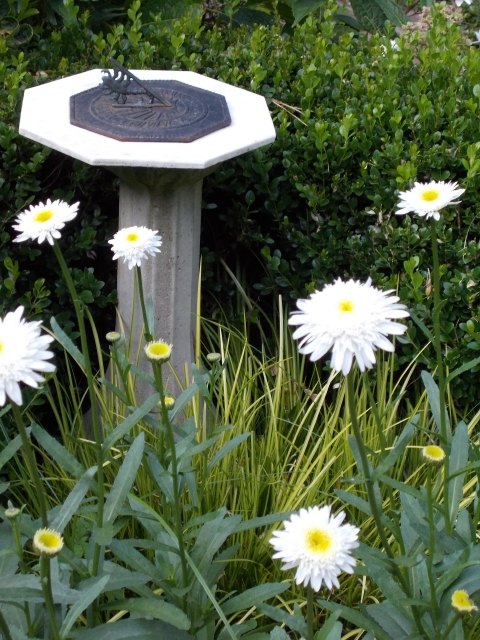
My eureka moment probably sounds pretty ho hum to you. Isn’t it obvious that desert plants won’t grow in bogs and reindeer moss won’t grow in the tropics? Yes, but I’ve learned that there are fine-tuned elements that make growing shasta daisies, for instance, easy to grow in one garden but impossible in another, and rarely do we understand why.

Special shasta daisies from friends bloomed for a season, then disappeared

My absolution has been years in coming. It probably began sub rosa during warrior days as an environmental steward advocating for clean water in eastern North Carolina — and delighting in the special dance between land and water here.

Exploring canoe trails and byways, wildlife refuges and historic sites put me in closer touch with how this dance shaped life throughout centuries. These were quiet times spent paddling creeks and ambling trails and moseying main streets of small towns. (Note: Good ice cream cones in these small towns around Albemarle Sound.)

A quiet afternoon on a creek that flows into the Alligator River

You meet a lot of people during all this advocating and meandering. Some were living in old family homes with a long history. These modern tillers of the soil had deep and abiding love for the land that nurtured generations. Rough treatment by the elements some years, and maybe famine. Or cornucopias of crops other years. It didn’t seem to matter. Their reverence for the land was rooted in faith and acceptance.

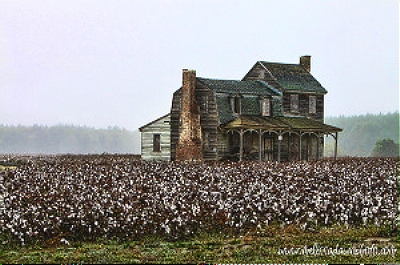
The 1786 Pendleton House in Pasquotank County surrounded by a cotton crop. Photo by Melissa Dawn

They accepted the unexpected and the unwanted. I had not encountered this depth of contentment-in-place anywhere else, and it touched me, and I began to delve deeper, even develop roots here.

Not the deep tap roots of time and family, but thready, wandery roots that pulled me into exploring past dynamics of this special place.

For me, it was a voyage through time and change on a landscape governed by wind and water.

Not so long ago, mighty trees once grew here in rich lowlands bathed by clear, tannin-stained black-water creeks and rivers that supported abundant wildlife.

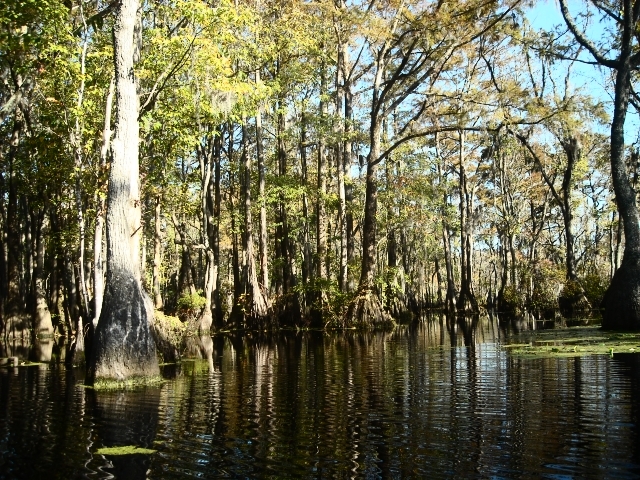
The upper Chowan River calls to mind the bottomlands that once covered much of northeast North Carolina

Our garden is not founded on rich bottomlands that once nourished farms. Instead, it is rooted in another typical eastern Carolina soil: gray clay. Our garden sits where quiet waters once lapped a shore, surrendering fine suspended sediments, laying them down in beds eons ago.

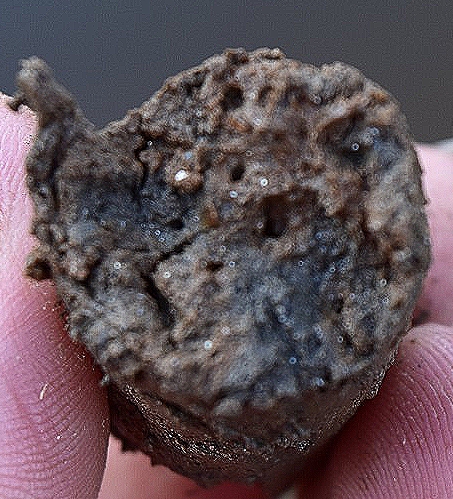
An example of gray clay in wetlands

Clay doesn’t tame easily, I learned. Even today, after modifications, it asserts itself. In the beginning, even weeds would not grow. I am responsible for the weeds. I brought in truckloads of topsoil that was supposed to bury the clay. The weeds were hitchhikers.

So I began to look at the garden through a set of long lenses that took me back through centuries-old time capsules of drought and flood, storm, and sea level rise and fall.

I began to understand that what was happening in my garden was a reflection in miniature of a greater landscape. Weather and climate toy with my plants just as they destroyed or nurtured corn crops of yesteryear, dispensing famine or feast on a whim of the wind.

Camellia shoa noa saki thrived for twenty-five years but finally succumbed after several rainy seasons super-saturated its moorings

I don’t have to worry about famine, but storms have torn trees from their moorings. During droughty years, ferns droop and plants shrivel and the clay cracks. Rainy years may bring great blooms in spring, but as summer slides away, plants tire of struggling in saturated soil. Or they are cut down by prolonged seasonal dry spells. Or, if I am lucky, during a good summer they thrive.

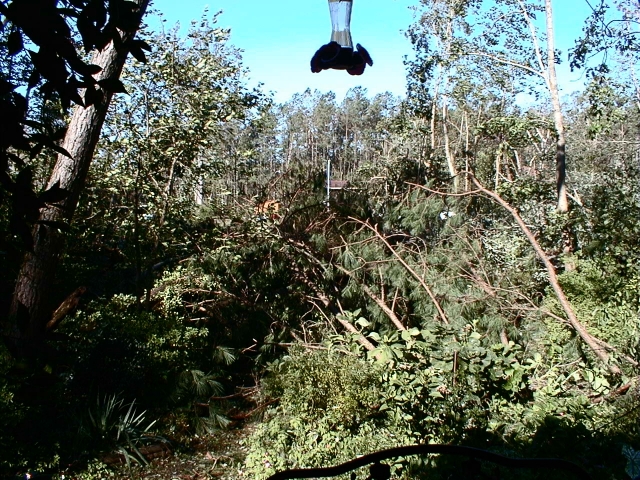
Hurricanes can erase a garden. View of our back yard after Isabel. The storm did not stop the hummingbirds

It took us a long time to gracefully, or not so gracefully, accept that today’s conditions would not necessarily apply to tomorrow’s seasons, that fickle clay was beholden to weather, morphing from muck to concrete as rains soaked or sun dried.

That compost lovingly laid down disappears in clay that floats to the surface after torrential rains. That it is pointless to wrestle shovels in muck that sucks all things into its maw. That we can neither depend on nor predict what the sky above will bring us.

We learned patience. Dynamic, living systems are not built in a month or a year or a decade. They are the results of millennia of change. (Yet they can be destroyed in a bulldozer-moment.) We are only ciphers in time on the land.

A prime example of patience! Here is a bald cypress, almost three thousand years old, among several growing in the Three Sisters Swamp of the Black River in southeastern  North Carolina. They are the oldest living trees east of the Rocky Mountains. The swamp is protected by The Nature Conservancy. istock photo by Earle Liason

Our property was a dark hole when we bought it, a runty mob of pines smothered by catbrier, vine and pine battling for light. An odd-looking skeleton lay on soft pine needles, a few scattered bones permeated by drifts of sea fragrance from a midden of mussel shells tossed by otters. (Lots of chiggers, too, we would discover.)

Not a particularly inviting canvas for a garden, but we were up for challenges we didn’t expect.

Dark woods were the backdrop for our first gardens, until storms toppled trees and brought light

It would take time to understand the singular contributions of earth, sky and water to this place and learn to play off them to grow a garden.

And even more time to accept that our land will never grow those shasta daisies, gifts multiple times over from good friends, divisions freely shared from their gardens growing on a river bank only a few miles away. But we can have fun with hydrangeas — and camellias and azaleas!

Two ‘Ayesha’ hydrangeas back ‘Lemon Zest’ not yet in bloom

And so I learned to celebrate the special gifts from our patch of land. I came to understand all this and write it down a month or so before we left the garden for good.

Posted in Climate Change, Creating a Garden, Environment, Northeast North Carolina, Uncategorized | Tagged , | 1 Comment

To Spray Or Not to Spray

The Unvarnished, Untold Story of our Pleasure Garden

Many of you commented on my recent posts about the wonderful spring we had here: a lovely blend of copious rainfall, balmy temperatures and sunny days that produced boundless garden bouquets.

Now I must confess the rest of the seamy story.

The underbelly of our garden is an iniquitous den of bloodthirsty despicables. This year they took advantage of moist growing conditions to multiply and gear up and gang up. They specialize in guerilla tactics and sneak attacks and they have taken over our garden like the thugs they are. We are being held hostage inside our house.

Beneath this tumultuous landscape lurks a hidden horde of ne’er do wells waiting to pounce on a trespasser

What’s a gardener to do? We mounted a blitzkrieg on the bugs.

After all, we have our reputation as gardeners to consider, which is not particularly sterling when it comes to controlling unruly guests. Summer visitors often come away from our gardens with souvenirs they didn’t count on.

Worse, we are probably the culprits in dispersing armies of villains by grinding litter from some beds and returning same, homogenized, to other beds. Fortunately, friends and relatives have been good-natured, but there are limits.

We clear the garden beds and the critters obligingly came along

As you may have guessed, the despicables are ticks, chiggers, and mosquitos.

So we called Jess, maestro of the blitzkrieg. She’s experienced. She’s on target. She’s a bugs-in-common friend.

Back in 2013, when our reputation was at a low point, I asked Jess, who had recently picked up a franchise for spraying despicables, if she could treat our garden with only natural ammunition, no synthetic chemicals. It would be an experiment. We’d take our chances on success.

Her parent company agreed with the plan. Jess sprayed only with garlic. The despicables were routed. We became her first customers to go “all natural,” and now most of her spraying is done with natural oils.

Essential oils are best purchased and stored in tinted bottles and should not be adulterated with other ingredients


This year Jess sprayed with a combination of garlic – lots and lots of garlic—and essential oils from a variety of plants: tea tree (an Australian native), cedarwood, lemon grass, citronella, rosemary, geranium, and chrysanthemum.

(Helpful Tip: Jess recommends a mix-it-yourself tea tree oil spray to repel ticks when you are outside: 8 or 10 drops to one cup of water in a spray bottle. Tea tree oil is readily available on-line or in drug stores.)

Since the garlic in the spray can be irritating, Tess wears safety glasses and a respirator, (standard Personal Protective Equipment or PPE) and dresses in layers with a hoodie. We stay in the house. She uses a gas-powered blower and carries a pack that weighs 68 pounds.

Jess geared up and ready to spray

You can smell the garlic for a few hours, but bees, butterflies and birds don’t seem to mind. They were out and about shortly after the fog dissipated.

Dragonflies were active, too, but I worry that they will go to bed hungry tonight. They can reach flying speeds of 30 miles an hour, twisting and turning to scoop up mosquitos and other fliers, but the mosquitos don’t seem to be flying now!

Some other animals may go hungry for a while. We may be dinner for chiggers, but chiggers are dinner for ants, beetles, centipedes, spiders and birds. And ticks are dinner for chickens, frogs, possums, ants, and probably some others. They all fit into a food web that we civilized people mostly try to ignore.

Well, I can’t worry about the world all the time. Spraying with essential oils, which are the volatile aromatics that plants produce to protect themselves from becoming some animal’s meal, sure beats using Sevin ready-to-use with carbaryl.

It is such a joy to garden without a nest of baby chiggers under foot ready to scale the heights of my torso, stopped only by bands on clothes. I know these tiny, almost microsocopic, larvae of the red bug or harvest mite are just trying to make a living but I’m not crazy about their dissolving my skin cells with their saliva for a feast. These relatives of spiders do not burrow, by the way, a common misconception.

A 1790 lithograph of a chigger. PBS

Itchy bumps are caused by your body breaking down the feeding tube chiggers leave behind after they fall off or are brushed off. They are best treated with anti-itch cream and calamine lotion. Teenagers (nymphs) and adults are pretty benign, feeding on decaying matter and soil insects.

The best thing about chiggers is: They do not carry disease, at least not here in the United States. They do carry a disease called scrub typhus in a wide swath of Asia and Australia, and most recently in Chile.

The redbug, or adult version of the chigger. Note the 8 legs which makes it a relative of the spider. TexasStandard.com

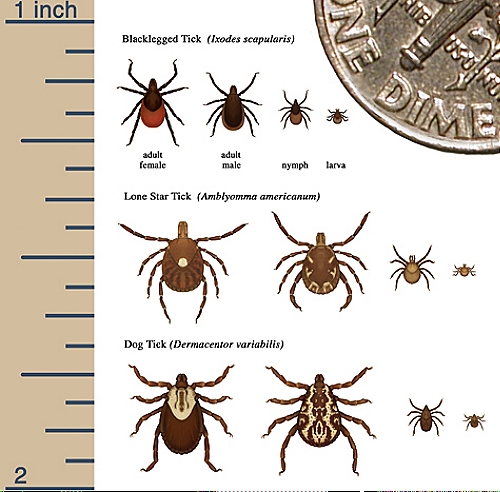
Ticks, also kin to spiders, are another story. They can carry serious diseases like lyme disease and spotted fever that need immediate treatment. Lone star ticks, recognizable by the prominent white blotch on their backs, can cause alpha gal syndrome and allergy to red meat that can be life-threatening.

Size comparison of ticks, from larvae to adult. CDC diagram

Ticks are blood suckers from the time they hatch as six-legged larvae, then grow to eight-legged nymphs, and finally to adulthood. They only need one meal per stage, but if you happen to be dinner during one of these stages, that’s one meal too many. The good news is, they die if they don’t eat during each stage. Most of them die, thank goodness.

How do they latch on? They have a behavior that is, quaintly, called questing. For me, it brings up images of knights in shining armor on their quests in the old days (though I was never quite sure of what their quests were – the hand of Guinevere maybe?)

Female lone star tick, identified by bright white spot on back, is questing, or extending front legs hoping it can hook onto a hapless animal passing by. ticksafety.org

Snakes don’t quest. Rabbits don’t quest, but ticks do. They perch on foliage near the ground with their two front legs extended, hoping to snag a passerby. If they succeed, they will explore this new (involuntary) host till they find the right spot, tender and. perversely, just beyond easy reach.

They are alerted by an animal’s breath, body odor, body temperature, moisture and vibrations. (And here you thought that morning shower made you invincible.)

Greatly enlarged, this group of larval ticks is cluster questing; they are hooked to one another and will automatically tag along when the first tick attaches to an animal. Photo by Brenda Leal, Entomology Today

As they bite, ticks may transfer some saliva into their host. If the tick’s saliva is carrying pathogens, it can cause disease. On the other hand, if the involuntary host is diseased, the tick will drink blood that will infect a new host the next time it feeds.

Proper suiting-up before gardening and a thorough check afterwards will prevent most insect trespass. Detailed information on ticks, chiggers and mosquitos is available on a variety of government and medical sites.

We are once again the Grand Pooh-bahs of our garden, (more realistically. the lowly caretakers.) Now there is no excuse for not putting the summer rioters and the invading vines and those galloping shrubs back in their places.

Crepe myrtles are next to be groomed, but they are such a welcome part of the July landscape, we can put this off for a while

If you live in northeastern North Carolina and want to contact Jess, email her at mosquitoOBX@gmail.com

Jess, out from behind her PPE

Posted in Ticks and Chiggers, Uncategorized | Tagged , , | 1 Comment

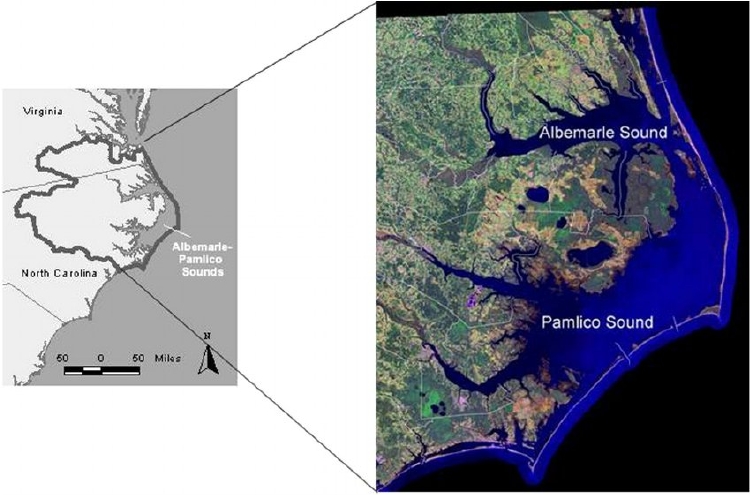
Albemarle Sound: Voyage Through Centuries XI

Rising Seas and Sinking Land

Nathaniel Batts may have been a recluse when he died in 1679, but he was a virtuoso wheeler-dealer in his younger days as fur trader, land owner, pardoned murderer, serial debtor, swindler, explorer who discovered an inlet, and friend of people in high places who eased him out of debt when a prenuptial agreement locked him out of his wife’s fortune.

Section of a 1775 map showing Batts Grave at the mouth of of Yeopim Creek

Batt’s colorful life surely deserves a ten-part mini-series, but for now we are more interested in his grave as an expression of what has been lost to rising seas and sinking land.

The North Carolina Gazetteer says that in 1749 the island called Batts Grave was 40 acres in area and had houses and orchards on it. By 1756, in just seven years, it had been reduced to 27 acres.

By mid-twentieth century Batts Grave was reduced to a fly-speck on a map. Today it is gone.

Rising seas, hurricanes and nor’easters ate at the island.  Sinking land played a lesser but inexorable role. These geologic forces are continuing today.

In fact, rising and falling seas that seem so dramatic to us today have been changing coastal landscapes for eons.

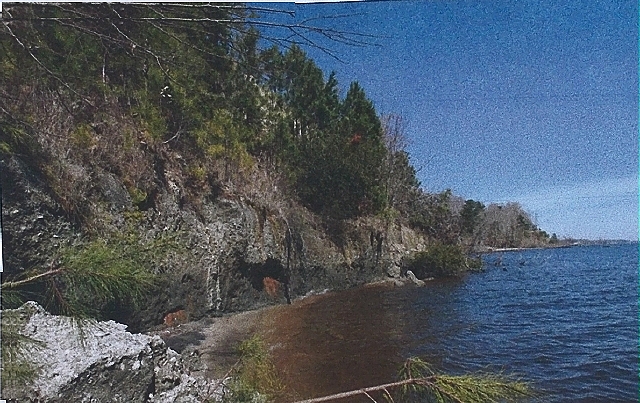
This photo by geologist Stan Riggs pictures a terrace in west Albemarle Sound that was once an old shoreline It adjoins the Suffolk Scarp 

The Suffolk Scarp referred to in the caption of this picture is the remains of a shoreline that existed 80,000 to 125,000 years ago, before glaciers sculpted North America, during a warm period when sea level was 25 feet higher than it is today.

At that time the entire Albemarle area was below water, a shallow continental shelf. The barrier islands that we know today did not exist.

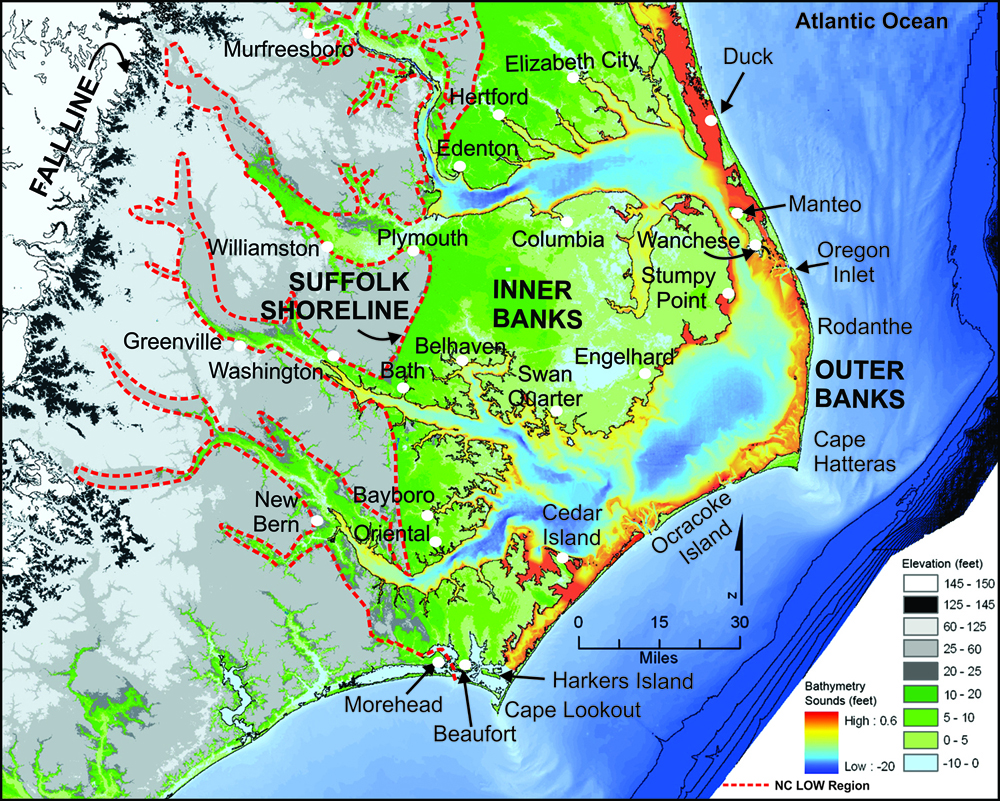
The map below shows that, at just a few feet above sea level, the coastal plain (Inner Banks) will flood as polar ice caps melt.

The Suffolk Scarp, or Shoreline, already discussed, is 25 to 50 feet above sea level, but even that will flood if the ocean reaches the Fall Line.

The Fall Line, in black, is where the rolling hills of the Piedmont begin. Interstate 95 generally follows this ridge, which is about 150 feet above sea level today. If  both polar ice caps melt, the ocean would rise to the Fall Line.

All land east of the Fall Line would be flooded. Millennia before glaciation, when temperatures were higher and the world was a warmer place, the ocean reached the Fall Line.

The Albemarle area today showing the coastal plain vulnerable to sea level rise, the old Suffolk Shoreline at 25 to 50 feet above sea level, and the Fall Line (in black) where the rolling hills of the Piedmont begin. NC Land of Water

Our lives are so short we can only observe nannoseconds of geologic change. Interludes of thousands of years of glaciation, when the world was cool and ice caps grew and the level of the ocean dropped. have lulled us into believing that what we experience today is what the land has always looked like. Nothing could be further from reality.

Let’s look more closely at what takes place when glaciers grow. Past glaciation is a major reason why the coastal plain, Albemarle land, is sinking, or subsiding. How can that be, you ask, when this land was never glaciated?

During the last Ice Age, 20,000 years before present, glaciers extended as far south as Long Island. Tons of ice from these glaciers compressed the land beneath. In response, unglaciated land to the south, including the Albemarle, reacted by easing upward. (Like a slo-mo see-saw.)

As climate warmed and glaciers finally melted, the land that had been compressed under them was released and began to rise. Land to the south (the Albemarle) reacted and is still reacting by sinking. (Now the slo-mo see-saw has changed direction downward.)

This action takes centuries. We are only seeing some of the results of this geologic change today, and lately the changes seem to be measured in decades.

Where decades ago, buildings seemed safe, today, there are puddles and flooded streets after storms, worrisome to anyone living in a vintage family home where water now encroaches on the front porch.

But this is only a small part of the story.

Let’s go back in time, say 15,000 years ago when glaciers were beginning to melt, and ocean water is still bound up in glacial ice.

The ocean is about 400 feet lower than today. Land would have extended some fifty miles east of today’s shoreline. A barrier beach, like the Outer Banks, if it existed, would have been just east of that. The Outer Banks, as we know it today, would not form until sea level rose to today’s levels.

The land is tundra-like, but warmer than you might expect because of the Gulf Stream that slides along the periphery. As climate warms, lush marshes and swamps will grow up, wonderful habitat for ice age mammals and birds — and early man.

Tundra on the continental shelf miles off today’s shore line? As climate warms, marsh and swamp will develop over thousands of years, then migrate west as sea level rises. NOAA

As the earth warms and sea level rises, the shore line is flooded by the ocean and pushed westward. Marshes are flooded and die and are born anew on higher ground. They replace swamp forests whose trees have drowned but scattered seeds that will take hold on higher, dryer land.

As sea level rises, there is an inexorable migration of water and life to the west.

Fossils of plants and animals and micro fossils of pollen tell stories.  By analyzing and carbon dating the kinds of life found in core samples of strata, scientists can read the ancient waves of climate change.

How long did this take? How far out on the continental shelf did early man live?  These are questions that cannot easily be answered.

The Albemarle area holds a plethora of  fluted points and artifacts, including a dugout canoe from about 6000 years ago. But artifacts of Paleo-Indians could date from 15,000 years ago, or earlier, and these are drowned in open seas today, so we can only imagine the extent of their occupation.

Let’s look at life from the perspective of Early Indians. They were hunter-gatherers who followed the food. They did not have vested interests in real estate and infrastructure.. They accepted what the land had to offer, and moved on when necessary. You could say they were resilient.

It wasn’t necessarily an easy ride. There were great storms and droughts, and floods and freezes and forest fires, even a mini-ice age that lasted almost 1500 years.

Coring on Roanoke Island by the NC Coastal Geology Cooperative reveals a combined rate of sinking land and rising sea level as follows:  Only three inches prior to the 19th century. Seven inches by the end of the 19th century. A whopping 16 inches by the end of the 20th century.

Can this be possible? Remember Batts Grave. Our own casual observations of water levels on our bulkhead tell the same story: about 6 to 8 inches rise in thirty-five  years.

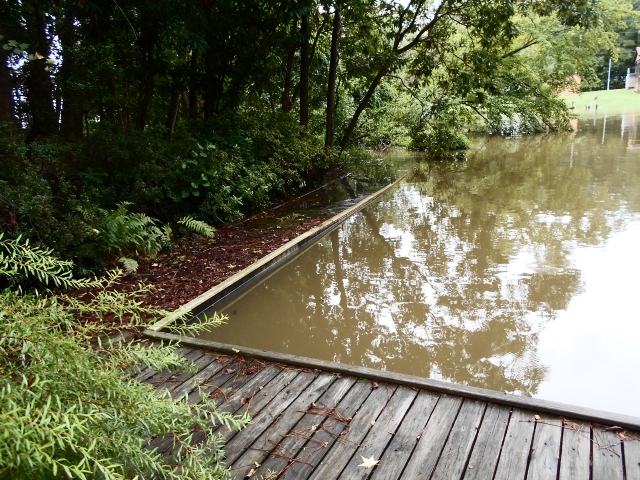
Photo of our boardwalk circa 1988. Note mini-dock we had for disembarking canoes and horizontal timber visible to the right. Today these  are totally submerged  except on rare occasions when the wind blows steady out of the north and water is pushed to the south. aheronsgarden.com

It’s not unusual for a storm to cause water to rise to the top of the bulkhead. After most storms some parts of our woodlands flood. aheronsgarden.com

Albemarle lands are among the most threatened in the country by a combination of subsidence and rising seas.

Do you remember the Suffolk Scarp, or Shoreline in the map above? It rises west of Albemarle Sound and was under water before climate cooled and glaciers froze ocean water and sea level dropped.

Rising seas are expected to reach the Suffolk Scarp in the next 100 to 500 years as climate changes. We are seeing the beginnings today with consistent flooding of roads, farms and yards.

What Do We Do?

Where scientists could not persuade, hurricanes, flooding, loss of low areas and the appearance of ghost forests are turning skeptics into believers in sea level rise.

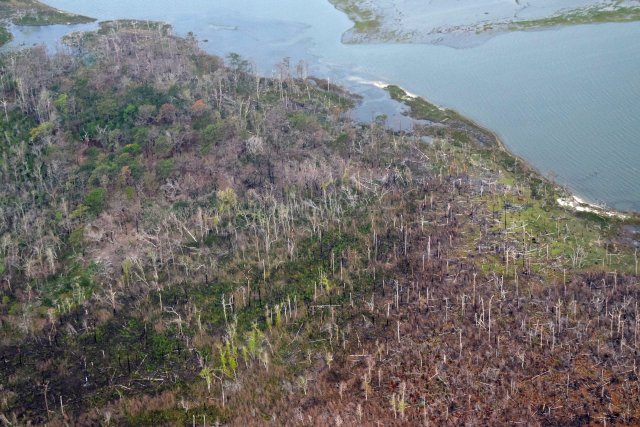
As sea level rises, salt water, from overwash of hurricanes, for instance, can kill plants that are not salt tolerant. These ghost forests are occurring on the Albemarle/Pamlico peninsula today. Mark Hibbs, South Wing SCRO

How will communities respond to threats to their way of life?

We are beginning to realize that we can no longer do battle with rising water and storms. Past knee-jerk reaction has been to harden structures — create seawalls, build jetties, erect bulkheads, pile on the rocks, or the  sandbags — to keep that water in its place.

Sand bags scattered on the barrier beach after a storm. Not working too well, judging from the flooding. NC Coastal Federation

Such efforts cannot be maintained in a dynamic environment where change is coin of a watery realm. Water will always win.

Tuning in to the natural world, and working with it, is the best way to preserve our well-being.

All that we have done to the land — ditching, draining, clear cutting the magnificent forests, building dams, laying down pavement — all this  speeds up and re-routes the natural flow of water and makes the land — and its people — more vulnerable to the forces of climate.

Spongy wetlands allow water to seep ever so slowly through the landscape. Mighty trees in acres of forests have vast networks of roots that drink copious quantities of water. Once removed, there is erosion and puddles and muck. Ugliness, too.

This former farm has been converted to wetlands. Rainfall from the farm once took only two minutes to run off into nearby waters. Now, drainage from these wetlands is naturally slowed, taking more than two months to find its way into creeks. NC Coastal Federation

New ideas must bubble up as scientists, politicians and communities work together. Money is needed to experiment and implement.

Like paleo-Indians we need to develop resilience. We should be working with climate, not against it, treating land as an asset to be managed wisely.

Resilience to storms: Are we just mopping up after storms, or are we making decisions that will reduce future damage?

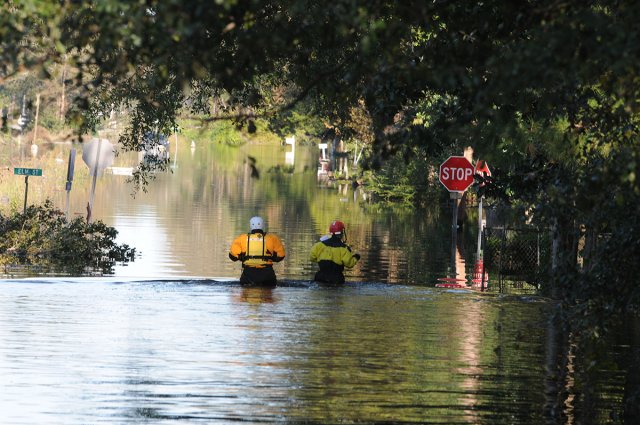
Managing flood waters after Hurricane Matthew. Almost one and a half billion dollars has been spent to clean up after Matthew and Florence alone. Photo by Leticia Samuels, USCG

Communities need help in planning and funding, developing shovel-ready projects that can put fixes in place immediately after a government call for proposals.

Resilience to rising sea level. Close kin of resilience to storms. We need to accept that we can’t prevent sea level rise, but we can develop long-term strategies tailored to sites and community needs.

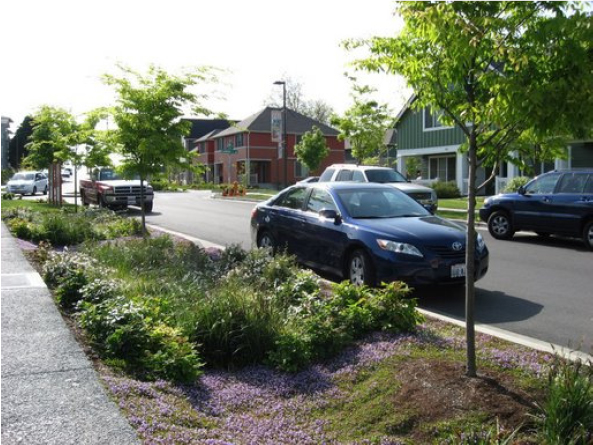
Even small projects like planting a rain garden or an acre of trees will help. NC Coastal Federation

Some examples that emphasize natural solutions:

  • moving homes to higher ground
  • planting trees whose roots are efficient at absorbing  water
  • removing impervious pavement
  • removing ditches to promote more natural flow of water
  • making the ground more spongy so rainwater percolates

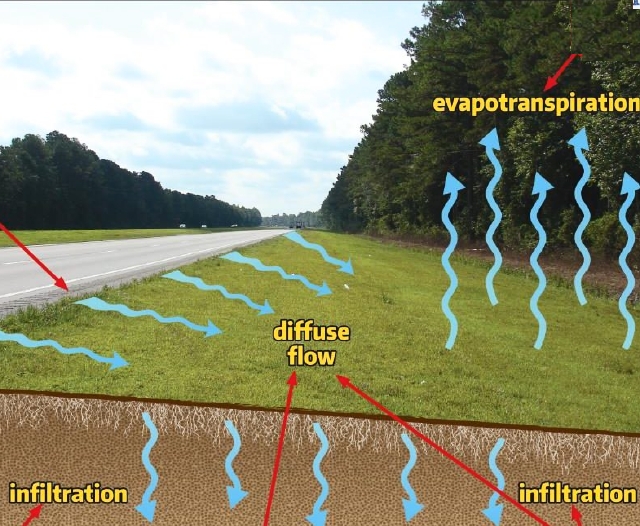
Wide swales on the side of a road diffuse runoff of rainwater and sediment, further helped by woodlands that transpire moisture. On grand scale, this is a technique that would mitigate runoff from miles of impervious roads, driveways and parking lots. NC Dept of Transportation

The mills of government grind slowly. Rising seas care not.

It is up to people brainstorming and barnstorming to find solutions that will protect people and the environment.

Political will. Public-private partnerships. Citizen activism. And community support. These are the tools we need to make sensible plans that will take us into the future.

We can’t know all the answers because we can’t predict the curve balls to come, but with close observation, a thoughtful approach, and cooperative efforts we can develop the resilience that grounded those Paleo-Indians long long ago.

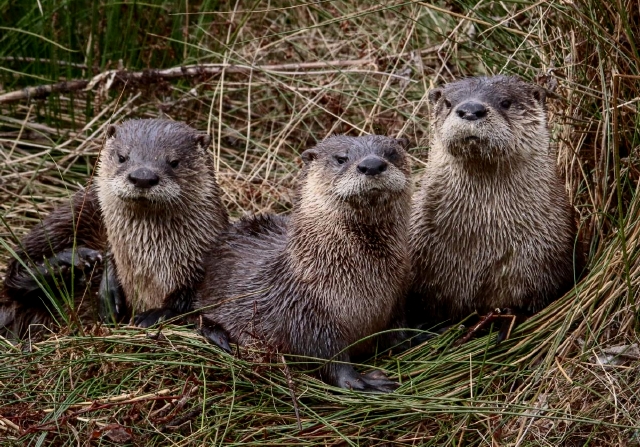
They will thank us. Photo of baby otters by Meekins USFWS

We thank the many career professionals and dedicated volunteers who are helping to protect the Sound, its land and rivers, and its wildlife.

I consulted many on-line sources to frame this Voyage through Centuries: among them, historian David Cecelski whose blog with its wonderful old photographs gives insights to  fisheries and everyday life; coastal and marine geologist Stan’s Riggs who tirelessly advocates for a realistic understanding of coastal dynamics and the opportunities they present; and environmentalist Todd Miller, who founded The NC Coastal Federation, a powerful watcher of coastal land and water issues and publisher of Coastal Review Online.

This Voyage grew exponentially out of a grant the Albemarle Environmental Association received from the Albemarle-Pamlico Estuarine Study thirty years ago to produce a series of Profiles of Albemarle Sound and its rivers. The original versions can be found on the website AEA on the Web.

Posted in Albemarle Sound, Climate Change, Environment, sea level rise, Sinking of North Carolina and Virginia coast, Storm recovery, Uncategorized | Tagged , , , , , | Leave a comment

Albemarle Sound: Voyage through Centuries X

Legacy

Some of the counties surrounding Albemarle Sound are among the poorest and least populated in the state. They are also the most vulnerable to rising seas, as we shall see in the final chapter.

Poverty and isolation are not particularly evident to a casual observer because families and communities are close knit. But the resources here, and the land, have been attractive to outside interests who would upset the precarious balance between rural life and land for a moment of greed.

Keeping memories alive that show how the Albemarle sustained people who worked and fished here is one way of forging strong conservation goals and pride of stewardship to counter centuries of exploitation.  State, counties, non-profit and community groups are working together to bring an enduring identity to the Albemarle that will carry it into the future.

To fully appreciate the 180-degree-turn that this twenty-first century voyage takes, we must take a look at the recent past.

Seeking Environmental Justice

There was a time, maybe three decades ago, mostly forgotten now, when the wetlands south of Albemarle Sound were considered ideal for a hazardous waste incinerator. After all, when you fly over this land, what can you see? A few clusters of houses, a lot of farmland with manmade ditches, maybe some ducks or geese, tangles of swamp that defy GPS, just a bunch-a-nuthin.

Imagine these wetlands that are historically prone to hurricanes and floods housing an incinerator whose innards would, we are assured, never belch any but fine clean air (or at least cleaner than the dross that goes in) to drift over farms. Imagine the roads that would be needed to carry the massive, rumbling, trucks with their poisons. And, God forbid, imagine a spill of the worst sort of poisons that would infiltrate networks of ditches that flow to native waters.

This state-of-the-art incinerator opened in Arkansas in 2016.With rotary kiln, spray dryers, scrubbers and filters it promises relatively clean emissions. Thirty years ago the technology was not as sophisticated

Residents fought this injustice. How they fought it! Through public education and public meetings, and presentations to county commissioners who saw the incinerator as a plus, a way to bring jobs to a community that desperately needed them.

The people prevailed. Once they were given the details and understood what they would lose, they rose up with the tenacity of their lineage, the lineage they had inherited from their ancestors who had the grit to survive here. No, thank you, they did not want the menial, and perhaps dangerous, jobs that came with this intrusive behemoth.

There was a time, two decades ago, when the United States Navy eyed this good-fer-nuthin place with a few people and a lot of birds as a practice landing field, called an OLF, for a new line of fighter jets housed at its Oceana base in Virginia Beach. Recently settled residents in Virginia objected to noisy take-offs and landings at nearby Fentress Outlying Landing Field (OLF).

Exporting the deafening noise to this nowhere land around Albemarle Sound seemed like a good idea to the Navy, who wanted to avoid clamor from local residents. Five sites were selected, each of which would be subject to an Environmental Impact Statement required by law.

F-i8 flying over farmland that seems empty in Washington County. Photo by Drew
Wilson. Virginian Pilot

Residents here, who are serenaded by choruses of crickets and katydids on summer evenings, were appalled by the idea of noisy jets flying back and forth from Virginia to North Carolina to practice excruciatingly noisy, repetitive practice runs in this land of black bear, snow geese and tundra swans.

This was a David-and-Goliath battle without the romance of a quick victory. It was automatically assumed we could not prevail. It became an eight-year battle, and then another five-year battle.

Residents lived on tenterhooks. They set aside their lives, met in private to plan strategy, held rallies and pig pickins, organized post-card-writing campaigns, all the while haunted by the sacrifices people would be compelled to make — for example, forced sale of home and farm that had nurtured generations of  families in exchange for relocation (where?) — and the losses to community life in exchange for the bones the Navy was prepared to throw into the pot.

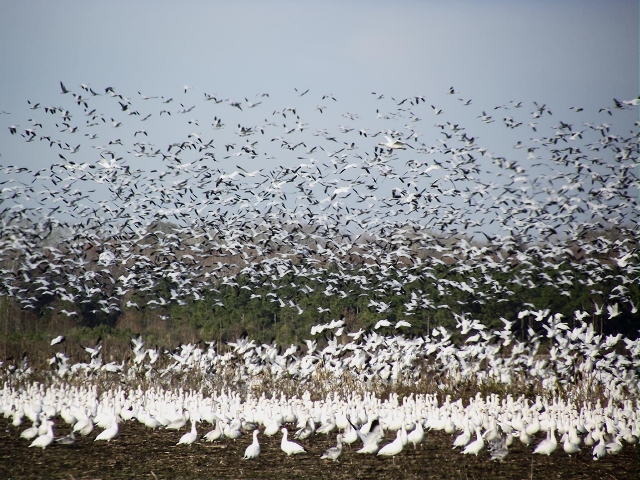
Crowds of snow geese, tundra swan and ducks inhabit the area in winter. During a demonstration flight flocks of birds rose up amid the planes and shaken pilots refused to continue flying. Photo from Visit Elizabeth City

After eight years, the Navy lost its case in court and the voluminous environmental statements that had been prepared by a firm in upper New York State were declared flawed. Another round began with another five choices, this time three in Virginia and two in the Albemarle. Finally, after thirteen long years, the Navy quietly went away and residents could listen to the katydids in peace.

During all those years of campaigning and lobbying lawmakers, activists conducted themselves with grace and dignity. There were no arrests for disorderly conduct or property damage. There was simply respectful patience and determination.

Both the incinerator and the outlying landing field were prime examples of environmental injustice.

A hazardous waste incinerator is never located near an affluent community.

Nor is an OLF. A 1990 socio-economic comparison of  Virginia Beach and Washington County (Navy’s final choice on Albemarle Sound) is in order. Virginia Beach: median income $45,000, 13% of children below poverty level, 20% African American population. Washington County: median income $28,000, 29% of children below poverty level and 49% African American population.

Identity Change Develops Momentum

We’ve come a long way since those decades when wetlands were nuisances, and the coastal plain was prime ground for exploitation.

Perquimans County shoreline. Photo by Lauren King. Virginian Pilot

There is a highway along the south shore of the Sound that used to be considered a tedious miles-long pass-through for vacationers hurrying to a sparkling ocean and a lively Outer Banks (OBX) tourist scene worth a billion dollars annually.

Today, people are stopping along that highway south of the Sound and other highways along the north shore of the Sound.

The Museum of the Albemarle in Elizabeth City tells the story of the Albemarle with photos and artifacts, including a historic shad boat. NCDNC

The Albemarle area is developing its own identity; it is becoming known as the Inner Banks (IBX). It’s a special place where vacationers can slow down and discover a venerable part of the country that has been — well — forgotten by the outside world.

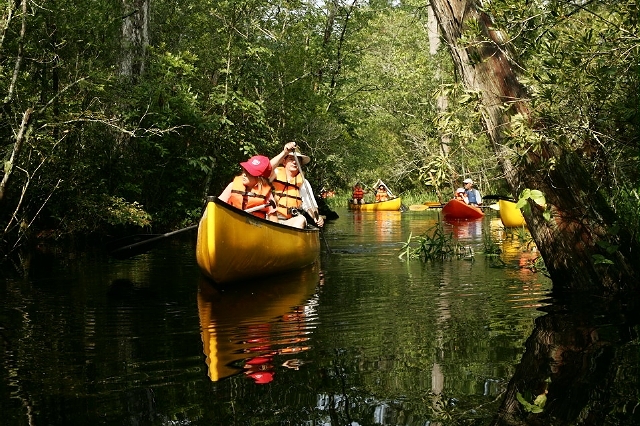
Canoeing on Salmon Creek, a newly opened recreation area in Bertie County fostered by the non-profit group Tall Glass of Water

Communities in northeast North Carolina are capitalizing on their history and their roots. Towns have visitor centers,  friendly museums or nature centers, galleries and arts centers featuring local craftsmen, boardwalks, river views, walking tours or tram rides, even tree houses for rent. Ice cream cones, too.

Port o’ Plymouth museum on the Roanoke River explores the history of the area and the Civil War. Pictured is a replica of the CSS Albemarle Ram

Here you can find an intimate step back into the history and environment of the earliest pioneers in the country.

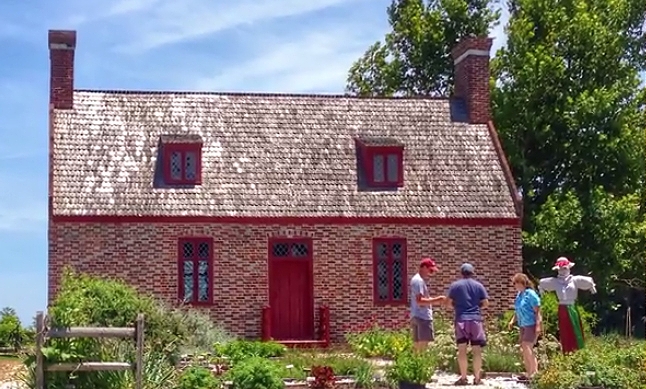
The Newbold-White House sits on land high above the Perquimans River, a reminder of some  of the earliest settlements in the Albemarle

The Albemarle is not glitzy. There are no fern bars. It’s inviting and comfortable and unhurried. And there is good fishing.

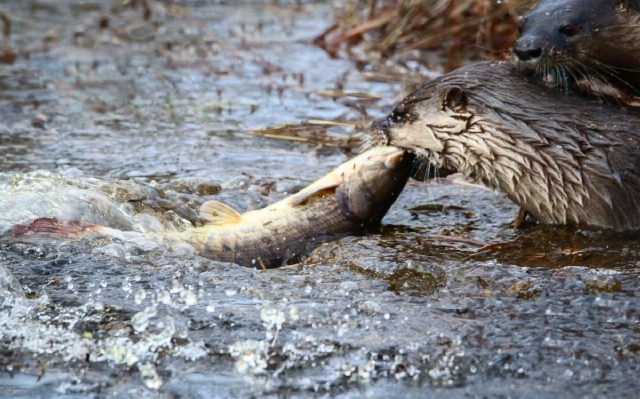
Otter catching a prize. Two-legged anglers enjoy fishing in these waters, also. Photo by Meekins USFWS

Natural areas — a network of wildlife refuges, state game lands, state parks, community parks offer visitors a place to have a picnic and photograph wildlife, or a chance to linger along a creek or hike a trail, or join a guided tour for hands-on experiences.

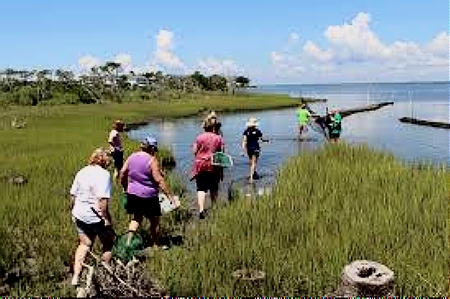
A group studying water quality and biota of the marsh. SeaGrant

These collective invitations to explore the Albemarle come from loose consortiums of public and private agencies.

Non-profit groups like The Nature Conservancy and North Carolina Coastal Land Trusts acquire and broker land for conservation.

Land along the Salmon Creek was acquired by the NC Coastal Land Trust, then folded into conserved county, state and federal lands. Portfolio Coastal Land Trust

NC Land of Water, Roanoke River Partners, and Bertie Water Crescent promote eco-tourism.

Boardwalk and camping platforms in the wilds of the Roanoke River flood plain. Roanoke River Partners

Coastal Wildlife Society, NC Coastal Reserve, and the Red Wolf Coalition are among many that work to conserve eco-systems.

Support comes from federal and state initiatives. Recent rollback of protection for streams and wetlands under the Clean Water Act has been reversed.

More streams (18%) and wetlands (51%) will be protected under re-instated directives of The Clean Water Act. US File Photo

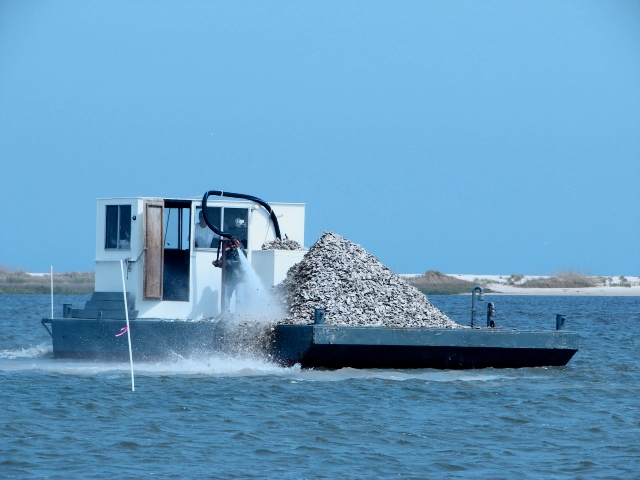
Oysters. once a staple of life in Albemarle waters but now struggling, partly because of changes in salinity and water quality, are being given helping hands. Oystermen are helping with initiatives, and, in the process, helping to promotethe industry.

Cultch planting, that is, dropping shells and stones into coastal waters creates a reef of sorts for oyster spat to attach to and grow. NC Coastal Federation

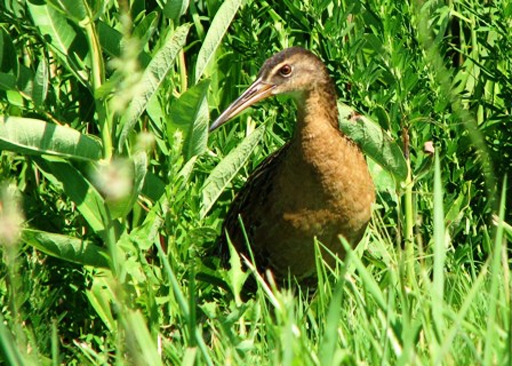
Funding through the North American Wetlands Conservation Act, matched by partners in North Carolina, will conserve habitat for waterfowl and shorebirds.

The elusive king rail will be protected under acreage added to Currituck National Wildlife Refuge. USFWS

The state is generously appropriating money for parks and recreation and clean water trust funds. Town and county governments are seeking funding and working with non-profits to promote eco-tourism.

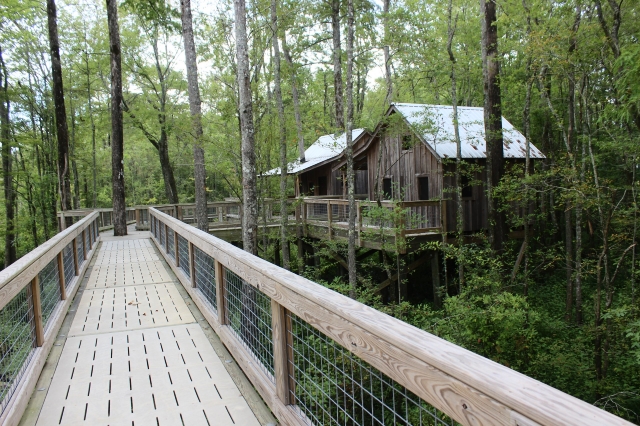
The town of Windsor conceived of and received matching funding for constructing treehouses and raised boardwalks for campers along the Cashie River, part of the Roanoke River system

Seeking Green Industry

But to preserve society here, the soft tread of ecotourism and eco-education needs to be augmented by green industry. Renewable energy featuring wind farms and solar arrays are punctuating the landscape, bringing income to farmers and the community.

Offshore wind farms, not offshore oil-drilling platforms, make sense to most. Technology has brought the costs of solar and wind power into competitive range, and the environmental and human losses created by, for instance, the BP catrastophe in the Gulf of Mexico would become sad memories, not future threats in hurricane-prone seas.

Yes, you can farm crops on a wind farm. Continuous blinking lights on blades warn birds during night flights

To move forward, there must be political will that overcomes regressive political and industrial moves. For instance, as of June 2021 the NC legislature is considering a bill that would force communities to make connections to piped-in natural gas instead of choosing cleaner electricity in new construction. It is blandly titled Assuring Choice of Energy Service but would, in effect, limit communities’ freedom of choice.

Additionally, a bill to Study Emerging Energy Generation, crafted by Duke Energy in conference with lawmakers, is on track in the legislature. It calls for replacing six coal-fired plants with three fracked-gas facilities and seeking permits for small nuclear facilities at ratepayers’ expense. These regressive proposals fall far short of the Governor’s climate change and clean energy plans that would make North Carolina a leader in renewable energy.

There is much progress to be proud of, but we face an un settled future.

The future is of little concern to this alligator loafing on the water with friends in Merchants Millpond State Park. Photo by Chuck Richardson

Posted in Albemarle Sound, Eco-Tourism, Uncategorized | Leave a comment

Albemarle Sound: Voyage Through Centuries IX

The Mighty Herring Fisheries

When the shadbush bloomed in spring, the hard work and celebrations began. Schools of shad and river herring teemed in from the ocean through inlets and into the Sound and up rivers, bound for their birth places to spawn a new generation.

Alewives, one species of river herring. Jerry Prezioso NOAA

At a time when people lived off the land, these silver fish brought great joy and the promise of full cupboards, a fine reason for exuberant annual celebrations.

Buckets, baskets, nets, poles. Families scooped up fish that would feed them throughout a long winter.  Shad had to be kept on ice to stay fresh, so it was eaten immediately, but the oily flesh of herring lent itself to salting, pickling and drying that would preserve it for a year or more.

(Well into the twentieth century you could find community celebrations of herring runs — and barrels of corned herring in country kitchens.)

Fishermen cast their net baskets off a bridge in Martin County late 19th century

Around the end of the 19th century, herring could be purchased on river banks in spring for as little as one dollar a thousand, though the average price was $2.50. A dollar a month, wrote one Chowan County native, would procure for a person the most usual diet of much of the population — herring, cornbread (corn was 40 cents a bushel) and tea brewed from native yaupon holly.

From the 1760s on, commercial fisheries were operating on Albemarle rivers, catching fish in cunning, labyrinthine weirs of poles and reeds. Pickled herring were shipped up the coast to Baltimore, New York and Boston; west to the Great Plains; and south to the West Indies. By sail. By steamer. By rail.

Salted herring packed in wooden bins for shipping. Smithsonian Institution Archives

A century later, about the same time shad boats were first skimming waters, the pound net was introduced, while huge seine nets were catching vast numbers of fish  with breathtaking efficiency.

The Seahawk herring boat piled high with fish, on Albemarle Sound

Every plantation had a shoreline of smooth sand where fish were landed and processed. Capstans, or windlasses for hauling seines in, salting houses, processing sheds, and offices created a mini fishing town.

Fishing flats Avoca

During fish hauls, two ten-oared boats would carry a seine more than two miles long and several feet deep off shore. Boatmen would row in opposite directions extending the seine, which had a line of corks on top to keep it afloat and a line of lead weights on the bottom to sink it. The seine would be strung out in a direction to block the herring as they swam upstream to spawn.

In 1861 Harper’s Weekly published a moment-by-moment rapid-fire account of hauling in a catch. Here is an excerpt. It begins after the fish have been caught in the seine and the seine is attached to capstans.
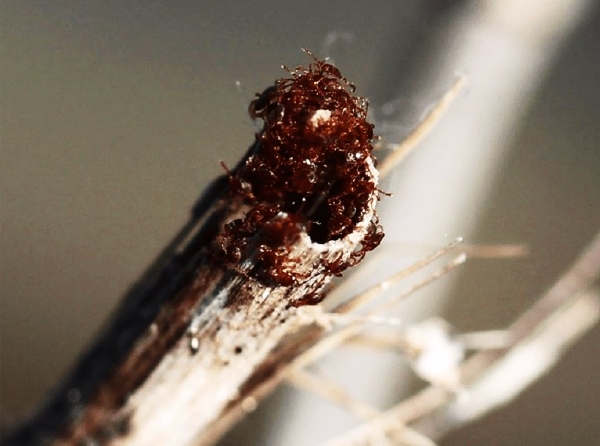
Capstans could be turned by men, mules, or eventually, by steam in order to tighten the seine

In this instance, mules are used to turn the capstans to tighten the seine until the fish are crowded and surrounded by net on shore.

Fifty stalwart men rush into the water, waist-deep. The captains shout and swear, the gulls and eagles scream, and dashing into the melee, audaciously snatch their share of the spoil.

A few minutes of heavy dragging and the flashing, wriggling mass is rolled upon the beach; a line of wide planks is hastily staked up behind, the net withdrawn, and the boatmen again put off cheerily to repeat the haul.

Hauling the catch, engraving from Harper’s Weekly i879

The women and boys now rush knee-deep into the gasping heap. The shad are first counted into baskets and carried to the packing-house; while the herring are headed, cleaned, and thrown into tubs, ready for the salters—all of which is transacted with merciless coolness and the most wonderful celerity.

It requires from five to seven hours to complete a haul ; and as there is no respite by day or night, three and four hauls are made within the twenty-four hours. The only time allowed for eating and sleeping is during the odd hours snatched by the different classes of workers when their especial branch of service is suspended. When the hauls are not heavy the cleaners and salters have an easy time between landings. The boatmen sleep while the mules wind in the net; the mules browse and bray while the boats are out.
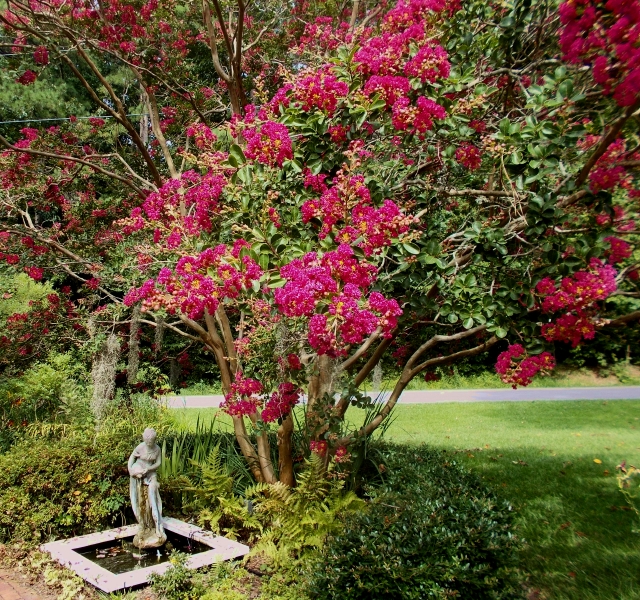
Black women waiting to sort, gut. head, salt and pack fish. By the time they finish one haul, another will come in. A seine is piled on a fishing flat in the background. Smithsonian Institution archives
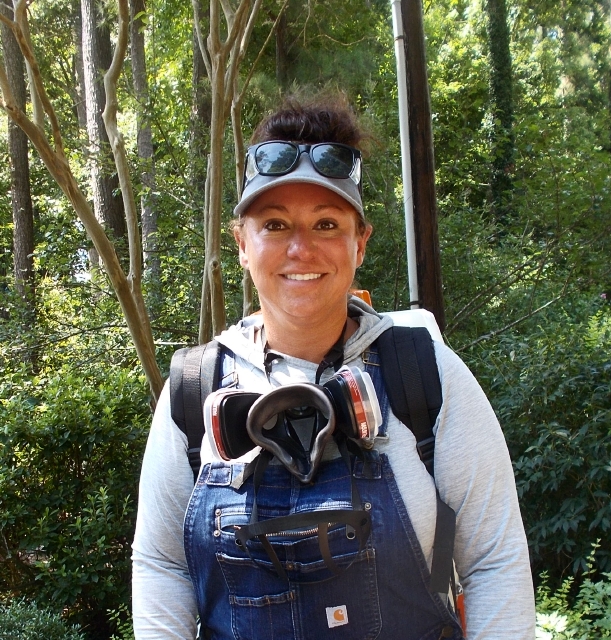
A first-class fishery employs from eighty to a hundred bipeds, and a dozen or twenty quadrupeds, and the labor during an active season of six weeks or two months is equal to that of a brisk military campaign in face of an enemy.

Of all the striking views of this exciting and picturesque business the night-haul is pre-eminent in interest. Here the lively scenes of the day are reenacted amidst the glare of pine torches, which exhibits the wild figures of the fishermen and the death-struggles of the finny captives in the most dramatic light possible.

Fishing at night was common during herring runs. Torches kept boats from losing their way. Fishermen’s night songs, hymns. chanteys, or old slave songs could be heard from across the water, “nothing more stirring than those crews singing on a moonlit night” recalled Col Capehart, owner of the fishery. Engraving from Harper’s Weekly

Besides needing captains and crews, cleaners and packers, skilled seine menders were valued for keeping the seines, which had to be tarred, in top shape. Holes in a net meant lost profits. Coopers made barrels for storage. A manager attended to details on shore and sold to customers on the beach.

Even children who were hanging around would be put to work where needed; their pay would be a bucket of fish for supper. Regular workers were paid a share of the profits.

Salting the herring for dinner at the fishery. Much larger troughs are used when salting for shipping. Smithsonian Institution Archives

It was not uncommon to take a hundred thousand river herring in a haul, though most hauls were smaller, five thousand up to thirty thousand. Since it cost between five and ten thousand dollars to establish a fishery, only wealthy planters could afford the upfront costs. The vast majority of farmers gathered their fish for personal consumption in dip nets or bow nets.

Every river had its haul of fish, though uniqueness of terrain and flow created differences in the personalities of rivers.

By the end of the 19th century the herring and herring roe of Albemarle Sound had won widespread fame. In a world where herring fisheries ruled, Albemarle fisheries were king.

Extracting shad roe 1877 at the Capehart fishery on Albemarle Sound. Smithsonian Institution archives

In a curious twist, settlers here  — laboring mightily in an inhospitable but richly endowed land, living on the edge, isolated,  self-reliant, insular — grew to have standing on the world map. Markets in New England, Europe, the Caribbean, even Russia eagerly sought their fish, their naval stores, their cotton and produce, their lumber.

We are fortunate today to have a rich photographic record of this era. During the 1870s the U.S Fish Commission sent scientists into the field to document fisheries nationwide. They produced a multi-volume report; the photographic collection is housed in Smithsonian Institution archives.

The North Carolina History Museum in Raleigh also houses archival photographs. Historian David Cecelski has reproduced many of these photographs in his blog posts about the herring fisheries. He tells an insider’s tale of coastal North Carolina life and fishing traditions.

At least thirty men heave thousands of fish onto the beach at Avoca in Bertie County 1877. Smithsonian Institution Archives

And Then the Fish Stopped Coming

As far back as the 1840s, a few prescient people sensed that the fishery could not last under such colossal landings. But it did not occur to most people that there could ever be an end to this bonanza. They simply assumed they could count on these fish to arrive on time each year, in the millions, as expected, forever.

Even the eminent scientist, Thomas Huxley, president of the Royal Society in England, saw no reason for concern. I believe, then, that the cod fishery, the herring fishery…and probably all the great sea fisheries are inexhaustible…(1883)

By 1896 0ver 1100 pound nets in Sound and rivers had replaced the labor-intensive haul seines, and fishermen were landing over 20 million pounds annually.

So many pound nets blocked passage of river herring that the state enacted the Vann Law in 1905 that required fishermen to leave a channel in the Sound to allow fish to migrate to their natal waters for spawning.

Still, the fishery continued to decline in the twentieth century. During the 1950s total catches were about 11 to 12 million annually. By the 1970s they had dropped to about 8 million, and in 1993 came the crash, down to one million.

Northeast North Carolina was not the only area that suffered losses. In 1965 the entire range of Atlantic states harvested over 64 million pounds. Forty years later total harvest for the combined area was under 100,000 pounds, almost a 99 percent decrease.

The fishery had died. In 2006 a moratorium on commercial fishing was declared in North Carolina. Three New England states, Connecticut, Massachusetts and Rhode Island, joined the moratorium, but other coastal states did not. The fish did not come back.

Fishermen once unloaded boat loads of herring at fish houses like Perry Wynn’s on the Chowan River. North Carolina Wildlife Resources Oct 2007

The demise of the river herring fishery has vast implications for life in the sea. It is, for instance, probably responsible for the weakening of the cod fisheries in New England and Canada.

The river herring, after all, is low man on the food chain. It is born to be eaten. Half of a herring’s year is spent out in the Atlantic Ocean, anywhere from Canada to South Carolina or Florida, being eaten by the big fish that count on the silvery slivers swimming in massive schools.

For eons the silver slivers have been dinner and dessert for big creatures of the ocean like cod. Without them and their cousins the food chain collapses and nobody gets dessert.

In the Albemarle river herring are the preferred food for the rockfish, or striped bass, another great Albemarle fishery whose story most appropriately belongs to the Roanoke River. Can you imagine the turmoil, the frenzy, the catching and losing, as river herring and striped bass jostle in that race of millions to find their particular spawning grounds?

Striped bass, or rockfish, are the tigers of the Sound. In the days of big herring catches, landings of rockfish could weigh thousands of pounds. It was not unusual for a single rockfish to weigh a hundred pounds. Wikipedia

Let us return for a moment to the first American settlements when tools were few and simple, and survival depended on the wit, skill, and hardiness of those early men and women.

The environment provided everything they needed if they learned its ways. And if the rains failed one season, or a drought or a flood came along, well, they would have to work harder, and they might lose anyway.

They were conservationists by default because they could tame the environment with only their sinew, and maybe a mule to help them along. They could not claim control over the land.

Giant tupelo and cypress trees in Merchants Millpond State Park in the flood plain of the Chowan River are suggestive of the swamps the settlers encountered. aheronsgarden.com

Then we developed bigger, more efficient tools, and the search for ease of living and profits replaced survival with two hands. (Can you blame us?)

We pursued technology that would control the environment and meet our needs and expectations. (Can you blame us?)

We thought our rational approach would solve problems, so we substituted that for an intimate understanding of wild ways, a knowledge that is only gradually acquired, with patience, a knowledge that doesn’t lend itself to committee meetings and graphing.

We set no boundaries. There was great good, but there was greed…

We lost touch with the ways of the land, and we did not know what we were losing. Not just here in the Albemarle but all over the country.

Progressive loss of touch and delight in progress undergird the loss of the river herring fishery–and many more losses.

When losses became too great, we woke up. We studied. Lots of studies. One is of particular interest because its scale had local and national focus.

Urged by a generation of activists who came along after the first Earth Day in 1970, farsighted congressmen took note of declines in fisheries across the country. In the 1980s they sponsored legislation that would fund major studies of estuaries.

The Albemarle-Pamlico Estuarine Study (APES) was born. Scientists, government officials and private citizens cooperated to explore reasons — and seek solutions — for declining catches.

The study area, the Albemarle-Pamlico Estuarine System. EPA and US Geological Service

Turns out these little ten-inch-long fish that weigh half a pound have had the book thrown at them.

Here is how we messed up and how we are trying to reconcile the damage:

Decades of overfishing.

  • In times past there was a balance between juveniles and older fish in schools of river herring.
  • Juveniles need to wait three or four years before they can spawn, and their first year of spawning is usually only a warm-up.
  • Older females become  more and more productive with age and can release up to 100,000 eggs annually. However, they are exhausted after spawning and vulnerable to predators. They return to the ocean to recover and refuel.
  • If you decimate either class, you lose the future. Hence the moratorium on commercial fishing for herring in 2oo6. It is still in place.

Spawning herring. Milt from the male turns water milky, while females lay eggs on the substrate. Alaska Fish & Game

Activity in the Atlantic Ocean.

  • During the late 1960s and early 1970s fleets of foreign trawlers with mammoth nets were intercepting herring out in the Atlantic Ocean on their way to the Sound, 24 million pounds caught in 1969 alone.
  • In 1977 the Magnuson-Stevens Act forbade fishing within the 200-mile band of waters called the Exclusive Economic Zone of the United States.

Bluebacks and alewives, collectively called river herring, are anadromous fish. They spend much of the year in the North Atlantic, then migrate south to the brackish water of the Sound to spawn. Their lives outside the Sound are a mystery, except  that they are eaten by big fish and sea birds. NC Wildlife Resources Oct 2007

Barricades block fish migration

  • Nets once reached across rivers until regulated.
  • Dams alter river flow.
  • Streams are forced into culverts as roads are built across them.
  • Today, where possible, bridges replace culverts and dam-flow is altered to aid spawning (with mixed results in the Roanoke River)

Water exiting a culvert at a road crossing. Fish do not like the turbulence inside this giant tin can, nor do they like brushing against cold steel instead of soft sand

Loss of Habitat

  • Wetlands ditched. Woodlands clear cut. Pavement laid down. Development favored.
  • Streams rerouted. Riverbanks reworked.
  • Rainwater that once seeped lazily into streams pulses unchecked into waterways that become an open fire hose flushing larvae and young fish.
  • Today, permits are necessary for work done near water courses that are protected under the Clean Water Act. Not all of them are protected and permitting can be sketchy.

Wetland that has been ditched on North River Farms. NC Coastal Federation photo

Pollution from Agriculture

  • Sediment that runs off farms and construction sites clogs gills and buries larvae.
  • Nitrogen and phosphorus in fertilizer runoff  cause algae to bloom. When algae die, they break down, robbing water of oxygen, causing fish kills. (A particular problem in the Chowan River).
  • Best Management Practices (BMPs) used on farms and forests reduce runoff, minimize erosion.
  • Integrated Pest Management on crops encourages farmers to use less pesticide (and saves them money, too.Algal blooms on the Chowan River

Pollution from Municipalities and industry

  • Toxic organics, heavy metals, and oil from roads and parking lots.
  • Nutrients, bacteria, heavy metals,  and chemicals from the sewers of industries and cities.
  • Updated treatment plants treat waste water from municipalities and industry. (Fortunately, minimal urban sprawl and industry here has limited pollutants.


Street-side swale and pervious concrete sidewalk that allow rain water to seep into the soil are ways to control urban run-off. Wikimedia

The great herring catches are shadows now.  We are trying to mend damages from two hundred years or more. We have removed too much critical habitat for the great fisheries to be reclaimed, but we have shifted toward conservation.

Wildlife refuges, state and county parks, and game lands protect land and provide habitat for wildlife and outdoor experiences for people.

Kayaking in the Alligator River National Wildlife Refuge

People must feel that they have a stake in protecting the vitality of land and water, their land, their water. Public education must focus on developing an understanding of natural cycles and how we can live in harmony with them.

The Albemarle-Pamlico National Estuary Partnership (APNEP) is  doing just that as today’s successor to the original estuarine study (APES).

As its name implies, it partners with a variety of groups to support research, restoration and public education. It is a comprehensive approach to protecting our land and water.

Monitoring water quality, Daniel Zapf

This coastal plain where the rivers meet the sea is still compelling, still beautiful, still a respite for many. With care, it can continue to be so.

Posted in Albemarle Sound, Uncategorized | Leave a comment

Albemarle Sound: Voyage Through Centuries: VIII

A War that Wasn’t Wanted and the Expedition Hurricane

North Carolina did not want a fight.

South Carolina must have been itching for one because she seceded in 1860, before President Lincoln took office. She commandeered federal forts in the state, then dared Lincoln to provision the troops at an unfinished Fort Sumter by firing on it.

North Carolina was enjoying unprecedented prosperity.

Her economy was booming. Wealthy planters did not want to lose their investments or their power. Small farmers were doing well and weren’t interested in fighting to support planters’ interests. Lincoln didn’t seem so threatening, though he hadn’t even been on the ballot in North Carolina. And, generally, people liked living under the protection of the federal government.

Debate over secession could be acrimonious, but as late as February, 1861 the vote by the legislature in Raleigh (the new capital) was overwhelmingly pro-Union.

A month after the firing on Fort Sumter in April 1861 and Lincoln’s immediate proclamation to stop the rebellion, North Carolina became the 11th and last state to vote to secede.

She had no choice. She would have been at war with her neighbors, fighting her Sister States. The vote was unanimous. 

Pro-Union sentiment was strongest in the eastern and western parts of the state. Many pro-union planters, fearful of ruin,  moved family and slaves to the central part of the state; others aligned with the Confederacy.

One of the finest painters of the Civil War was Conrad Wise Chapman, who actually fought as a Confederate soldier, Here is  a rendering of The 59th Brigade, also called Wise’s Brigade, that fought in Virginia and Carolina

North Carolina had nothing to gain and everything to lose by seceding. And lose she did. 

She sent 130,000 of her young men into the war. She lost 40,000, half to disease. More than any other confederate state on both counts.

Confederate soldiers, from The Civil War, by Ken Burns

Albemarle counties raised volunteer units, many of whom saw the full brunt of the war, including the fateful Pickett’s Charge in Gettysburg. Captain Benjamin Skinner wrote of the constant whistle of the musical minnie… above our heads.

There was no standing army but each county had its own militia. It was not unusual for troops to be furnished with firearms purchased from private citizens. Sometimes daily rations amounted to as little as a few crackers and a quarter pound of meat, and men might go for a month without a change of clothes.

Photo of Confederate volunteers

Wrote the same Captain, Sufferings, privations & hardships have been endured such as no modern armies of their countrys have ever been called upon to undergo…but the… greater our sufferings now the more glorious will be our greater triumph…

Within a year, General Ambrose Burnside’s Expedition had captured towns in the east and established a blockade.

The Great Expedition under way, the Union armada to establish a blockade, sketched in October 1861

Control of Albemarle and Pamlico Sounds was firmly in Union hands in a bid to cut off General Lee’s southern supply routes to Virginia.

Hatteras had fallen. Roanoke Island was falling.

Artist’s engraving of Union troops going ashore on Roanoke Island to battle Confederate troops

Union troops and a fledgling Navy easily outmaneuvered seven small Confederate boats they called The Mosquito Fleet to capture the Island. On land volunteers tangled with Burnside’s men but were no match for the larger forces.

They were captured and three weeks later they were paroled. They then set about forming a new company with others and joined another regiment.

Confederate Prisoners by Winslow Homer, who had toured the South and sketched military and civilian life there during the war

Apparently the release of captives was common in the early years of the war. Prisoners of war would be held for a while, then freed, sometimes after taking an oath of allegiance to the Union. Whether they re-enlisted was an individual decision.

Life in Albemarle counties was overturned. Sound and rivers became thoroughfares for gunboats. Towns were shelled in skirmishes to maintain the Union blockade.

Confederate Steamship Eolus patrolled Albemarle Sound and rivers

To counter Union action the state authorized counties to form guerilla bands called Rangers to harass Union forces. Rangers in the Albemarle were most effective, since their members were so familiar with its forbidding terrain. They also prevented slaves from crossing Union lines and terrorized Union sympathizers.

Stating that they were virtually bandits, an angry Union commander threatened serious reprisals. Locals, too, were not happy with the depredations and the secretive nature of these bands.

Meanwhile, Albemarle residents had been smuggling supplies for Lee’s army. Provisions would be shipped from Norfolk Virginia through the Dismal Swamp Canal into northeast North Carolina.

From there they were ferried  west through swamp and river, then back up north to Lee’s army in Petersburg, or further north to Richmond, Virginia. The hand-off of supplies was probably done relay-style, from crew to crew.

To stop the smuggling, federal forays destroyed bridges and roads but the supply stream continued.  The Union then organized Negro troops to intervene, a move that was bound to incite citizens, particularly in light of reputed atrocities. It worked. Citizens were kept in a state of fear and panic.

A truce of sorts was arranged. The Union would remove Negro troops if citizens stopped smuggling and the Rangers were disbanded.  A jittery peace was restored, though it a Union captain acknowledged later that this circuitous supply route through northern North Carolina remained effective during the War.

Exports of cotton, lumber, ships stores and fishery products that were expected to pay the bills were halted by the blockade. Imports of necessary goods were blocked. Basics became luxuries.

From 1862 to 1865 prices soared because of profiteering by smugglers: a barrel of flour went from $18 to $500; corn, a staple, went from $1 a bushel to $30. Parched corn was used to make coffee, and sorghum was grown and processed instead of purchasing sugar.

Wrote one resident, Sure this War is meant to check the profusion in which we have lived & to teach the rising generation economy & the employment of their resources.

Many southerners could not believe that slaves would want to escape bondage. They were quite sure that slaves felt such a strong attachment to their masters they would never leave, that they were being driven or enticed to federal camps. When slaves took advantage of the Emancipation Proclamation, planters felt betrayed.

There were, however, blacks who remained loyal to the Confederacy

Yet as soon as Union troops arrived in an area slaves would follow their camps. Slaves that did not flee often piloted Union ships and revealed the location of Rangers.

If you can cross the creek to Roanoke Island, you will find safe haven.

Roanoke Island became a refuge for escaped and freed slaves. Protected by the Union army, over 3500 refugees would settle there in a camp called the Freedman’s Colony where community life flourished: families could live as families, children could attend schools, gardens could grow and going to church was central to life.

Photograph of housing in the Freedman’s Village

Some freedmen from Roanoke Island and other camps in eastern Carolina offered their skills to Union forces, or became spies, guides and scouts, built forts and bridges and served in four Union regiments.

Blacksmith working in the Freedman’s village. There were at least two other similar villages in the east

After the war the land was returned to the original owners and colony members became refugees again. Reports of depredations by some of these refugees and others caused counties to establish militia to maintain control.

It wasn’t all rosy for Union ships on Burnside’s Expedition. Bad weather plagued them in turbulent seas. In November, 1861, the Expedition Hurricane scattered a Union fleet of 75 ships off Cape Hatteras. Two vessels sank, and others were wrecked by Confederate forces. Storm surge was so high it  inundated Hatteras Island.

Words from one sailor: Wind continued to rise till at 11 pm it blew almost a gale…The scene was fearful but magnificent. The ship was tossing and pitching…The waves were rolling at least 20 feet high.

Words from another: Last night was the worst I ever saw. I could not sleep for I had as much as I could do to hold myself in my bunk. Reynolds got thrown out of his…8 am Window in stern got stove in the night…water was three or four inches deep. Shoes, guns, knapsacks…floating round in fine style.

Rescue of a battalion of 485 Marines from the foundering SS Governor. Seven men were lost trying to jump toward the rescue ship USS Sabine

Then, on a stormy New Years Eve in 1862 the ironclad warship, the Monitor, sank in 300 feet of water almost 200 miles off Cape Hatteras, losing 16 of her crew. She had performed extraordinarily well in service.

The Monitor, foreground, sinking offshore. In addition to a revolving turret, many unique features had been included in her hull

The first ever duel between ironclad warships took place near the mouth of the James River when the smaller Monitor clashed with the formerly wooden frigate Virginia. The Virginia had previously sunk, then was raised and re-outfitted as an ironclad and rechristened the Merrimack.

Battle between the Merrimack and the Monitor. The Merrimack looks like the roof of a barn; the Monitor sits low in the water, only 18 inches exposed

The Confederacy hoped to use the Merrimack to break the Union blockade, and before the Monitor arrived, she had already destroyed two wooden Union ships.

The battle ended inconclusively; the blockade remained. But the clash between two ironclads marked a major turning point in the history of naval warfare, and the two ships are memorialized in the names of Hampton Roads tunnels.

The Union and Confederacy had both developed steam-powered ironclads because ships built from wood could no longer withstand fire power from late-model heavy artillery.  European countries took note of this battle and immediately stopped construction of wooden ships.

The Monitor’s location is a watery historic site, and the Mariners’ Museum in Newport News, VA tells the story of that time through exhibits and artifacts.

The Monitor in its national marine sanctuary. noaa.gov

Only a few months before the Monitor sank, the Merrimack was blown up by her Confederate commanders as Union troops approached Norfolk to tighten the blockade. She was heavily salvaged, so few remnants remain as relics.

There was only one major battle fought on Albemarle Sound, a year before the end of the war. Three confederate warships, including the Albemarle Ram, an ironclad built in a cornfield, and eight Union gunboats faced each other. The battle ended indecisively at sunset.

Battle of the Albemarle May 1864. Three Confederate warships, including an ironclad ram in foreground and sidewheeler in background engaged eight Union gun boats until sunset, when both sides retired. Weapons and Warfare

(During the Civil War, much action in the Albemarle centered on the rivers and towns north of the Sound. These details will be available as we post the profiles of these rivers.)

Aftermath

Left with a shattered economy and a broken society  — devalued land, bearish cotton prices, a crumbled plantation system, destroyed homes and businesses — citizens began to find ways down new paths.

The social fabric of the community had been frayed. Soldiers came back wounded, or they didn’t come back at all. Families were broken by death and disease. Livelihoods were cobbled together by every member of the family.

Going to school would not put food on the table. Money was so tight that the personal surety bond, a sign of trust that was used regularly before the war, was replaced by the mortgage.

The country store and gristmill, many now in disrepair, had offered antebellum farmers more than essential goods and services. Along with churches, they had been the  nucleus of community life. Rural folk, whether landowner or tenant, free black or white, converged to purchase supplies, have their corn ground, or simply visit with neighbors and friends.

A Grand Opening in Plymouth, on the south side of the Sound, 1865

The structure of county government changed. Instead of Justices being appointed to manage affairs, county commissioners were elected to govern, a more democratic process that allowed for participation by blacks, who now voted and began to hold county offices.

Heavily in debt, Albemarle’s county governments struggled to provide aid to the poor, repair bridges, roads and ferries and restore public schools that had been closed early in the war.

Loss of labor, unstable race relations, and an uncertain political future reduced the wealthy to poverty. The Capeharts of Scotch Hall whose plantation had been bringing in $100,000 a year were left with $1200. Still, that was a tidy sum compared to assets of most people.

Freed slaves, now refugees, looking for a new home. Harpers Weekly, 1863

Class and color remained strong points of division throughout the century. Planters had trouble accepting the new equality enjoyed by blacks, and especially the idea of blacks holding public office. Blacks aligned with republicans, putting democrats in the minority.

The Perquimans Record opined in 1892 that the white element in the Republican party is the best class of our people, wealthy, Intelligent and refined. 

Democrats  worked very hard to gain the majority, presupposing that once in power they could reduce the Negro to his former subservience. The rise of Populism that attracted many farmers, slowed them down, but by the 1900’s they were firmly entrenched with a racist agenda.

Cotton and corn crops were good that first year after the war. They fetched high prices. People were optimistic. But rains brought poor cotton crops the next couple of years, and there was barely enough corn for bread.

Spring plowing, the beginning of a new season of hope

The 1870 census revealed devaluation of farm acreage, livestock and crop yields. Cash value of farms dropped by half or more.

Freed slaves and poor whites lacked the money to purchase even devalued farmland and supplies to start them on a new life. Planters  were so deeply in debt that they could not pay workers up front, so they divided up their property and worked out a system of sharecropping or tenancy.

Tenant farmers rented the house and the land they tilled. They had control over what  crops they grew and how they were sold. Out of the cash they received they paid the planter and any merchants the money due for rent and supplies and kept the rest.

Picking cotton on a tenant farm

Sharecroppers seldom owned anything. They rented the land and the house they lived in, along with all supplies needed for farming. They were told what to plant and had no control over sales. After harvest the planter took what was owed to him and paid what was left to the sharecropper.

Most bought supplies from local merchants on credit with the hope that they could pay off their debts after harvest. For many it was an endless cycle of debt and  poverty, reminiscent of the miner in the country-western song, Sixteen Tons, who owed his soul to the company store.


Sharecroppers in the 1890s

Sharecropped farms occupied about 35 percent of farmland north of Albemarle Sound, much less in counties along the south shore. Easing the penury were gifts from Sound and rivers, the dependable, annual running of herring and shad that could be freely taken.

The prosperity of antebellum years never returned to the Albemarle. Post-war industrialization elsewhere in the country did not reach here and farmers still planted their crops and watched the weather.

Those swamps, managed to keep the world away. A low population and lack of an industrial base protected the environment from smokestacks and warehouses. This watery oasis was not seen as a destination for building a bustling metropolis.

Even inroads wrought by Union armies could be and were repaired. Future threats  would come along and would-be moguls would try to exploit the environmental wealth, but they did not succeed with any permanence, even in the twentieth century.

This lack of commerce and industry created some of the poorest counties in the state. Yet there was not a vast exodus of African Americans from the Albemarle  during either wave of the Great Migration during the  twentieth century.

They chose to stay

Families with long lineage here, black and white, close-knit and close-by, have given support and comfort to each other through centuries, and a relatively benign climate eases life.

Lack of heavy commerce maintained a relaxed pace of life that allowed for neighborliness, deferential respect, and time-honored values of God, family and country. In fine weather or flood, people count on each other for help.

Shoreline along the Albemarle Sound, one example of the appeal of the region

Whatever hurt remained from the war, every spring communities could look forward to those heady days when the fish swam up rivers. And they knew that life in the Albemarle would be sustained for yet another year.

Posted in Albemarle Sound, Civil War and Aftermath, Uncategorized | Tagged , , | Leave a comment

My Garden is a Madhouse

And I am the Mad Keeper of the Madness

I think it is safe to say the inmates have escaped and are now at large and in charge.

Weather created this garden asylum. You have to believe me. This was none of my doing, I can assure you. (Except maybe setting plants a tad too close, but that’s because they looked lost in a saner garden. . .who could guess they would take over like an army.)

All these plants had been pruned before spring. I know that because I made a garden resolution to keep the pruners busy this year

During two weeks in May and June we had ten inches of rain. A couple of days later I stepped outside and, aha, I surprised the inmates in their crack-brained insanity.

It was years before we were able to grow much in the soggy soil in this bed, though three hydrangeas grew big enough to fill it — until they wilted so after the crabapple that gave them shade was removed, so they had to go

Oh, the gleeful high fives that never came down. The poking and the pushing and the jockeying for prime positions, then the lolling when they got drunk on all those nutrients in the compost we so lovingly applied.

Rudbeckia laciniata, variety ‘Jack’s Beanstalk’. Usually the basal leaves make a beautiful ground cover and the flowers grow to about six feet. More like 12 feet this year

I freely admit that I am grinning. Many of these plants have taken years to look happy.

No doubt the spring that dripped blossoms (my last garden post), the spring we assumed would drown the garden but instead managed to crown it with blooms was an early perpetrator.

Another major battle in the bed, this between distilium, a rangy evergreen that should stand alone to be appreciated, and dwarf burford holly. excised twice but can’t take a hint. Weigela ‘Wine and Roses’ and clethra ‘Hummingbird complete the picture. All pruned heavily in spring. I should take pictures of the truckloads of prunings we gather up in late winter/spring

But here’s the rub. Late April and most of May we hardly saw a drop of  rain with blasts of hot sun that shriveled tender new growth. A few plants even got sunstroke and died. We had to dicker with sprinklers and coddle the water hogs.

.

This hydrangea looks lovely after buckets of water and 10 inches of rain but it is perhaps the neediest plant in the garden. Maybe I should give it some slack. Greedy dwarf burford holly and Leonard Messel magnolia are neighbors. When it becomes a rag doll in August and I can’t stand the way it looks, I prune it hard, which makes it come back bigger which sets up the watering cycle next year

(Sprinkling is my least favorite garden task, way below weeding briar and thistle, because I have to be alert at all times to avoid getting soaked. At least the birds get to preen and play.)

A lovely Japanese iris, the queen trying to manage her unruly subjects. Usually they stay fairly vertical until July when I cut them back for a second surge of growth but no flowers

After a month or so of these dry sunny days, there was talk of drought.

Drought? Drought? That’s what casual friends in Montana have every summer. They tell about watching the sky and seeing rain evaporate before it hits the ground. And still they try. And still they are optimistic when that mail order stuff doesn’t grow properly, or doesn’t grow at all. I would take up beading.

Trumpet creeper ‘Orange UFO’ (If Beatles can do Yellow Submarine…)Doesn’t need rain, will grow to great heights, birds love to nest in its tangle,  and my, how it spreads through a garden

Note the slits in the blossoms. Hummingbirds love the nectar, which is at the base of the bloom and almost inaccessible. I’ve read that birds tear the slits to find the nectar. Not sure. Stay tuned

Drought is what’s going on out west for years now, isn’t it? Drought caused the Dust Bowl, didn’t it?’ Drought finished off civilizations. So quitchyerbellyachin’  over a month or so without rain, I tell myself as I finesse the aim of a sprinkler one more time and a truant breeze splats the spray in my face.

Stokes aster, a perennial that grows in sun or shade, is a reasonably drought tolerant, native. Here, a Palomedes Swallowtail sips nectar, having grown up on the swamp redbay that grows wild in our garden

It took me a while living in east-coast crop country to understand that drought is relative. When farmers look to the sky, what they want to know is if they will have a crop this year to pay the bills and cover the loans. So drought is measured here in inches below normal, not decades dry as hard tack in a mess kit.

A signpost commemorating Hurricane Isabel. Note the small, opportunistic wisteria growing up the post. Susan and I dug some up from a vacant lot years ago (witnessed by a friend driving by, darn) and it was ten years before it climbed a tree. This year it is surprising us as it hops around the garden. The ground cover is a tame rudbeckia laciniata

Drought is not only relative, it’s spotty here. Last I looked, the climate map said our area was dry. Our garden tells us we are not. Are we under unique and repeating bands of rainstorms?

Tuff Stuff hydrangea, fast grower, hardy hardy hardy, this plant from a cutting two years ago. As of this writing, the blooms have turned a rich purple with rosy, sterile-flower petals

It goes the other way, too. A decade or more ago, the rest of the area was well watered, but we were watching the sky and waiting for rain. The squalls came but they stopped less than a mile from us.

That pattern lasted a couple of years.

Clematis jackmanii, such a reliable old friend, has to compete with aggressive cross vine, sweet autumn clematis and trumpet vine and still she comes through and improves with age

Oh, how the ground cracked and the plants struggled. I couldn’t grow a lenten rose or a decent daylily. Established shrubs held on but they were not full and happy. We had forgotten what rainy days and mud puddles looked like.

Proof positive that we pruned this year, this double reeves spirea was taken down by half. For a spring picture see the full blown white flowers in my spring post .

Same plant a month later with Joe Pye Weed native behind it. If you don’t want a tall Joe Pye, you can cut it back a couple of times for a nicely shaped shrubby plant that will bloom well. To the right,  out of range, is New York ironweed, thrilled to be back in the limelight after being sidelined by the spirea, racing with Joe Pye to see who can hit the sky first

So I am not complaining about that month of dry weather. I know what it is like to watch the sky — and I am not growing food needed for the table or crops to pay the rent.

And I know that next year I may be watching the sky. I wish I could share this year’s gifts, but it doesn’t work that way.

An unknown species of local swamp dogwood, here 20 feet tall and wide, barely three feet in the wild. But it doesn’t berry the way it should.It and the hosta below are saving a sasanqua camellia in a wet bed

Not as flashy as some, but oh such a steady grower, Antioch hosta and the dogwood above are drinking up the puddles in the bed. Without their busy roots the camellia would be swamped

The sun is out but the air is dripping on me. This will be a good time to sneak inside and reread that lovely sixty-year-old book, The Plant Sitter, about a little boy who was babysitting plants that got out of hand. Maybe I will get some plant tips (no pun intended).

The happiest canna. I dug a piece of it a couple of years ago from someone’s pile of garden trash (with permission) and it has taken hold, with no bug bites this year — yet

Another five inches fell last night and this morning is threatening. Can I justify leaving the inmates to their madcap frolics and delay the clipping and staking to bring them to order?

Planted ten years ago, this hydrangea is finally exploding this year

You bet I can!

Old hydrangeas by the edge of the woods. Between compost and mulch which tend to be acid, and our naturally neutral soil, their colors are variable. They change as the season progresses and each year is a surprise

And finally, the lovely crepe-papery pomegranate bloom, from a cutting several years ago  recently planted. The old flowering pomegranate is gone now; I can’t remember why it left us, but I’m glad it gave us heirs. It’s a precarious life in this garden, and I must confess I would miss the merry madcaps of the carousers.

Punicum granatum ‘Plena’ does not fruit

Posted in Garden Humor, garden maintenance, Garden Memories, Hydrangeas, summer bloom, Uncategorized | Tagged , , , , , | 5 Comments