. . .and a Dollop of Fantasy
The garden is not large but its hidden paths and imaginative combinations of plants take us on a leisurely journey that can seem otherworldly.
We begin our ramble along the sweep of plantings that compliments the front of the house. It speaks of today’s landscape language with a special flair, yet many of the plants are decades old.

Front Garden with lilac (dwarf) in thw center and large weigela ‘White Knight’ flanked by pruned ‘Neon Splash’ spirea, and a variety of annuals and perennials
The pastel palette of spring bloomers, foxglove, penstemon ‘Husker’s Red,’ and rose campion is gone now, replaced in summer by a lively group of plants with hot colors.
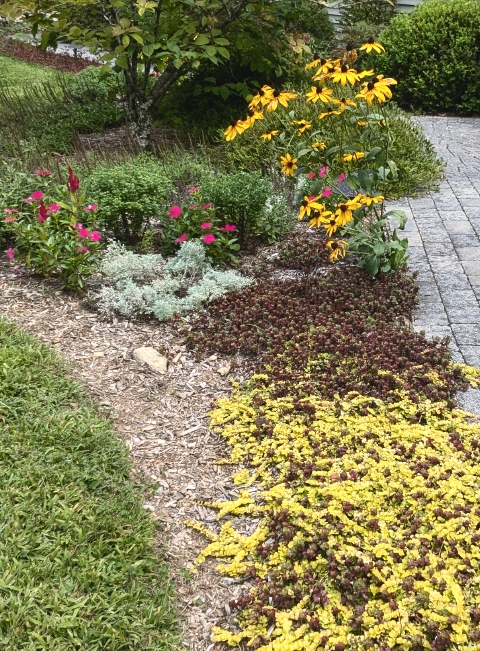
Dragons blood sedum fights with nummularia for territory, rudbeckia rises above annual vinca and volunteer salvia, and Artemisia ‘Silver Mound’ adds contrast, all able to withstand hot dry conditions. The permanent stone path replaces more casual bluestone pavers that are now used behind the house
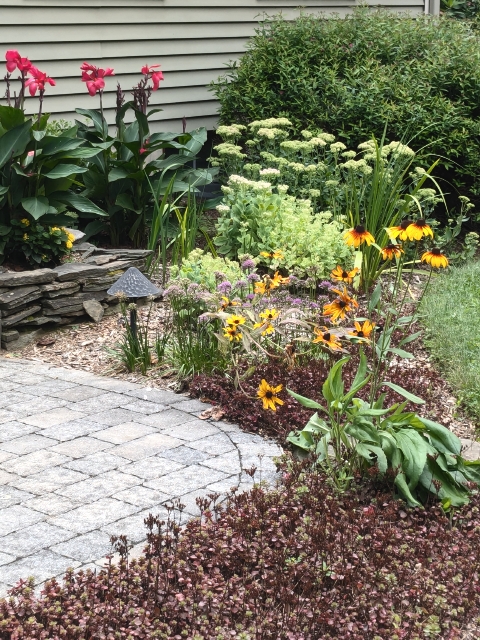
Canna, repeat of rudbeckia, allium ‘Millennium’ and sedum ‘Autumn Joy’ complete the summer show
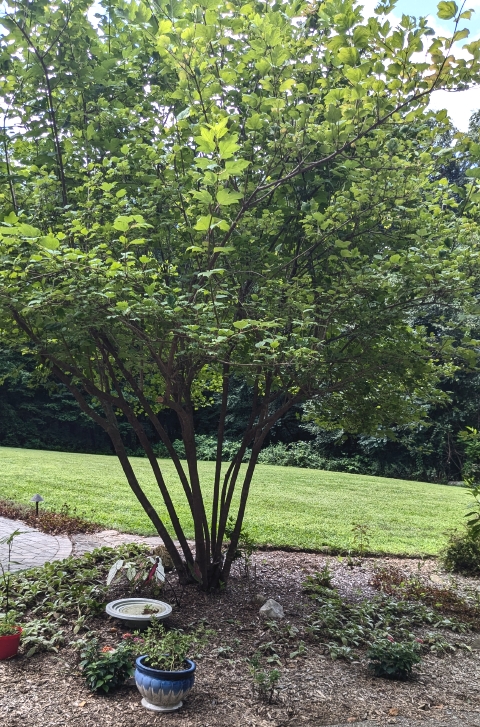
Near the front corner is cranberry viburnum, prized for its luscious red berries in fall, about twelve feet high, lower limbs and branches pruned up to create a small tree. It has earned the nickname Pfizer Viburnum because it came from a cutting I took near a fence that secured Pfizer property.
But it is the mysteries of the gardens in the back that we want to explore now.
It was probably about twenty years ago when our son, Steven, and his wife, Lisa, first began to think about planting the sun-soaked, weedy slope behind their house that merged into dark woods.
They wanted it all. They wanted to eliminate the drudgery of weeding. They wanted native plants that would attract birds and bees. Since their patio looked out on the rise, they wanted plants that would behave and give summer color, no floppers or thugs.
They weren’t going to leave the garden’s planning to chance. They consulted a landscape designer who suggested they first nuke the entire slope to kill everything, not only the weeds but also the plants they’d already put in. He then recommended a mass planting of rosa rugosa and one willow tree.
Rosa rugosa has it all: it is an easy-care native plant; its blossoms attract bees and beneficial insects in summer; and birds enjoy rose hips in fall.
But nuking the entire slope? That seemed extreme. And rosa rugosa was a bit too thorny and brambly for their tastes. Should they ignore the expert? They hesitated, then banked on their instincts and said No!
They had good times going plant hunting to local Mom and Pop nurseries, Big Box nurseries, and mail order nurseries. They’d look for plants on sale at the end of the season, choose what they liked, feel good about the savings and learn from trial and error.
Over time they would create a garden rich with a mix of natives and non-native shrubs, perennials and annuals, but no brambles.
Some of what they planted came from shrubs we had propagated in our North Carolina garden: the dependable old varieties of spirea, hydrangeas, deutzia, viburnum. Some perennials came from Susan’s New Hampshire garden.
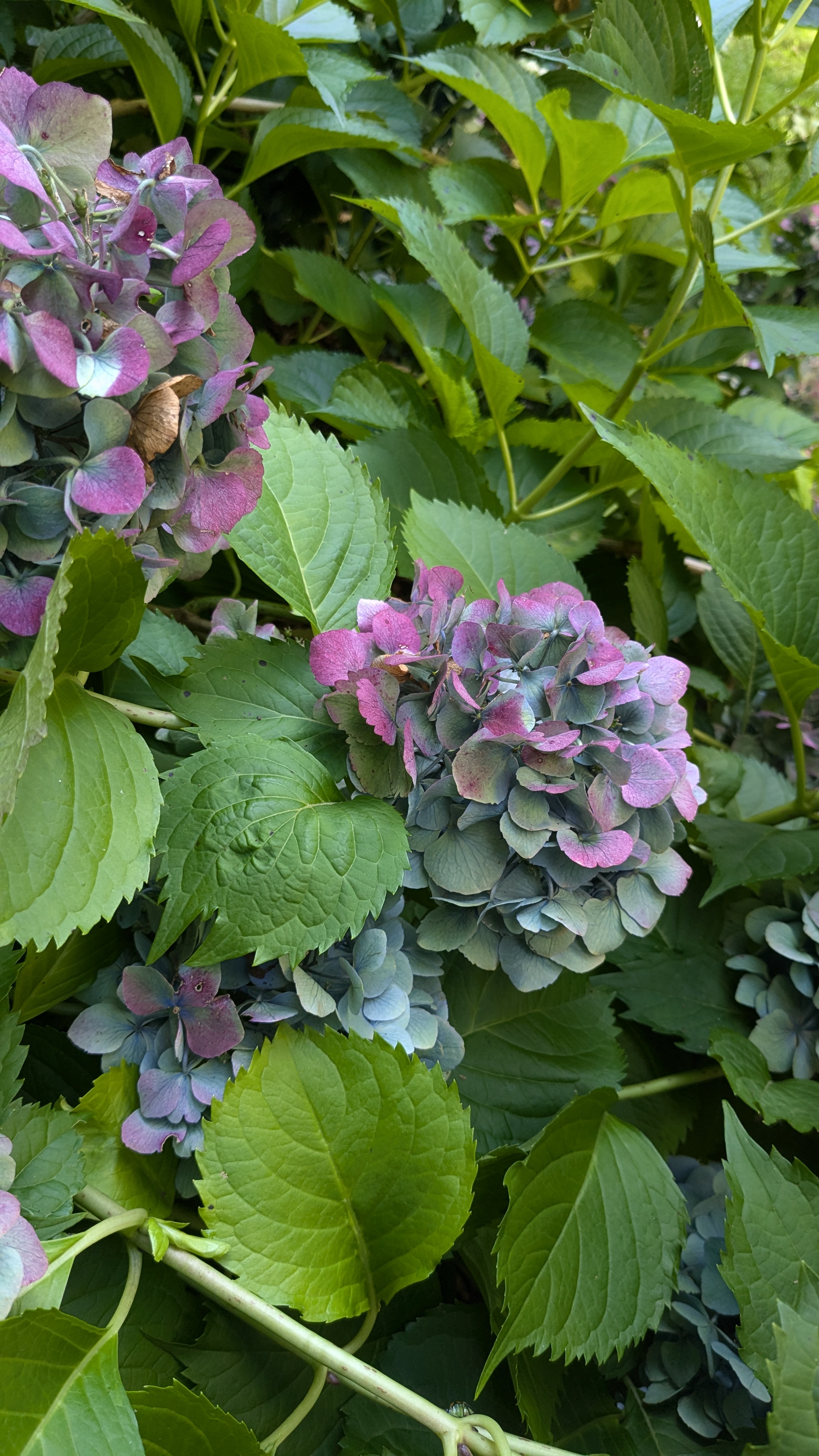
Mophead hydrangea, nobody remembers the name
Other plants came from Lisa’s Mom’s garden, among them, smokebush that has become a graceful mini-forest via lower branches that layered themselves. They are accented by the copper bird bath from her garden.
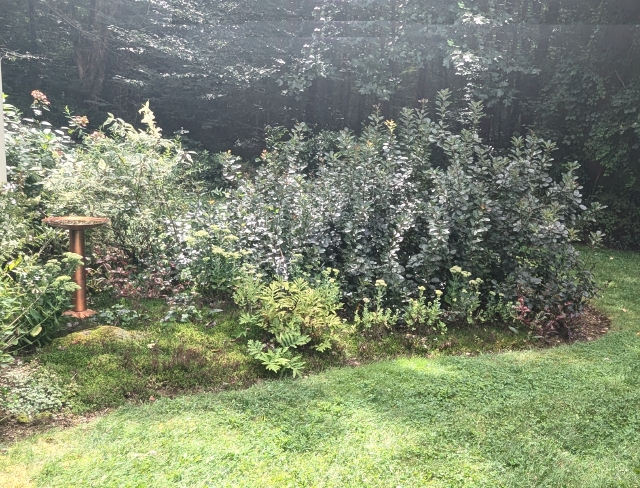
A small planting of smokebush near a front corner of the house has naturalized through the years, enhanced by sparkle from the birdbath
Steven is the architect of hardscape. He lays paths and creates walls, builds tuteurs and trellises, edges grass with a shovel and muscle power, and unflinchingly prunes plants when necessary.
Lisa is the painter with plants, the designer who can trim and weed, too. We call it Lisa’s garden, though trips to nurseries usually involve both of them.
And so the garden has evolved.
Let us turn the corner and meander into the back.
An old-fashioned monolithic mock orange stands as gate keeper to this garden, where flagstones mark a major path and casual summer plantings and a trellis add color and interest.
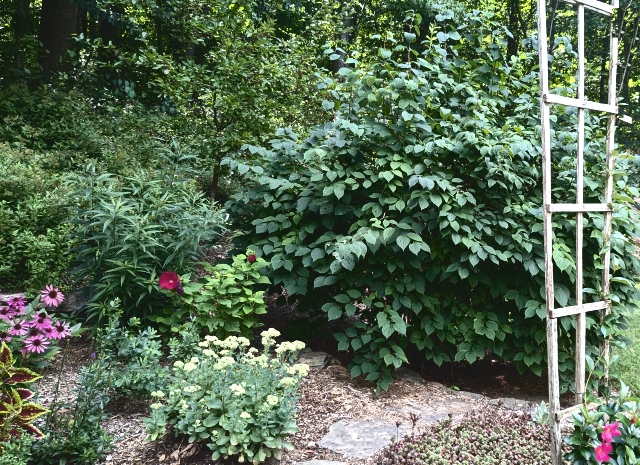
The mock orange is a descendant from a plant in Steven’s grandmother’s garden that
has been passed along by cuttings. A single hibiscus bloom peeks out above a false indigo (Baptisia), and sedum ‘Autumn Joy’ is waiting
Continuing along we come to a nook flanked by another lilac (dwarf) and planted with coleus, angelonia, echinacea, and chrysanthemums for fall bloom.
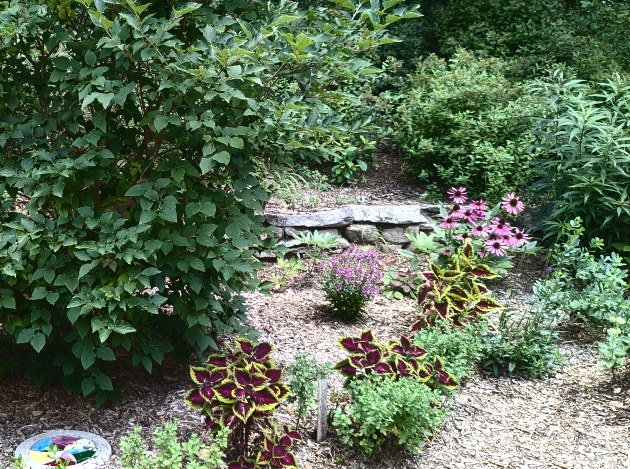
Hmm-mm. That primitive stone wall seems to surface and disappear into the landscape. Steven and Lisa called the curved stone, a tuchus, Yiddish for rear end. But could any wee creatures be hiding behind that wall, watching?
We pass the patio and take the boulder-strewn, rough stair steps lined with daylilies and tumbling spirea ‘Shibori,’ its stems topped with spent blossoms (must have been a knock-out during spring bloom) and re-enter the garden.
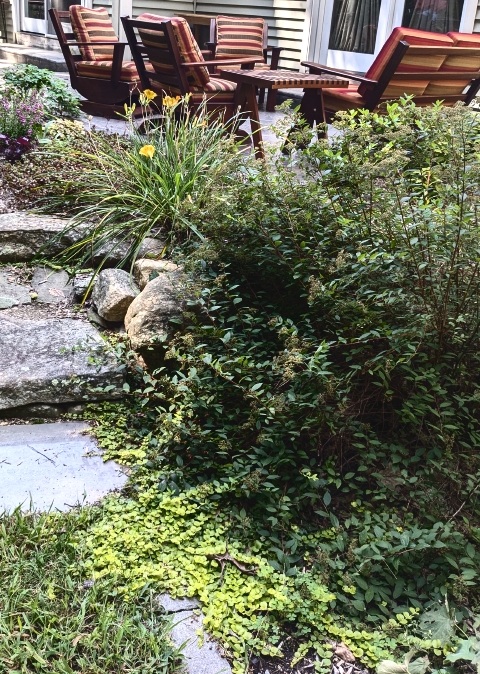
Creeping nummularia gives the rough hewn path a feeling of age
From here we follow the flagstone path crowded with varieties of annuals and perennials vying for a space in the sun.
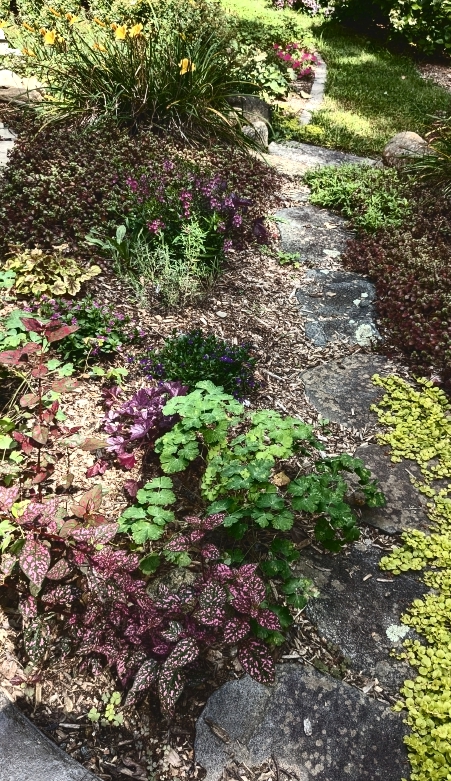
Are these herbs destined for some wee creature’s dinner? Someone other than rabbits or slugs?
A short winding path set with stone is a feast for gardeners’ eyes, with lots of texture, shades of green, and contrast between pruned and naturally flowing plants. It’s a rollicking combination of fern, butterflybush, persicaria, hydrangea, peonies and spirea.
Is that another stone wall, almost hidden?
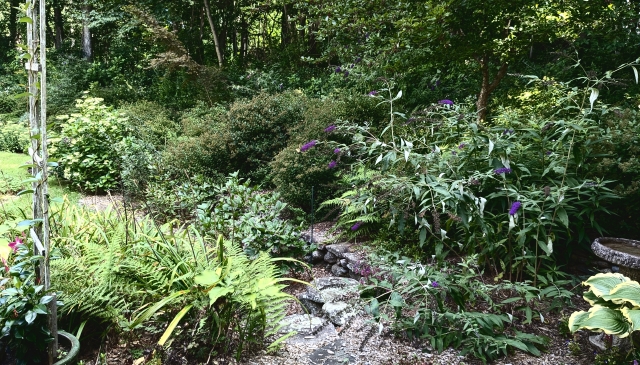
Shall we take a closer look?
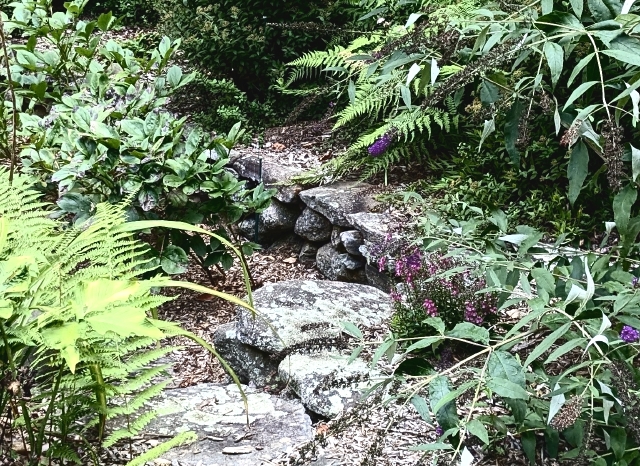
The stone wall, or is it a secret path, or maybe an entrance to a diamond mine, looks like it could come from a long-ago Middle Earth. Lichen etching the stones speaks of age. Only the plants are recent.
The rambling butterfly bush we’ve just passed, decades old now, brings back my memories of early days in their garden when plants were young and seeking firm footing in new ground.
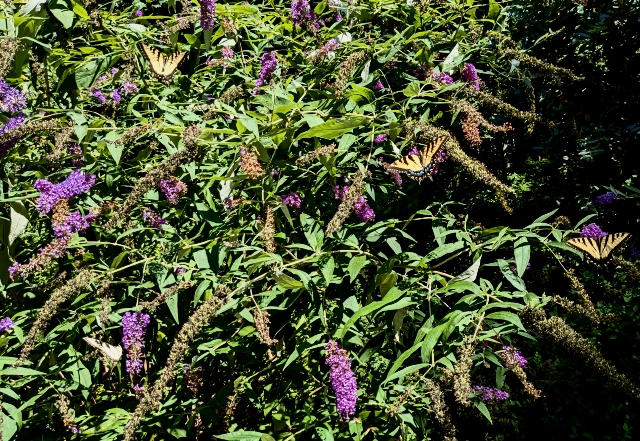
Swallowtails feasting on late August blooms
Further along the paths, mophead and lace cap hydrangeas are set against spirea on the slope. The deep green of spirea ‘Shibori’ looks especially handsome and blends seamlessly into the woods beyond. It is rare to see the Japanese spirea used in such dramatic sweeps with such good effect.
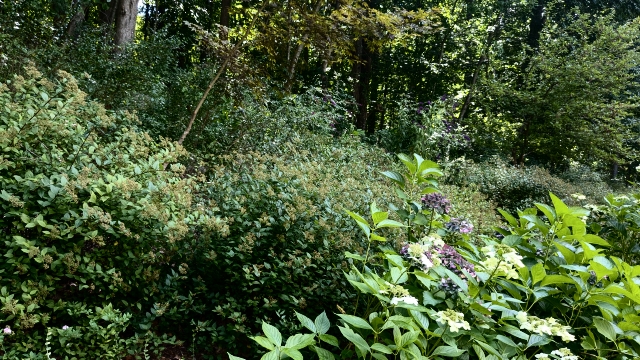
Drifts of spirea form a subtle backdrop to the garden, create a natural enclosure. The “drifts” emerged from a few plants, with little help from the resident gardeners
Opposite the woods is an open area with a wide patch of perennial geranium near the house playing off rosy impatiens.
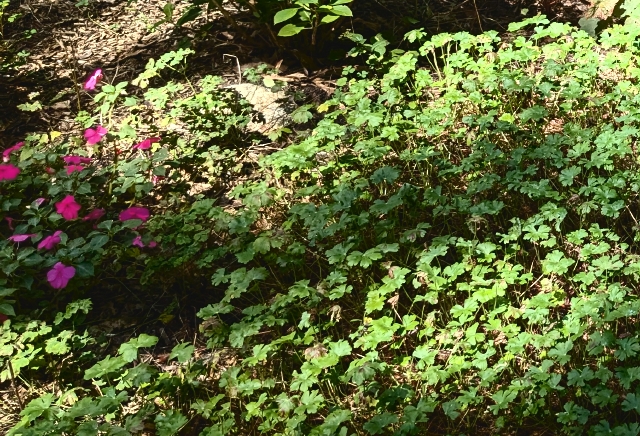
Do you suppose that dark shadow indicates a path that wee creatures might take through a geranium meadow?
Now we’ve come upon a wide swathe of sedum autumn joy backed by interesting textures of fern, azalea and spirea. Note the stone edgers laid to keep grass at bay.
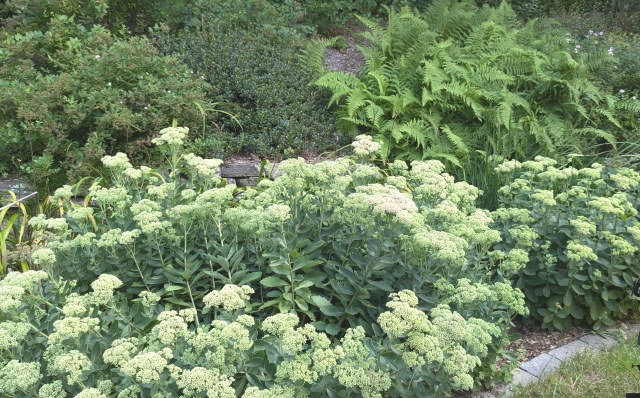
Is that a beam hidden among the this garden of sedum? Let’s take a closer look
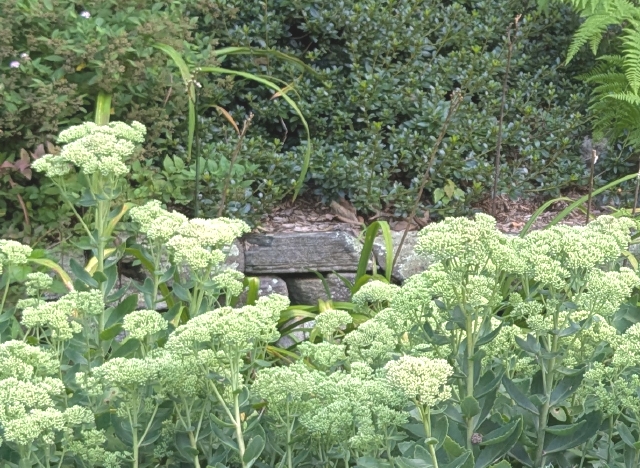
Is a wee creature’s house underneath all this?
We walk on and find a tomato cage — with a lock! — flanked by thunbergia and basil. No doubt this was constructed by a frustrated Big Person. We had some good snacking on sweet ones along the way.
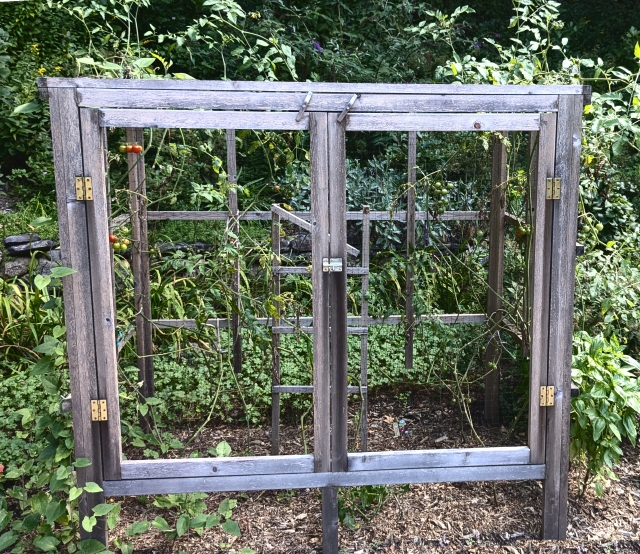
The question is: Who got the most tomatoes this year? The gardeners, the rabbits, the deer, or the wee creatures?
We are leaving the garden now, as it opens up to sun.
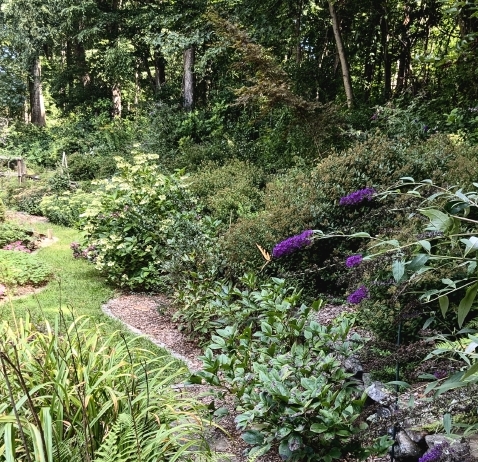
Stepping stones give way to curving grass paths and open sunlight. A lone swallowtail perches on a butterfly bush bloom
Oh dear! Oh dear! Oh dear! What has happened here? We’ve come upon some wee creatures who have left their hideouts. They are dwarfs! Were they seeking sun after a day in a diamond mine?
Alas, it looks like they’ve been set upon by a fierce creature and tried, valiantly, as dwarfs will do, to take him on before he took them.

Brave Dwarfs! Bad Bear!
Will the rest of the troupe stay in hiding? Or will they leave this comfortable garden that they know so well to escape this creature? Where can they go?
There is a way out, but the path to escape will take them through open land and sunny skies until it disappears just beyond the diervilla in the rear of the picture to a place we cannot know
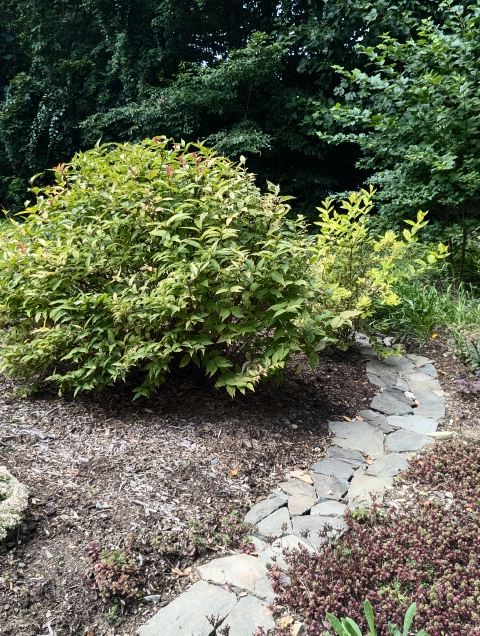
The ‘path’ is actually a dry creek bed. Big people would crush it if they ventured onto it, but dwarfs could skip right along and leave no trace
We reluctantly leave this garden that invites a ramble and sparks the imagination. As we go, we pass a double rose of sharon we brought from our garden as a young plant a long time ago and we are reminded of years gone by.
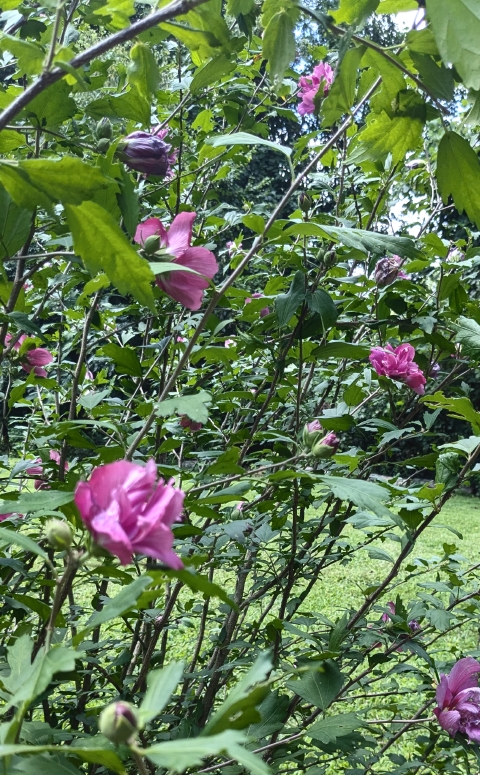
Double rose of sharon blooming well in full sun
And now, as we create new gardens in New Hampshire, Lisa and Steven are returning the favors, digging plants from their garden for us. Some of them are happy returns of our gifts that have multiplied. Others are old favorites that we could not grow in our southern garden because they prefer northern climates.
And the cycle of sharing and creating and imagining goes on.
 A Heron's Garden